
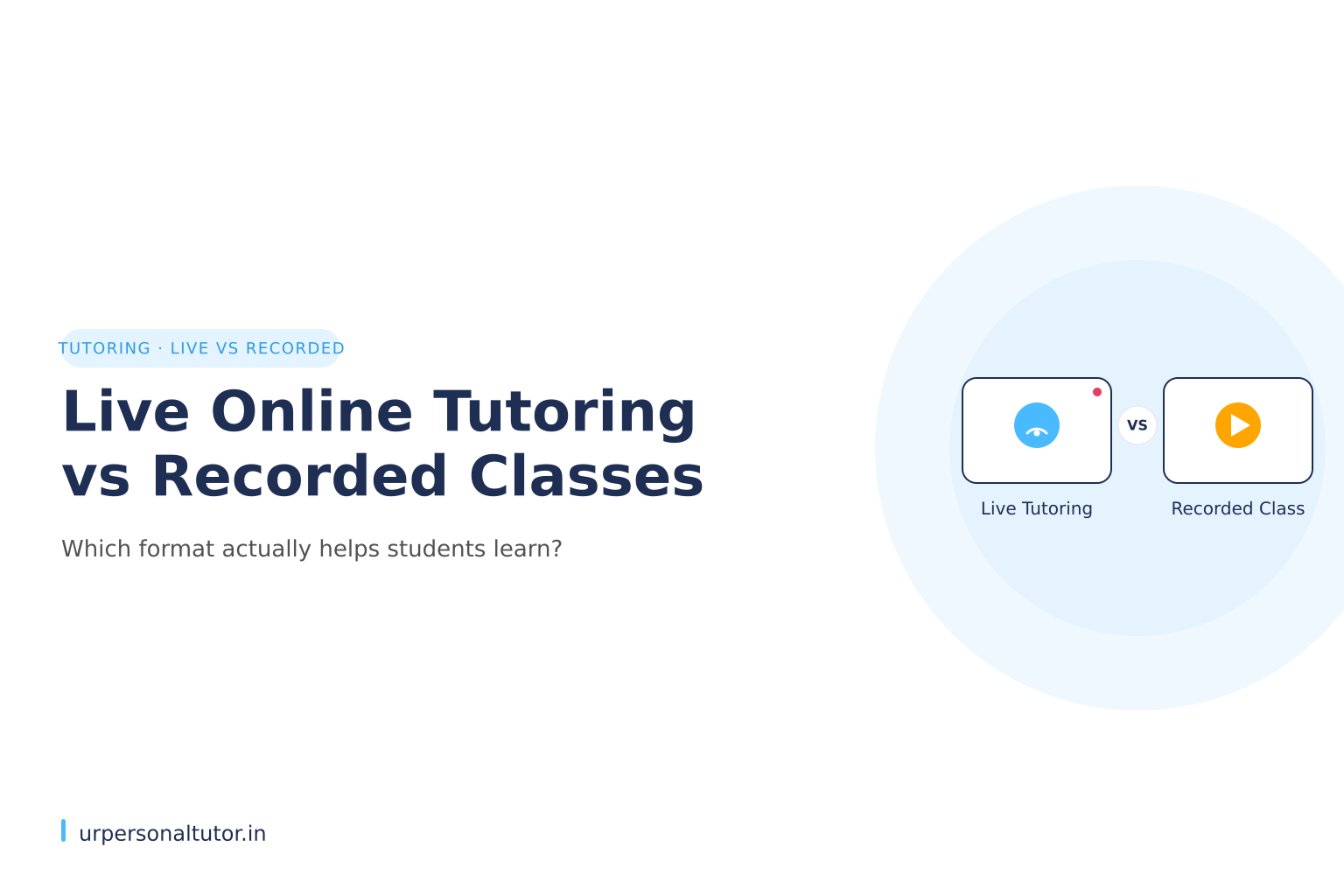
Live online tutoring beats recorded classes for most students because it gives real-time doubt-solving, personalised pacing, and accountability that pre-recorded video simply cannot replicate. Recorded classes still have their place, mainly for quick revision or topics a student has already understood once. But if the goal is actually learning something new, especially a subject like physics, chemistry, or math where one missed step derails the whole problem, live online tutoring is the stronger choice.
Parents researching options for their children often assume recorded lectures are “good enough” because they’re cheaper and available on demand. That assumption breaks down the moment a student hits a question a video can’t answer.
What Is Live Online Tutoring and How Does It Differ from Recorded Classes?
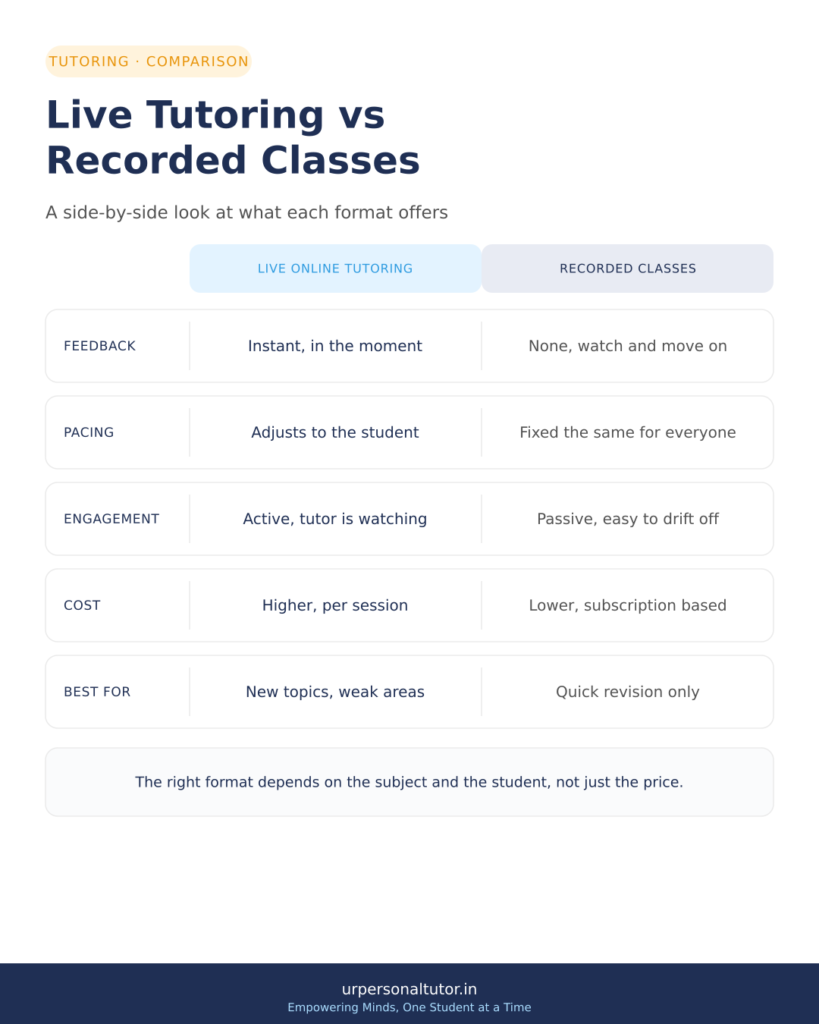
Live online tutoring means a real tutor teaches a student in real time over video call, responding to questions as they come up and adjusting the lesson based on how the student is actually performing. Recorded classes are pre-made videos, often filmed once and sold or streamed to thousands of students who never get direct feedback.
The core difference isn’t the screen. It’s the feedback loop. In live online tutoring, if a student says “wait, why did the sign flip there,” the tutor stops and explains it on the spot. In a recorded class, the student either figures it out alone, rewinds the same three minutes five times, or gives up and moves on with a gap in their understanding.
That gap compounds. A student who doesn’t understand why the sign flipped in one physics problem will hit the same confusion in the next ten problems that use the same rule.
Live Online Tutoring vs Recorded Class: A Straight Comparison
Cost is usually the first thing families compare, and recorded classes do win there. A subscription to a video library costs a fraction of one-to-one sessions. But cost per hour and value per hour aren’t the same number.
With recorded classes, a student watches passively. Attention drifts around the fifteen-minute mark for most teenagers, and there’s no one checking whether they’re actually absorbing the material or just letting the video play in the background while they scroll their phone. Live online tutoring forces active engagement because the tutor is watching, asking questions, and expecting answers.
Pacing is another gap. Recorded content moves at one fixed speed for every student who ever watches it. A student who needs three extra minutes on projectile motion doesn’t get them. A student who already understands rotational dynamics still has to sit through the full explanation because skipping ahead risks missing something. Live online tutoring adjusts pace lesson by lesson, sometimes minute by minute, based on what the student actually needs that day.
Why Live Online Math Tutoring Works Better Than Video Lessons for Problem-Solving
Math is a subject built on sequence. Get one step wrong and every step after it is wrong too, even if the method is otherwise correct. This is exactly where live online math tutoring earns its value.
In a recorded video, a student watches someone else solve the problem correctly. That’s useful for seeing the method, but it doesn’t reveal where the student’s own reasoning breaks down. Live online math tutoring flips this: the student works the problem, the tutor watches in real time, and the mistake gets caught the moment it happens, not three questions later on a test.
There’s also a confidence factor worth naming honestly. Students rarely admit confusion out loud when it’s just them and a screen playing a video. They tell themselves they’ll “figure it out later.” With a live tutor present, that avoidance gets interrupted, and the student is more likely to actually ask the question instead of quietly falling behind.
When an Online Live Chemistry Tutor Beats a Pre-Recorded Course
Chemistry has its own specific problem: it mixes conceptual understanding with a heavy vocabulary of reactions, mechanisms, and exceptions that don’t always follow a clean pattern. An online live chemistry tutor can catch the exact moment a student confuses two similar-sounding mechanisms, something a recorded course has no way of noticing.
Lab-based reasoning is another area where live sessions matter. Chemistry exams often ask students to predict what happens in a reaction they’ve never directly memorised, based on principles they’re expected to apply on the spot. An online live chemistry tutor can walk through that reasoning process interactively, asking guiding questions rather than just stating the answer, which builds the kind of transferable understanding that recorded content struggles to teach.
Board exam boards like ICSE, CBSE, IGCSE, and A-Level chemistry papers also vary in how they phrase and structure questions. A tutor working live with a student can tailor explanations to the exact exam board the student is sitting, something a generic recorded chemistry course, often built for a different curriculum entirely, cannot do.
The Case for Recorded Classes: When They Actually Make Sense
None of this means recorded classes are useless. They’re genuinely good for revision once a concept has already been taught properly the first time. A student reviewing organic chemistry reaction mechanisms two weeks before an exam, who already understands the underlying logic, can benefit from rewatching a clear five-minute explanation at 1.5x speed.
Recorded classes also work well for topics that are purely descriptive rather than problem-solving heavy, such as historical background in a subject or definitional content that doesn’t require interactive practice. And for students in time zones or schedules that make live sessions genuinely impossible, recorded content is better than nothing.
The honest answer is that recorded classes work as a supplement, not a substitute, for the initial teaching of a concept.
Myth: “Recorded Classes Are Just as Good Because You Can Pause and Rewind”
This is one of the most common claims made by recorded course platforms, and it needs a direct answer. Pausing and rewinding lets a student replay content, but it doesn’t generate new explanations. If a student didn’t understand something the first time, watching the identical sentence again rarely fixes the underlying confusion. What actually helps is hearing the concept explained a different way, with different examples, tailored to what specifically confused that student. A recorded video cannot do that. A live tutor can, instantly.
The pause-and-rewind argument sounds reasonable on the surface, which is exactly why it’s worth correcting. Convenience and comprehension are not the same thing, and treating them as interchangeable is where students lose the most time.
How to Choose Between Live Online Tutoring and Recorded Classes for Your Child
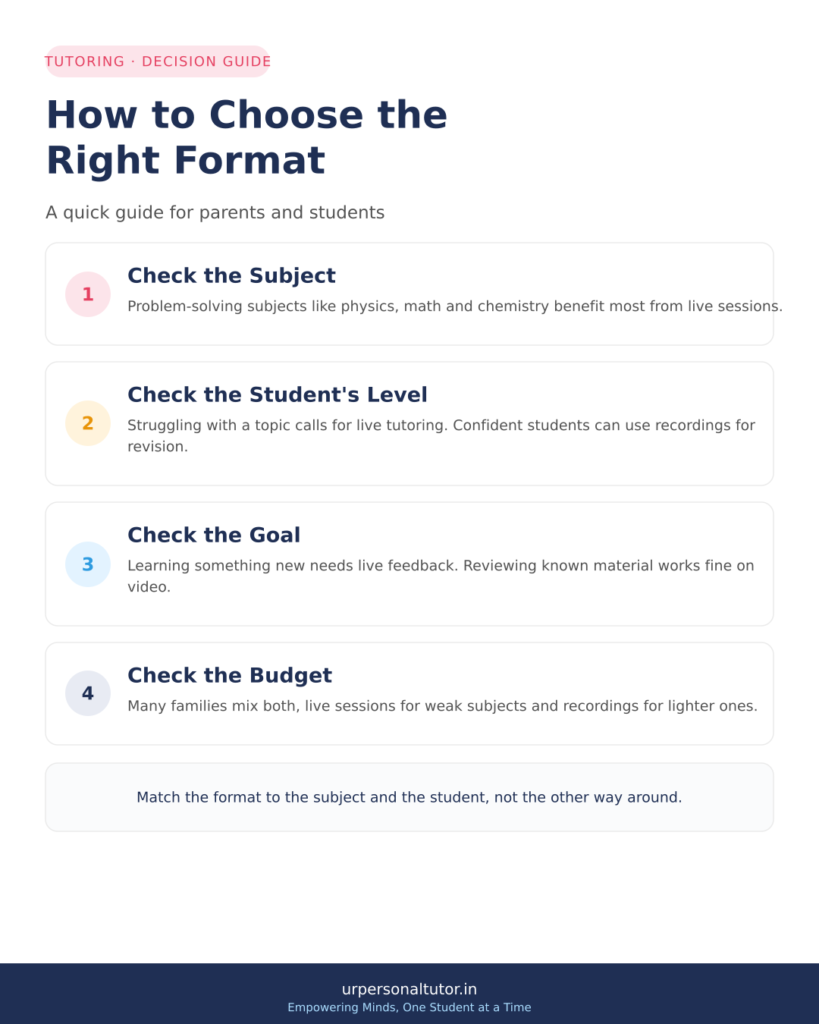
Start with the subject and the student’s current level. If the subject involves problem-solving under exam pressure, physics, math, and chemistry all qualify, live online tutoring is worth the investment, especially in the months leading up to board or entrance exams like JEE, NEET, IGCSE, or A-Levels. If a student is confident in a subject and just needs light revision, a recorded library can fill that gap cheaply.
Watch for warning signs that recorded content isn’t working: a student who says they “understood it while watching” but can’t reproduce the method independently later is a common pattern. That gap between passive recognition and active recall is exactly what live sessions are designed to close.
Budget matters too, and it’s fair to be honest about that. Some families use recorded classes for lighter subjects and reserve live online tutoring specifically for the subject a student is struggling with most. That kind of mixed approach is often more realistic than an all-or-nothing choice.
A Note on Hybrid Learning
Many of the strongest study plans use both. A student might use live online tutoring for physics, where problem-solving and immediate feedback matter most, and recorded videos for a lighter subject purely as revision support closer to exams. This isn’t a compromise so much as matching the format to what each subject actually demands. Planning around a physics study schedule makes it easier to decide where live sessions fit best and where recordings can fill the gaps.
Choosing the Right Tutor Matters as Much as the Format
Even the best format falls flat with the wrong tutor. What actually makes one-to-one tutoring effective is a tutor who knows how to use real-time feedback well, not just someone reading through a syllabus out loud. A tutor who lectures for forty-five minutes straight without checking understanding is essentially running a live version of a recorded class, and loses most of the advantage.
Time management around live sessions also needs planning, particularly for students juggling board prep with IB exam preparation, where fitting tutoring sessions into an already packed schedule requires some upfront thought rather than adding them in randomly.
Frequently Asked Questions
Is live online tutoring worth it compared to free recorded videos on YouTube?
Free recorded videos work for a general overview, but they can’t diagnose why a specific student keeps making a specific mistake. Live online tutoring costs more but targets exactly where a student is stuck, which usually saves more time than it costs.
How many live online tutoring sessions per week are actually needed?
This depends entirely on the exam and current level, but two to three focused sessions per week per subject tends to outperform daily short sessions, since it allows time for independent practice between lessons without losing momentum.
Can live online tutoring replace school or coaching classes entirely?
For most students, no. Live online tutoring works best as a targeted supplement for weak areas or for one-to-one attention that a classroom of thirty or more simply cannot provide, rather than a full replacement for structured coursework.
Do recorded classes get updated for exam pattern changes?
Rarely, and this is one of their biggest drawbacks. Exam boards change question patterns and syllabi periodically, and a recorded course filmed two years ago may not reflect the current format, while a live tutor can adjust immediately.
Is live online tutoring effective for younger students, or only for exam-level classes like JEE and NEET?
It works across levels, including students struggling with the jump from Class 10 to Class 11, where foundational gaps are easiest to fix early with direct feedback rather than letting them accumulate into bigger problems later.
Ready to See the Difference for Yourself?
The clearest way to know whether live online tutoring fits your child’s learning style is to sit in on one session. Reach out to book a trial class and see how real-time, one-to-one teaching compares to whatever they’ve been using so far.