
The Short Answer on How to Prepare for JEE With Limited Time
With a few months left, the fastest way to prepare for JEE is to stop trying to cover the entire syllabus and instead rank chapters by weightage, drill NCERT-level concepts first, and spend the majority of remaining time on timed practice rather than fresh learning. Students who try to “finish the syllabus” in the last stretch usually run out of time before they run out of topics. Students who triage instead almost always end up scoring higher.
The rest of this guide breaks down what that looks like week by week, depending on whether you’re two months out or down to your final thirty days.
How to Prepare for JEE Mains in 2 Months
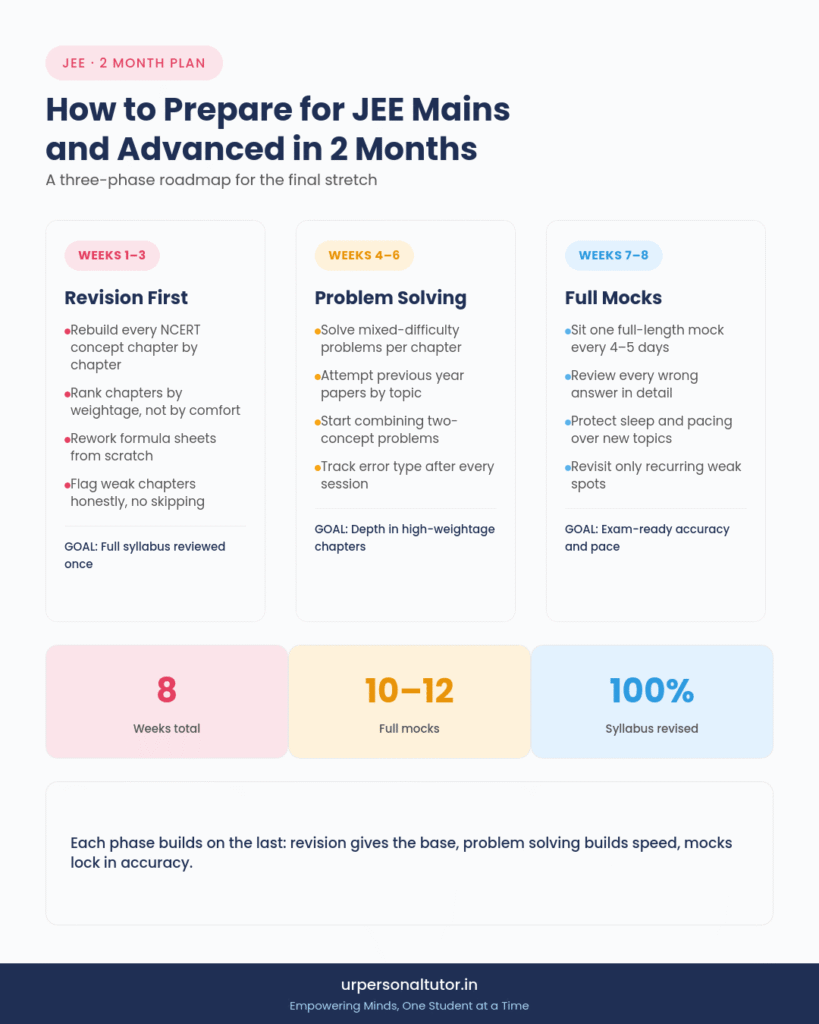
Two months is tight but workable if the plan is built around revision, not fresh content. The first three weeks should go entirely toward revisiting Class 11 and Class 12 NCERT concepts chapter by chapter, since JEE Mains leans heavily on direct application rather than the trickier multi-concept problems JEE Advanced favours.
Once that first pass is done, the remaining five weeks should shift almost entirely to solving previous year papers and full-length mocks. A student who wants to prepare for JEE Mains in this window needs at least one full mock every four to five days, followed by an honest review of every wrong answer rather than just checking the score and moving on.
How to Prepare for JEE Advanced in 2 Months
JEE Advanced rewards depth over speed, so the two-month plan here looks different. Instead of racing through chapters, spend the first month on the twenty or so topics that historically carry the most weight across Physics, Chemistry, and Maths, solving progressively harder problems within each one rather than moving on once the basic version is solved.
The second month should be almost entirely problem-solving under time pressure. JEE Advanced questions often combine two or three concepts in a single problem, and that skill only develops through repeated exposure to mixed-difficulty sets, not through reading solutions.
How to Prepare for JEE Advanced in 1 Month
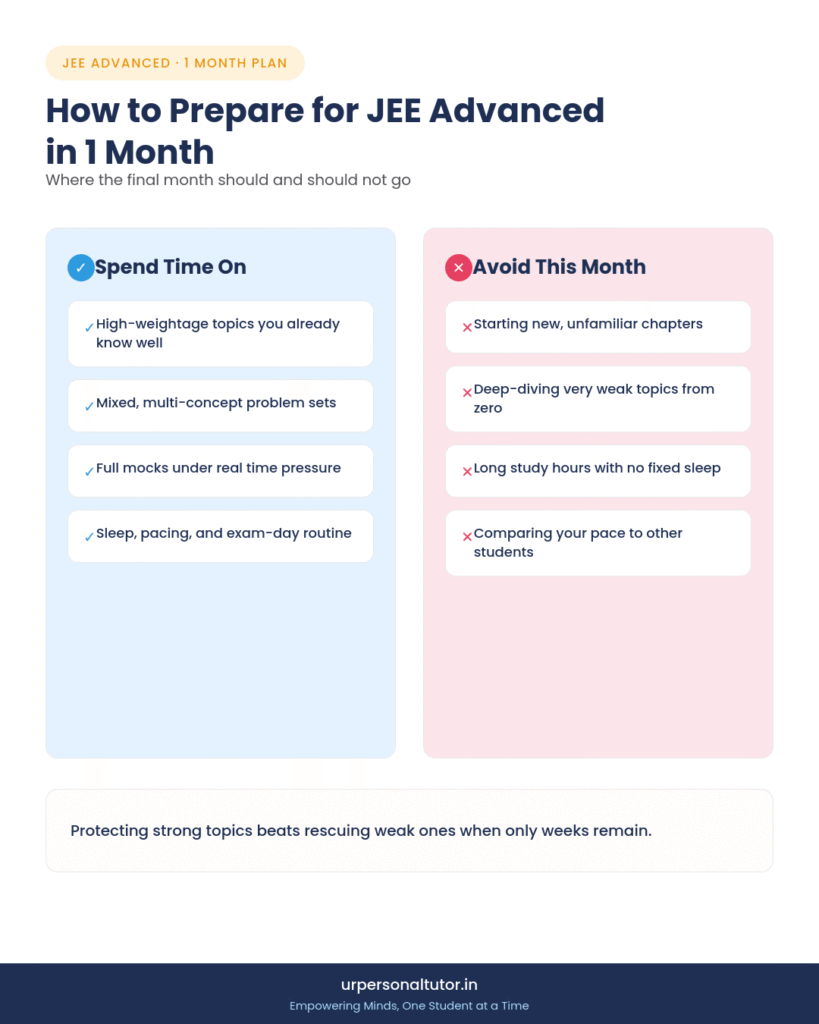
With only a month left, the plan narrows further. There isn’t enough time to strengthen weak chapters from scratch, so the smarter move is to accept a few weak areas and protect the strong ones instead. Spend the first ten days solving only high-weightage, high-difficulty problems from topics already reasonably strong, then move into full mock tests for the remaining three weeks.
Sleep and pacing matter more in this window than in a longer one. A tired brain a week before the exam undoes far more progress than one extra topic ever adds.
Subject-Wise Priorities When Time Is Short
Physics
Mechanics, Electrodynamics, and Modern Physics carry the most weight across both Mains and Advanced. Numerical accuracy matters more here than in any other subject, and working through a wider range of physics jee problem solving approaches for tricky questions tends to close gaps faster than re-reading theory chapters that already feel familiar.
Chemistry
Physical Chemistry rewards formula fluency and quick calculation, Organic Chemistry rewards pattern recognition across reaction types, and Inorganic Chemistry is largely memory-based. With limited time, Inorganic often gives the fastest returns since it needs recall rather than problem-solving speed.
Maths
Calculus and Coordinate Geometry dominate the paper most years. Algebra questions tend to be shorter but appear across multiple chapters, so a strong grip on the basics pays off in more places than any single advanced topic would.
Building a Daily Schedule That Actually Works
A realistic day, even with only a few months to prepare for JEE, splits into three blocks: one for revising theory, one for solving problems in that same topic, and one for mixed practice across subjects. Skipping the mixed practice block is one of the most common reasons students feel ready in isolated topics but freeze during a full paper, where questions jump between subjects without warning.
Six focused hours most days will outperform ten distracted ones. Fatigue lowers accuracy long before it lowers motivation, and accuracy is what the exam actually measures.
Common Mistakes When Preparing for JEE in a Short Window
The most common mistake is spending too long on weak chapters at the expense of strong ones. A chapter that’s already 70 percent solid usually needs far less time to reach 90 percent than a weak chapter needs to reach even 50 percent, yet students often do the opposite.
Another frequent error is solving mock after mock without reviewing mistakes properly. Simply tracking the score without understanding whether an error was conceptual, careless, or time-pressure related wastes most of the value a mock test offers.
A third mistake shows up when students try to prepare for JEE entirely on their own during a short window without any outside check on their weak spots. A short stretch of personalised, jee one-to-one guidance can catch blind spots far faster than self-study alone, particularly when time is too short to discover them by trial and error.
Ready to Build a Plan Around Your Timeline?
A generic study plan rarely fits a real calendar. If you’d like help turning the months, weeks, or days you actually have left into a working schedule, book a session with Ur Personal Tutor or browse more exam-specific guides on the blog.
Frequently Asked Questions
Is it realistic to prepare for JEE in just one or two months?
It’s realistic for meaningful score improvement, especially for students who already have a foundation from Class 11 and 12. Starting from zero in one or two months is a different challenge, and expectations should be set accordingly.
Should I focus on JEE Mains or JEE Advanced first if time is short?
Mains first, since its pattern is more direct and the syllabus overlap means Mains preparation strengthens Advanced readiness too. Advanced-specific problem-solving can be layered on once Mains-level accuracy is solid.
How many mock tests should I take in a two-month window?
Roughly ten to twelve full-length mocks, spaced every four to five days, gives enough data to spot patterns in mistakes without leaving too little time for the revision those mocks point toward.
What if I run out of time before covering the whole syllabus?
That’s expected and even normal. A syllabus finished at 70 percent depth with strong recall usually scores higher than one finished at 100 percent with shallow understanding of most chapters.
Does the number of hours studied matter more than the plan?
No. A structured six-hour day consistently outperforms an unstructured ten-hour day, since accuracy under exam conditions depends on focus quality, not raw hours logged.