
If you have three months left and the organic chemistry syllabus for JEE still feels like a mountain, here is the direct answer: it is possible, but only if you stop treating every chapter equally. Split the syllabus by weightage, spend the first month on structure and nomenclature, the second on reactions and mechanisms, and the third purely on revision and speed. Students who try to read everything once, then panic-revise in the last two weeks, almost always run out of time before they run out of syllabus.
Why the Organic Chemistry Syllabus for JEE Feels Overwhelming
Organic chemistry is not one subject. It is closer to fifteen small subjects stitched together, each with its own reagents, exceptions and named reactions. A student who is strong in physics or inorganic often struggles here simply because organic rewards pattern recognition built over months, not last-minute memorising. That is exactly why the organic chemistry syllabus for JEE needs a plan rather than a reading list. Three months is tight, but it is enough time if the plan respects how the subject actually works.
Most JEE aspirants lose weeks in November and December because they treat GOC (General Organic Chemistry) as optional revision material instead of the foundation it actually is. Skip GOC and every later chapter, from haloalkanes to biomolecules, becomes twice as hard to remember.
The Organic Chemistry Syllabus for JEE, Chapter by Chapter Weightage
Before building a timetable, it helps to know where JEE actually asks questions. Based on the last several years of JEE Main papers, these areas carry the heaviest weight:
- General Organic Chemistry and isomerism, which underpins almost every other chapter
- Reaction mechanisms including SN1, SN2, elimination and addition
- Named reactions across alcohols, phenols, aldehydes and ketones
- Aromatic compounds and their electrophilic substitution behaviour
- Biomolecules and polymers, which are shorter but scoring if revised properly
Notice that GOC sits at the top of that list, not the bottom. Any serious attempt at the organic chemistry syllabus for JEE has to start there, because concepts like inductive effect, resonance and hyperconjugation reappear in nearly every reaction mechanism you will study later.
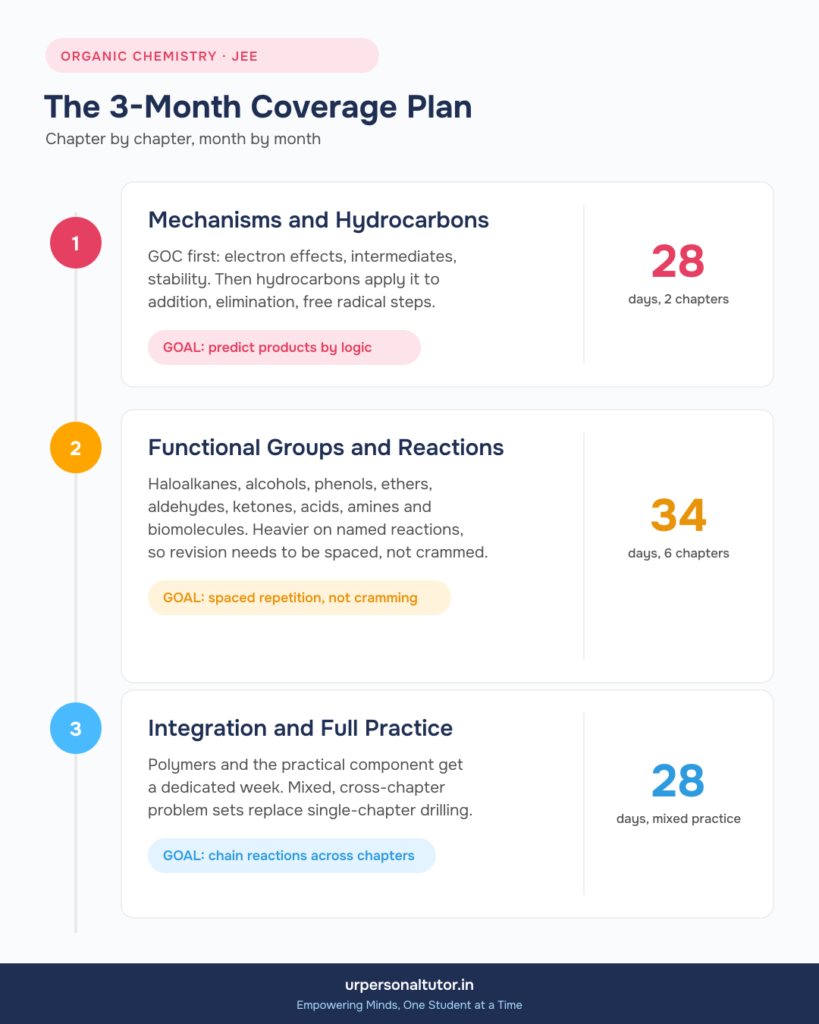
Month 1: Building the Base
The first four weeks should have zero focus on speed. The goal is simply to understand structure.
Start with nomenclature and isomerism until naming a compound feels automatic rather than something you have to pause and think about. Move into GOC properly, spending real time on inductive effect, resonance, hyperconjugation and acidity or basicity comparisons. These four ideas explain roughly half of all organic reasoning questions on the JEE paper.
Once GOC feels solid, begin hydrocarbons: alkanes, alkenes, alkynes and their preparation methods. Keep a single notebook per chapter rather than scattered notes across textbooks and coaching material, since jumping between sources at this stage slows you down more than it helps. If your notes tend to sprawl, it’s worth reading how to make notes for JEE that you can actually revise quickly under pressure, since the format matters almost as much as the content.
By the end of month one, you should be able to explain why a reaction happens, not just recall that it does.
Month 2: Reactions, Mechanisms and Named Reactions
This is the heaviest month, and it should be. Cover haloalkanes and haloarenes, then alcohols and phenols, then aldehydes, ketones and carboxylic acids. Each of these chapters brings its own set of named reactions: Grignard, Cannizzaro, Aldol, Hell-Volhard-Zelinsky and dozens more.
Rather than memorising each reaction in isolation, group them by mechanism type. SN1 and SN2 reactions share logic even when the substrate changes. Once you see haloalkane substitution and alcohol dehydration as variations on the same electron-pushing idea, the organic chemistry syllabus for JEE stops feeling like an endless list and starts feeling like a smaller set of rules applied repeatedly.
Amines and aromatic compounds close out this month. Aromatic electrophilic substitution deserves extra attention here, since it appears in combination with nearly every functional group chapter that came before it.
Keep solving problems as you go rather than waiting until revision month to test yourself. A useful benchmark is how many questions to solve per chapter for JEE, since organic chemistry punishes passive reading far more than physics does. Reading a mechanism twice teaches you almost nothing; solving fifteen variations of it does.
Month 3: Revision, Practice and Speed
The final month has one job: convert understanding into speed. This is where the three-month plan either pays off or falls apart.
Week one should be a full revision pass through GOC, hydrocarbons and haloalkanes. Week two covers alcohols, phenols, carbonyl compounds and amines. Week three focuses entirely on aromatic chemistry, biomolecules and polymers, since these are frequently under-revised despite being scoring topics. Week four is reserved purely for previous year questions and full-length tests, since that’s where speed either shows up or falls apart.
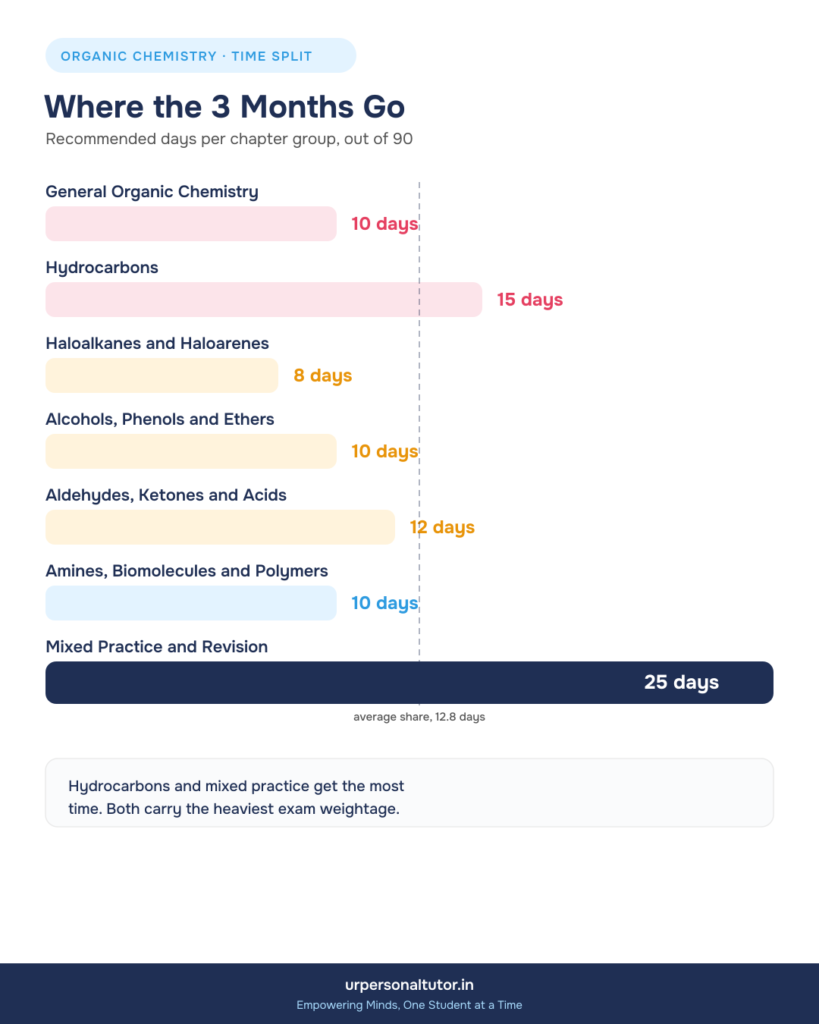
By this stage you should be timing yourself. A student who knows a reaction but takes ninety seconds to recall it during the exam loses just as many marks as one who never learned it at all. Speed comes from repetition, not from re-reading the chapter a fourth time.
Common Mistakes Students Make While Covering Organic Chemistry in 3 Months
A few patterns show up year after year among students attempting the organic chemistry syllabus for JEE on a tight timeline.
Skipping GOC to “save time” is the most common one, and it backfires almost every time, since every later chapter depends on it. Another is memorising named reactions without understanding the mechanism behind them, which works fine for direct questions but collapses the moment JEE asks a slightly reworded variant. A third mistake is ignoring biomolecules and polymers because they feel less important, when in reality they take far less time to master than a single mechanism-heavy chapter and offer nearly guaranteed marks if revised properly in the last month.
There is also a tendency to compare your pace against classmates who started earlier or seem to be moving faster. That comparison rarely reflects your actual position and mostly adds pressure you do not need three months out.
Should You Get Help With Organic Chemistry This Close to the Exam
Three months is enough time to cover the organic chemistry syllabus for JEE properly, but only with a plan you actually follow, not one you write once and abandon by week two. If you are finding it hard to stay on schedule, or specific chapters like reaction mechanisms keep slipping, one-to-one guidance can help you course-correct faster than self-study alone. Book a consultation with UrPersonalTutor and we will map out a chapter-by-chapter plan built around the time you actually have left, not a generic template.
FAQs
Is three months enough to complete the organic chemistry syllabus for JEE from scratch?
Yes, if you follow a structured split rather than reading chapters in random order. Students starting from a weak base need to prioritise GOC and hydrocarbons in the first three to four weeks, since everything else builds on those two areas.
Which organic chemistry chapters carry the highest weightage in JEE Main?
GOC and isomerism, reaction mechanisms, and aromatic compounds together account for a large share of organic questions in recent JEE Main papers, followed closely by carbonyl compound reactions.
How many hours a day should I give to organic chemistry during these three months?
Two to three focused hours daily is realistic alongside physics and inorganic preparation. Consistency across ninety days matters more than occasional six-hour marathon sessions.
Can I skip named reactions and still score well?
No. Named reactions form a meaningful portion of both JEE Main and Advanced papers, and many appear disguised inside longer, multi-step questions rather than asked directly.
What should the last two weeks before JEE look like for organic chemistry?
Pure revision and timed previous year papers, with no new topics introduced. New material this close to the exam tends to create more confusion than confidence.