
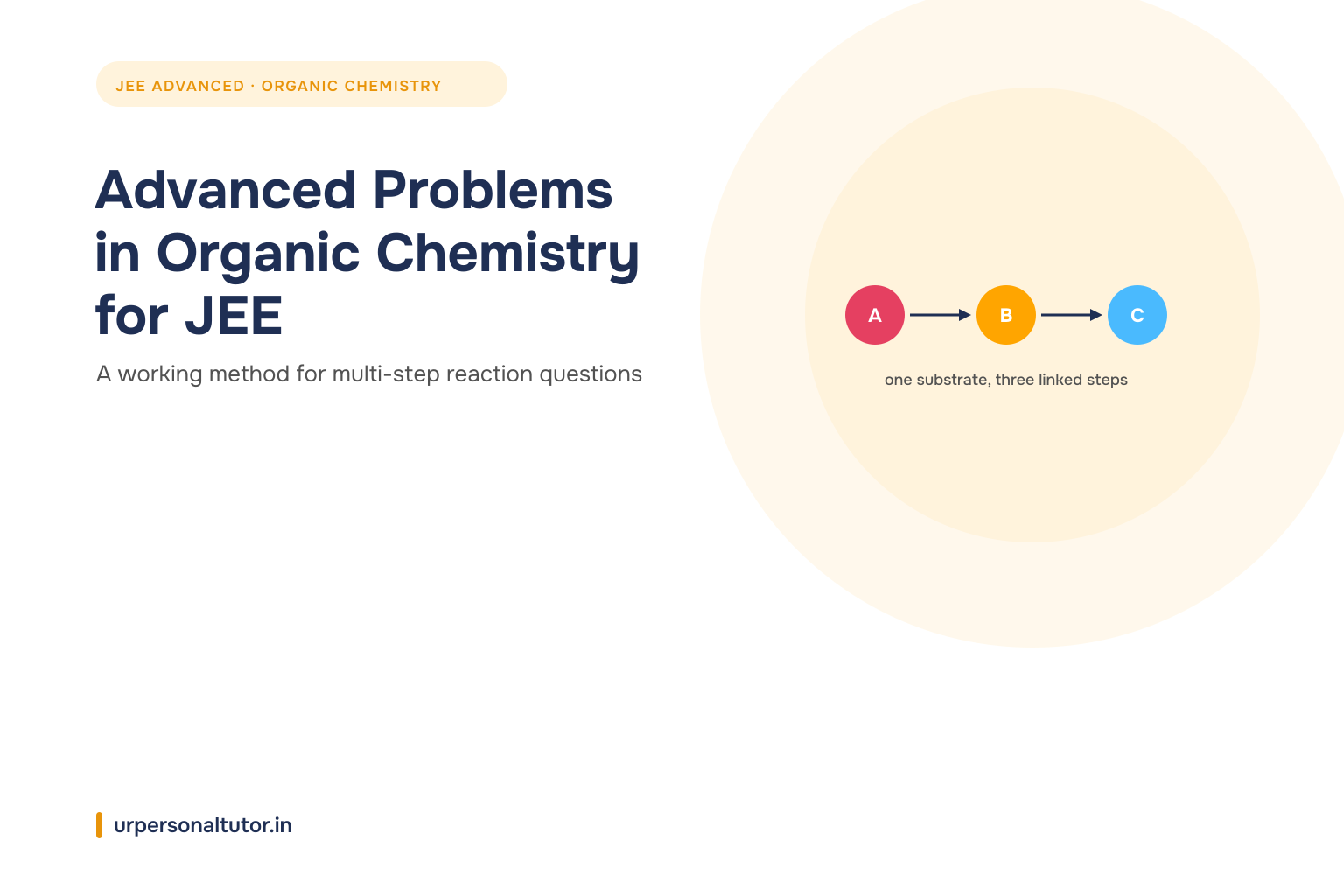
Advanced problems in organic chemistry for JEE are rarely about knowing a single reaction. They test whether you can chain three or four reactions together, predict an intermediate you were never shown, and justify why one mechanism wins over another under specific conditions. Students who memorise reagent lists tend to plateau here, because the exam is built to punish exactly that habit.
Organic chemistry often gets treated as the “easy scoring” subject in JEE preparation, right up until Advanced-level questions show up in a mock test and the same student who aced NCERT-level reactions suddenly can’t place a single mark. That gap is worth understanding properly, because it’s fixable once you know what these questions are actually asking for.
What Makes Advanced Problems in Organic Chemistry for JEE Different
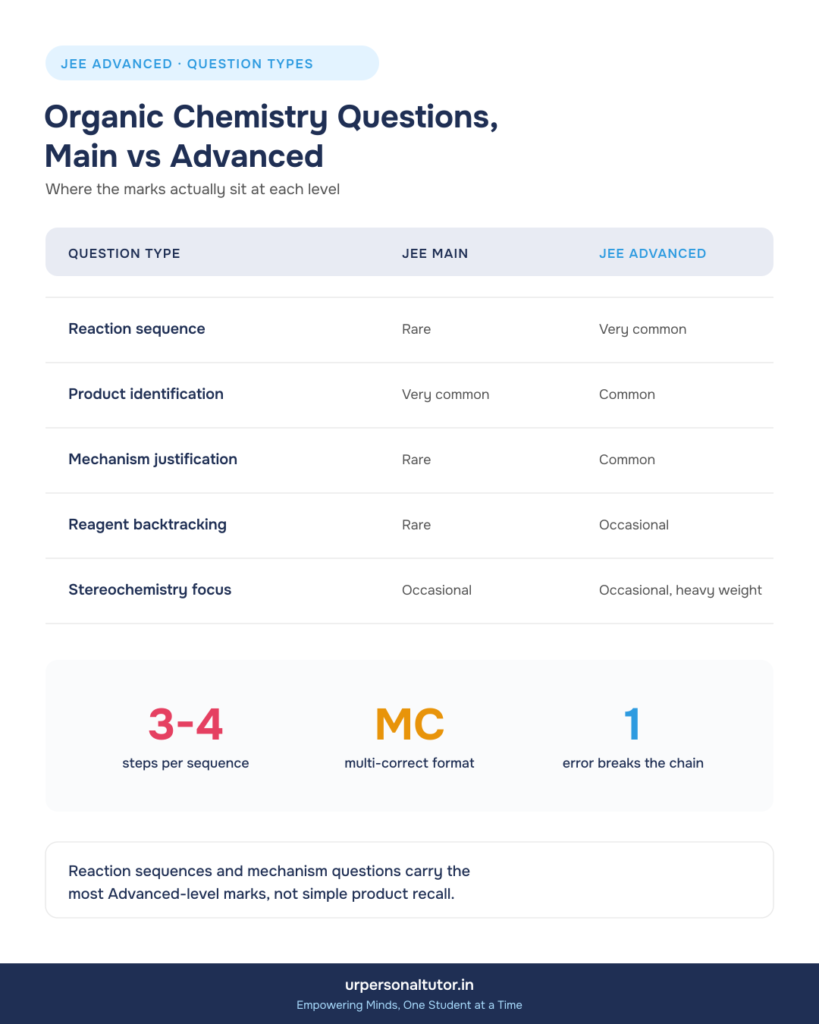
A JEE Main organic question usually asks you to identify a product or name a reagent. A JEE Advanced question builds a short story: start with compound A, apply three unrelated-looking steps, and ask you to identify compound D, sometimes without naming any of the intermediates along the way. Missing step two means the whole chain collapses, even if you understood everything else perfectly.
This is why advanced problems in organic chemistry for JEE demand a different kind of preparation than memorising named reactions. You need to recognise reaction patterns quickly enough to spot which transformation is happening, even when the question dresses it up in an unfamiliar substrate.
Building a Method for These Questions
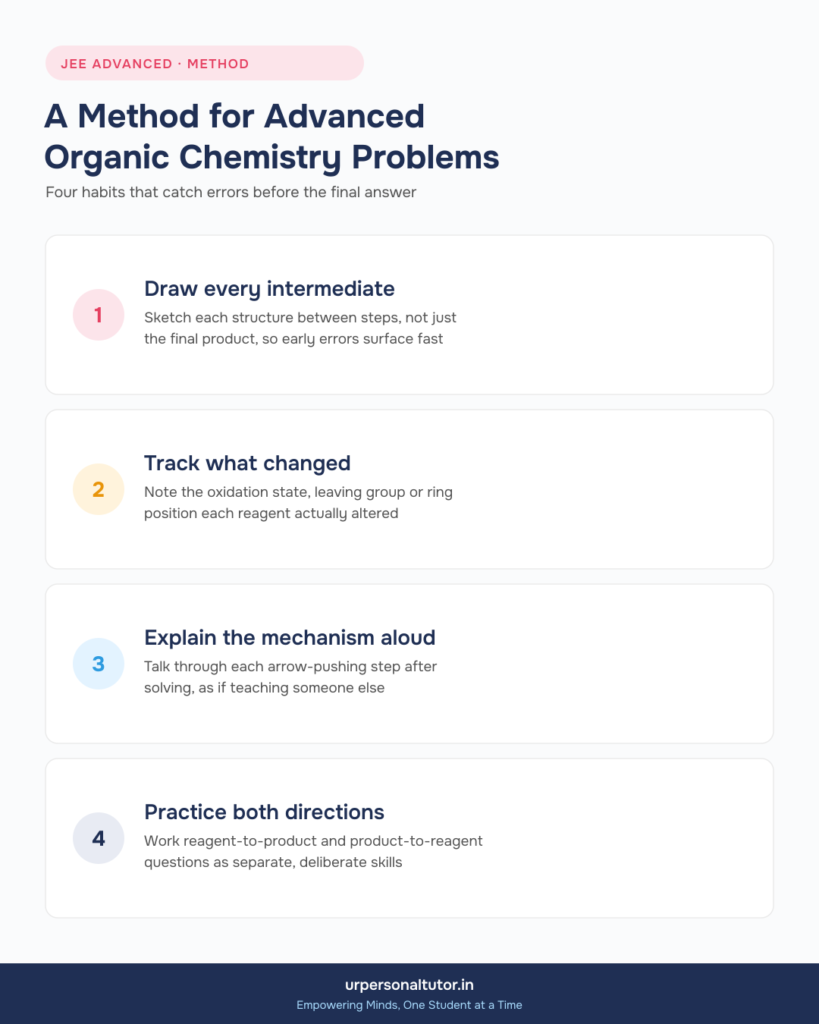
Most students approach a multi-step organic problem by trying to jump straight to the final product. That works for easy questions and fails badly on harder ones. A better habit is drawing out every intermediate structure as you go, even the ones the question doesn’t explicitly ask for, because a mistake in your mental image at step two silently corrupts everything that follows.
Functional group tracking matters just as much. Every reagent changes something specific: an oxidation state, a leaving group, a ring position. Students who write down what actually changed at each step, rather than just the reagent name, catch their own errors far more often before they reach a wrong final answer.
[INSERT INFOGRAPHIC 1]
Common Question Types in JEE Organic Chemistry
Jee organic chemistry questions at the Advanced level tend to fall into a few recurring shapes. Reaction sequence questions, where you predict a product through several linked steps, make up a large share of the marks. Mechanism-justification questions, where you explain why a reaction proceeds through SN1 rather than SN2 given specific conditions, are less common but disproportionately difficult when they do appear.
A smaller but consistent category asks you to identify a reagent from a described transformation, essentially working the sequence backward. These questions punish students who’ve only practiced forward prediction, since backward reasoning through a mechanism uses a slightly different mental process.
Reaction Mechanism Practice for Organic Chemistry for JEE Advanced
Mechanism-based practice is where most students under-invest. It’s easy to memorise that a tertiary carbocation is more stable than a primary one. It’s harder to explain, on the spot, why a specific substrate under specific conditions favours rearrangement over direct substitution. Advanced problems in organic chemistry for JEE frequently hinge on exactly this kind of reasoning rather than rote recall.
One habit that helps considerably: after solving any mechanism question, go back and explain each arrow-pushing step out loud, as if teaching it to someone else. Students who skip this step often get correct answers on easy problems through pattern-matching alone, then have nothing to fall back on when a harder variant changes the substrate slightly.
Question volume also plays a role here, and it’s worth being deliberate about how many problems you work through per reaction type rather than moving on the moment one feels familiar. A sensible question count per chapter exposes weak spots that a quick read-through of solved examples never will.
Common Mistakes When Solving Advanced Problems in Organic Chemistry for JEE
The most frequent mistake is treating stereochemistry as an afterthought. Questions that involve chiral centres or ring stereochemistry often hide the actual difficulty in a detail students skim past, like whether a reaction proceeds with retention or inversion of configuration.
A second common issue is over-relying on named reactions without understanding why they work. Knowing that a Grignard reagent adds to a carbonyl is not the same as knowing why it fails in the presence of an acidic proton elsewhere in the molecule, and Advanced-level questions like to test precisely that kind of exception.
Weak foundational habits from earlier years also resurface here more than students expect. A shaky grasp of basic mechanism concepts often stays hidden until a question stacks three of those concepts on top of each other, which is part of why class 11 foundations matter more to JEE Advanced organic chemistry than most students realise until a mock score doesn’t match how well they thought they understood the chapter.
How JEE Advanced Organic Chemistry Questions Are Scored Differently
Because JEE Advanced uses partial and negative marking schemes that vary by question type, a single small error in a multi-step organic problem can cost more than it would on an equivalent JEE Main question. Multiple-correct-answer formats, common in this section, mean that guessing an extra option to hedge your bets often costs more than leaving a genuinely uncertain option unmarked. Reading the exact marking scheme for each question type before attempting a paper is a small habit that prevents avoidable losses on top of the conceptual ones.
Want a study plan built around your actual weak spots in organic chemistry rather than a generic revision list? Get in touch with urpersonaltutor.in to book a session and work through the reaction types that are actually costing you marks.
FAQs
How different is JEE Advanced organic chemistry from JEE Main organic chemistry?
JEE Advanced questions typically chain several reactions together and expect mechanism-level justification, while JEE Main questions more often test a single reaction or product identification in isolation.
Is NCERT enough for advanced problems in organic chemistry for JEE?
NCERT builds the base concepts but rarely covers the multi-step reasoning or backward mechanism questions that show up at the Advanced level, so additional practice beyond it is usually necessary.
How much time should mechanism practice take compared to reaction memorisation?
There’s no fixed ratio that suits everyone, but students who spend more time understanding why a mechanism proceeds a certain way tend to handle unfamiliar substrates far better than those who focus mainly on memorising reaction outcomes.
Do stereochemistry questions appear often in JEE advanced organic chemistry questions?
They appear less frequently than reaction sequence questions, but when they do, they’re often weighted heavily since they combine mechanism understanding with spatial reasoning in a single question.
Should retrosynthesis-style questions be practiced separately from forward reaction questions?
Yes, working backward from a product to reagents uses a different reasoning path than forward prediction, and treating it as a distinct skill rather than an extension of forward practice tends to close that gap faster.