
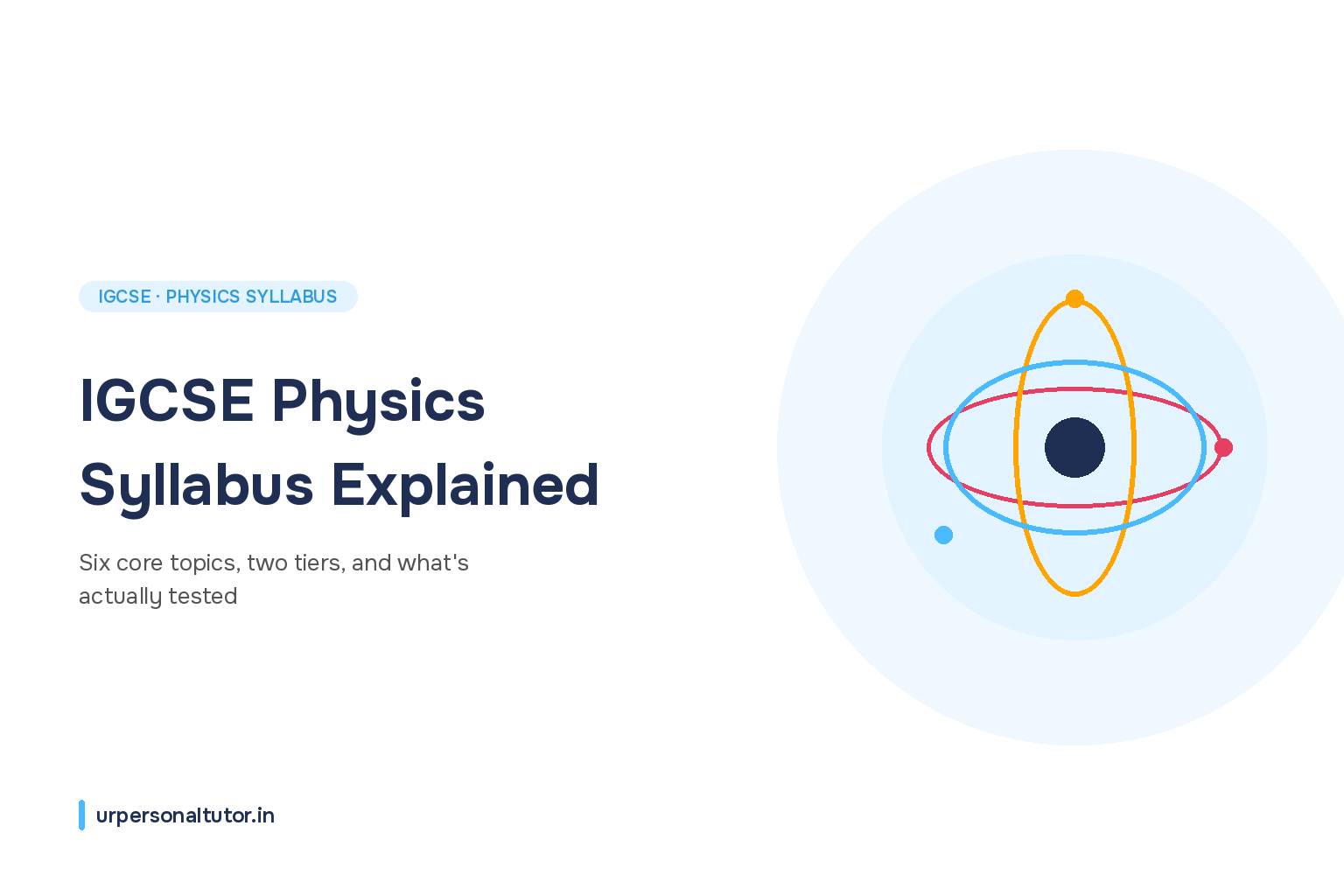
The IGCSE physics syllabus covers six main topic areas: general physics, thermal physics, waves, electricity and magnetism, atomic physics, and space physics. Cambridge assesses it through two or three written papers plus a practical component, and students choose between a Core and an Extended tier depending on the grades they’re targeting. That’s the short version. The rest of this guide walks through what each section actually involves and how to plan your study time around it.
[INSERT FEATURED IMAGE]
What Is the Cambridge IGCSE Physics Syllabus (0625)?
The Cambridge IGCSE physics syllabus is officially numbered 0625, and it’s designed to build scientific thinking rather than just memory recall. Students learn to apply physical laws to real situations, interpret data from experiments, and explain phenomena using correct terminology. Cambridge updates the syllabus periodically, so it’s worth checking the exact specification document for your exam year rather than relying on notes from an older cohort.
Most schools teach the content over two years, starting in Year 10. The pacing matters more than students expect. Rushing through electricity in three weeks to “get it over with” usually means it has to be relearned before the mock exams anyway.
Core Topics Covered in the IGCSE Physics Syllabus
Here’s what sits inside the IGCSE physics syllabus, section by section.
General physics opens the syllabus and covers motion, mass, density, forces, momentum, and energy transfers. This is the foundation for nearly everything that follows, which is why weak understanding here tends to show up as weak marks in later topics too.
Thermal physics deals with kinetic theory, states of matter, thermal expansion, and heat transfer through conduction, convection, and radiation. Students often find this section approachable at first glance, then lose marks because they describe processes vaguely instead of using the specific vocabulary examiners look for.
Waves covers general wave properties, light, and sound. Refraction and reflection questions come up almost every year, usually paired with a diagram students need to complete accurately rather than just describe.
Electricity and magnetism is the largest section by mark allocation in most papers. It includes circuits, current, voltage, resistance, electromagnetic effects, and magnetic fields. Circuit calculations are where a lot of Core-tier students plateau, since the maths compounds quickly if the basic formulas aren’t automatic.
Atomic physics introduces radioactivity, the structure of the atom, and nuclear processes. It’s a shorter section but a common source of last-minute panic, since it’s frequently left until the end of the course.
Space physics rounds things out with the solar system, stars, and the universe. It’s usually the smallest scoring section, though Extended-tier papers go slightly deeper into orbital motion and the life cycle of stars.
Core vs Extended: Which IGCSE Physics Syllabus Tier Should You Choose?
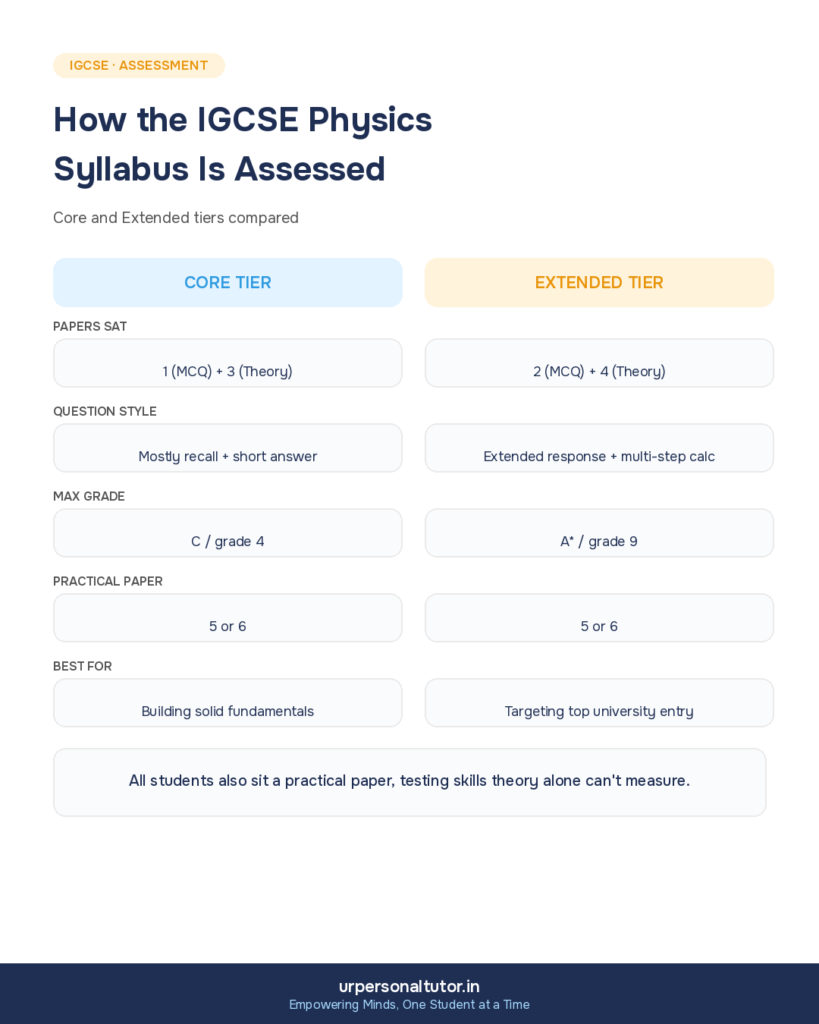
Cambridge splits the IGCSE physics extended syllabus from the Core tier, and picking the right one changes both what you study and the highest grade you can achieve. Core tier caps out at a C grade (or equivalent under the 9-1 scale) but covers a narrower range of content, with less demanding maths. Extended tier opens access to the full grade range up to an A*, but adds harder numerical problems, more depth on electromagnetism, and questions that expect students to apply concepts to unfamiliar contexts rather than recall them directly.
Teachers usually make this call around the midpoint of Year 10, based on mock results and how comfortable a student is with algebra-heavy questions. If you’re on the border, it’s worth talking through the trade-offs with a personalized igcse tutor before committing, since switching tiers late in the course is possible but adds pressure to an already tight timeline.
How the IGCSE Physics Syllabus Is Assessed
Assessment for the IGCSE physics syllabus is split between written theory papers and a practical skills component. Core-tier students sit Paper 1 (multiple choice) and Paper 3 (theory), while Extended-tier students sit Paper 2 and Paper 4 instead, both of which carry a higher proportion of extended-response and calculation questions. All students also complete either Paper 5 (a practical test) or Paper 6 (an alternative to practical, for schools without full lab access).
Grade boundaries shift slightly year to year depending on overall performance across the cohort, so a raw mark that scored a B one session might score an A the next. It’s a system worth understanding rather than obsessing over, since chasing exact percentage targets can distract from actually learning the content properly.
Practical Skills the IGCSE Physics Syllabus Tests
Practical competence isn’t an add-on to the IGCSE physics syllabus, it’s a formally examined component. Students are expected to plan simple investigations, take accurate readings, record data in appropriate tables, plot graphs correctly with labelled axes, and draw conclusions that are actually supported by the data collected. Errors in this section are rarely about physics understanding. They’re about habits like forgetting units, misreading a scale, or drawing a best-fit line that ignores an obvious anomaly.
Students who only ever revise from a textbook, without doing hands-on practicals or at least working through past practical papers, tend to underperform relative to their theory knowledge. It’s one of the most fixable gaps in the whole syllabus.
Common Struggles Students Face With the IGCSE Physics Syllabus
A persistent myth is that the IGCSE physics syllabus rewards memorising formulas and definitions word for word. It doesn’t, not on its own. Cambridge questions frequently rephrase a familiar concept into an unfamiliar scenario, and students who’ve only memorised without understanding the underlying logic get stuck the moment the wording changes. A formula sheet helps with recall, but it can’t substitute for knowing when and why to apply a given equation.
The honest answer is that strong performance comes from a mix of solid recall, comfort with the maths, and enough exposure to varied question styles that nothing on exam day feels genuinely unfamiliar. There’s no shortcut that skips the practice.
How to Study the IGCSE Physics Syllabus Effectively
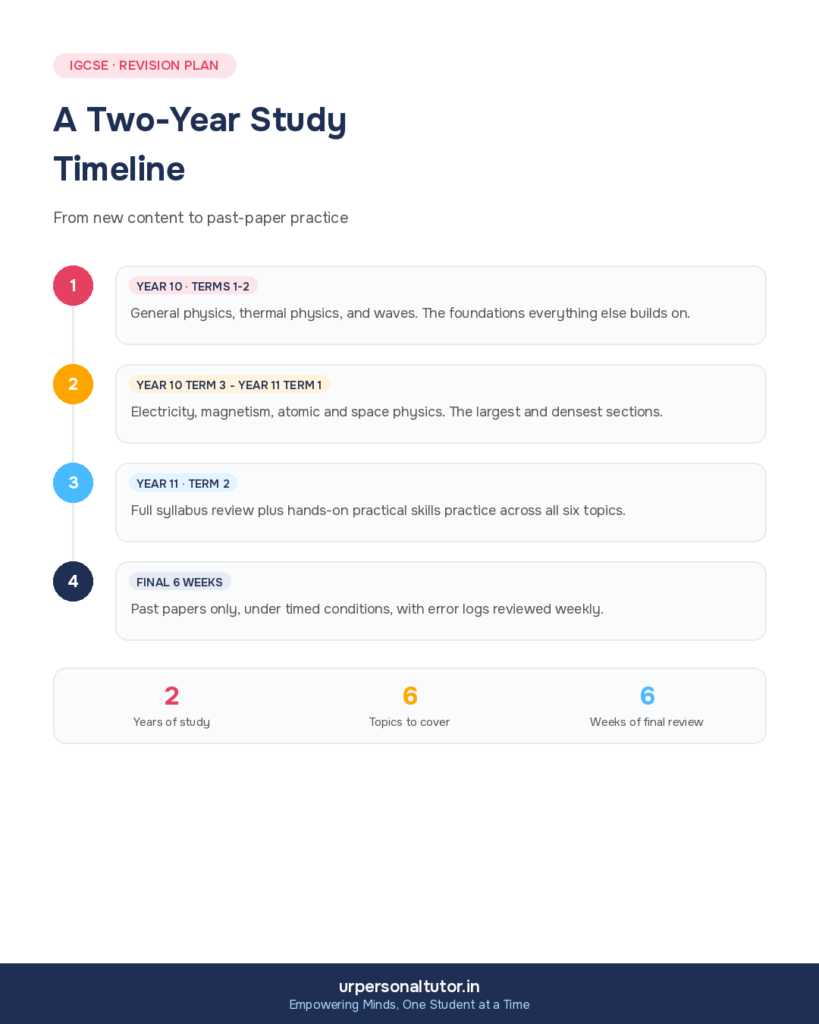
Spacing out revision across the full two-year course, rather than compressing it into the final term, consistently produces better outcomes than cramming. A rough but workable approach: cover new content steadily through Year 10 and early Year 11, then dedicate the final months almost entirely to past papers, since Cambridge’s question style is distinctive enough that familiarity with it makes a measurable difference. Students moving from a different curriculum, such as comparing IGCSE against CBSE, often need extra time just adjusting to how IGCSE frames its questions before the content itself becomes the main challenge.
Grade boundaries and how marks translate to letter grades cause a lot of confusion too, and it’s worth understanding the grading system properly before setting target scores, since assuming a percentage maps directly onto a grade can lead to misplaced confidence or unnecessary panic.
A structured final stretch matters as much as the content itself. Students who follow a clear countdown plan in the last weeks, rather than revising whatever feels urgent that day, tend to walk into the exam room calmer and better prepared.
Want a structured plan for working through the IGCSE physics syllabus without leaving gaps? Book a one-to-one physics session and get a study plan built around your exam timeline and current tier.
FAQs
Is the IGCSE physics syllabus hard compared to GCSE?
The core content overlaps significantly with GCSE Physics, but IGCSE papers tend to ask more application-based questions rather than straight recall, which can catch students off guard if they’ve only revised definitions.
How many topics are in the IGCSE physics syllabus?
Six main topic areas: general physics, thermal physics, waves, electricity and magnetism, atomic physics, and space physics, each broken into several subtopics within the full specification.
Do I need a calculator for IGCSE physics?
Yes, for most papers. Extended-tier papers in particular include multi-step calculations where a calculator is expected, though students should still show working clearly for method marks.
Can I switch from Core to Extended tier partway through the course?
It’s possible but not ideal. Switching mid-course usually means covering missed Extended content quickly, which works best with focused support rather than trying to catch up alone.
What’s the difference between the practical exam and the written papers?
The written papers test theory, application, and calculation. The practical component (Paper 5 or the written alternative, Paper 6) specifically tests experimental skills like measurement, graph plotting, and drawing valid conclusions from data