

Good JEE Notes Come From Selecting, Not Copying
The fastest way to learn how to make notes for JEE is to stop transcribing the textbook and start filtering it. Notes that work are built from what you got wrong in practice, not from rewriting every line a textbook already says clearly. Students who copy chapters word for word end up with thick, unusable files, while students who select only the traps, formulas, and exceptions end up with something they can revise in twenty minutes flat.
This distinction matters more than most aspirants realise. A notebook stuffed with definitions looks productive but rarely gets reopened before the exam. A notebook built around your own mistakes gets reread constantly, because it’s short and it’s yours.

How to Make Short Notes for JEE Without Losing Depth
Short doesn’t mean shallow. Learning how to make short notes for JEE means learning to compress an idea to its trigger, the one line or diagram that brings the full concept back to mind. If a formula has five steps of derivation, your note should hold the final result plus the one assumption that trips people up, not the full derivation again.
A useful test: if a note takes longer to read than it would take to re-derive the concept from scratch, it’s too long. Real jee notes are closer to flashcards than essays. One page per chapter is a reasonable ceiling for most topics, with exceptions for genuinely dense chapters like Organic Chemistry reactions or Rotational Mechanics.
Building a Notes System for Your Full JEE Preparation Guide
A single notebook rarely survives two years of preparation. Most aspirants end up with three layers, and understanding this structure is central to any working jee preparation guide.
The first layer is class notes, taken live and messy, just enough to follow along. The second layer is the digest, made within 48 hours of the class, where the messy notes get filtered down to what’s actually worth keeping. The third layer is the exam-week sheet, a distilled one or two pages per subject that gets reviewed the night before a test. Skipping the digest step is the single biggest reason class notes turn into a graveyard nobody revisits.
Physics tends to need the most rework at the digest stage, since formulas without context are easy to misapply. Anyone who has tried to solve IIT JEE physics problems using a memorised formula alone, without the note on when that formula actually applies, knows how often that goes wrong under exam pressure.
Common Notes-Making Mistakes in IIT JEE Exam Preparation
The most common mistake is highlighting everything. When half a page is yellow, nothing stands out, and the highlighter stops meaning anything. A better habit is reserving colour for exceptions and traps only, so a glance at the page tells you exactly where past mistakes happened.
Another frequent error shows up during IIT JEE exam preparation when students take notes from solutions instead of from their own errors. Copying a model solution’s steps teaches you what the expert did, not what you personally tend to miss. Notes built from your own wrong answers, with a short line on why you got it wrong, catch far more repeat mistakes than notes copied from someone else’s clean method.
A third mistake is treating notes as static. Chapters revisited a second or third time deserve updated notes, not a fresh page stacked on top of the old one. Cluttered, duplicate notes across multiple notebooks make revision slower, not faster.
Subject-Wise Notes-Making Techniques for JEE Notes
Physics Notes
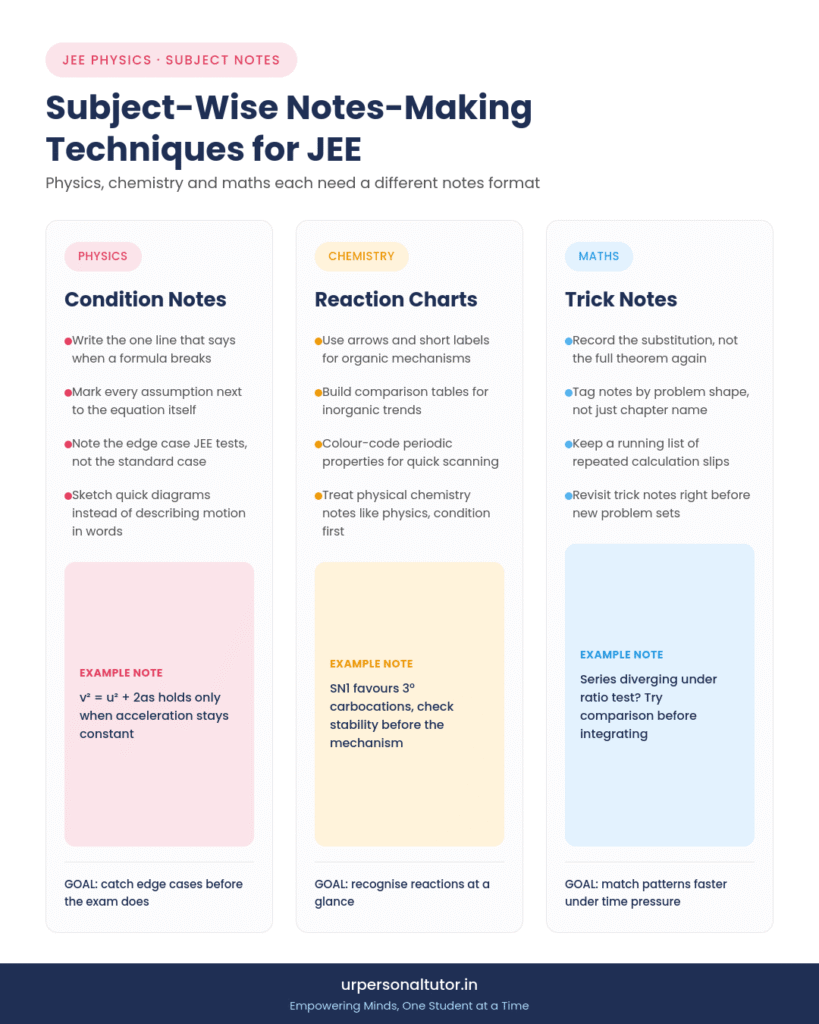
Physics rewards notes built around conditions, not formulas. For every equation, write down the one line that says when it breaks. A projectile motion formula assuming no air resistance is only useful if that assumption is written next to it, because JEE loves testing the edge cases where standard formulas fail.
Chemistry Notes
Organic Chemistry benefits from reaction-mechanism notes with arrows and short labels rather than paragraphs. Inorganic Chemistry works better as comparison tables, since most questions test how one element or compound behaves differently from a similar one. Physical Chemistry sits closer to physics, so condition-based notes work well there too.
Maths Notes
Maths notes should hold the trick, not the theorem. Most JEE maths questions aren’t testing whether you know a formula, they’re testing whether you recognise which trick applies to a specific problem shape. A note that says “if you see this pattern, try this substitution” is worth more than ten lines restating the theorem itself.
Revising With JEE Notes During the Final Months
In the last few months, jee notes should shrink, not grow. Every revision pass is a chance to cut, not add. If a line hasn’t been useful in two revision cycles, it probably doesn’t need to survive a third.
A common question during this phase is how many questions to solve per chapter for jee before moving on, and the honest answer is that it depends more on your notes than on a fixed count. If your notes for a chapter are thin because the concept came easily, fewer questions are needed to confirm that. If your notes for a chapter are dense with corrections, that chapter needs more practice before you move forward.
Final-month notes work best when read out loud once, quietly, rather than just skimmed. Reading aloud catches gaps that silent skimming tends to miss, especially in physics where a missing condition can sit unnoticed on the page for months.
Digital vs Handwritten Notes for JEE Aspirants
Handwritten notes still edge ahead for physics and maths, where diagrams, arrows, and quick sketches matter. The physical act of writing also seems to help recall better than typing does, based on what most toppers report about their own preparation.
Digital notes work well for chemistry, especially reaction charts and periodic trends that benefit from colour-coding and easy search. A hybrid approach, handwritten for physics and maths, digital for chemistry reference tables, tends to suit most JEE preparation guide followers without forcing a single format on subjects that don’t need it.
Students working with structured JEE and NEET tuition often find their tutors already push this hybrid split, since it matches how the two exam patterns test recall differently.
Frequently Asked Questions
How many notebooks should I keep for JEE preparation?
Three is a workable number: one for live class notes, one for the 48-hour digest, and one exam-week sheet per subject. More than that usually means information gets duplicated instead of refined.
Should I rewrite my notes every time I revise a chapter?
Not entirely. Update the parts that changed, based on new mistakes or new question patterns you encountered, but keep the core structure so you’re not starting from zero each time.
Is it better to make notes chapter-wise or topic-wise?
Chapter-wise works for most of the syllabus, but a few cross-cutting topics, like unit conversions or graph interpretation, benefit from a separate topic-wise page that pulls examples from multiple chapters.
How do I know if my JEE notes are too long?
If a note takes longer to read than it would take to solve a fresh problem on that concept, it’s too long. Short notes exist to trigger memory, not to replace the textbook.
Can I skip making notes for chapters I’m already confident in?
A short one-liner is still worth keeping even for confident chapters, since confidence early in preparation sometimes fades by exam time and a quick trigger note saves rebuilding that comfort from scratch.
Ready to Build a Notes System That Actually Works?
Good notes are built over months, not overnight, and the process usually goes faster with someone checking whether you’re keeping the right things and cutting the rest. If you’d like guidance on building a notes system alongside your physics preparation, book a session with Ur Personal Tutor or browse more preparation guides on the blog.