
The Most Common Mistakes in A Level Differentiation Questions
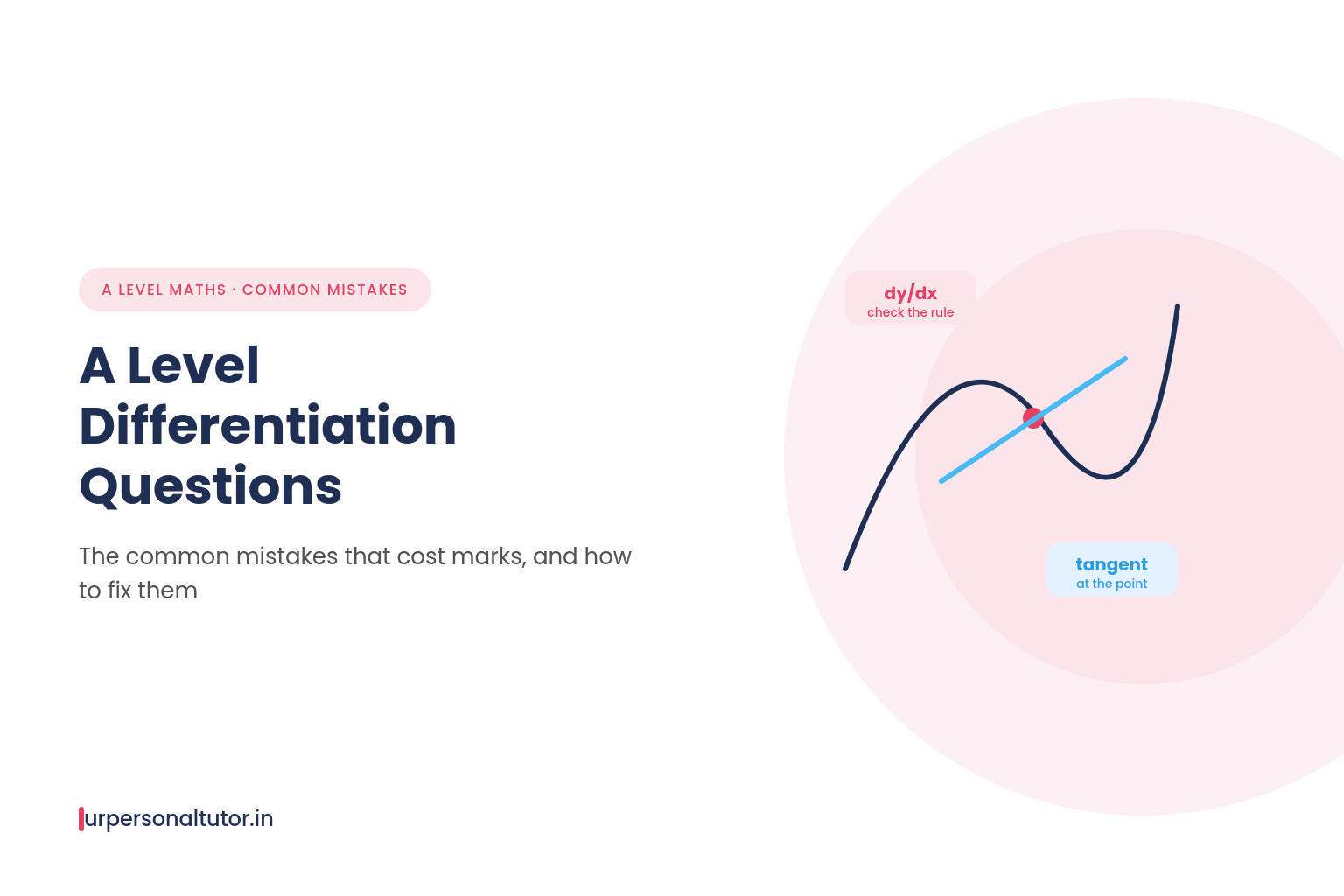
Five errors account for most of the dropped marks. Students leave out the inner derivative in the chain rule, swap the order in the quotient rule, differentiate before rewriting roots and fractions as powers, work in degrees instead of radians, or stop at dy/dx = 0 without saying whether the point is a maximum or minimum. Each one is quick to fix once you know what it looks like.
The rest of this guide takes them in roughly the order they appear in a Year 2 paper, with the wrong answer students actually write next to the correct one.
Why Differentiation A Level Maths Questions Cost So Many Marks
Pure content makes up about two thirds of A Level Maths, and differentiation runs through most of it: curve sketching, optimisation, tangents, rates of change and the long calculus questions that close a paper. One shaky habit therefore turns up again and again, and it quietly shapes where a student lands in the final A-Level grading. A slip in the first line of a 6-mark question also follows you down the page, even though follow-through marks soften the damage.
Chain Rule Slips in A Level Differentiation Questions
The chain rule is the most dropped skill in Year 2. Students differentiate the outer function and forget to multiply by the derivative of what sits inside.
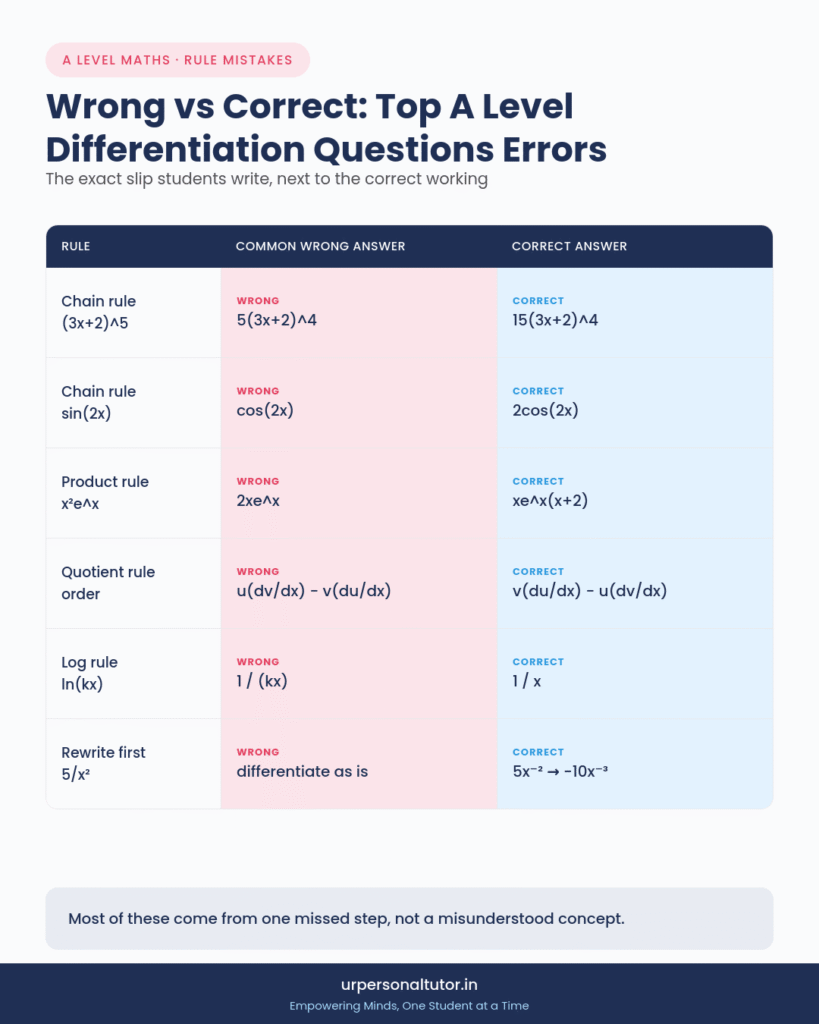
Take y = (3x + 2)^5. The derivative is 15(3x + 2)^4, but the usual wrong answer is 5(3x + 2)^4, which loses the 3 from the bracket. The same thing happens with sin(2x), which differentiates to 2cos(2x), and with e^(4x), which gives 4e^(4x).
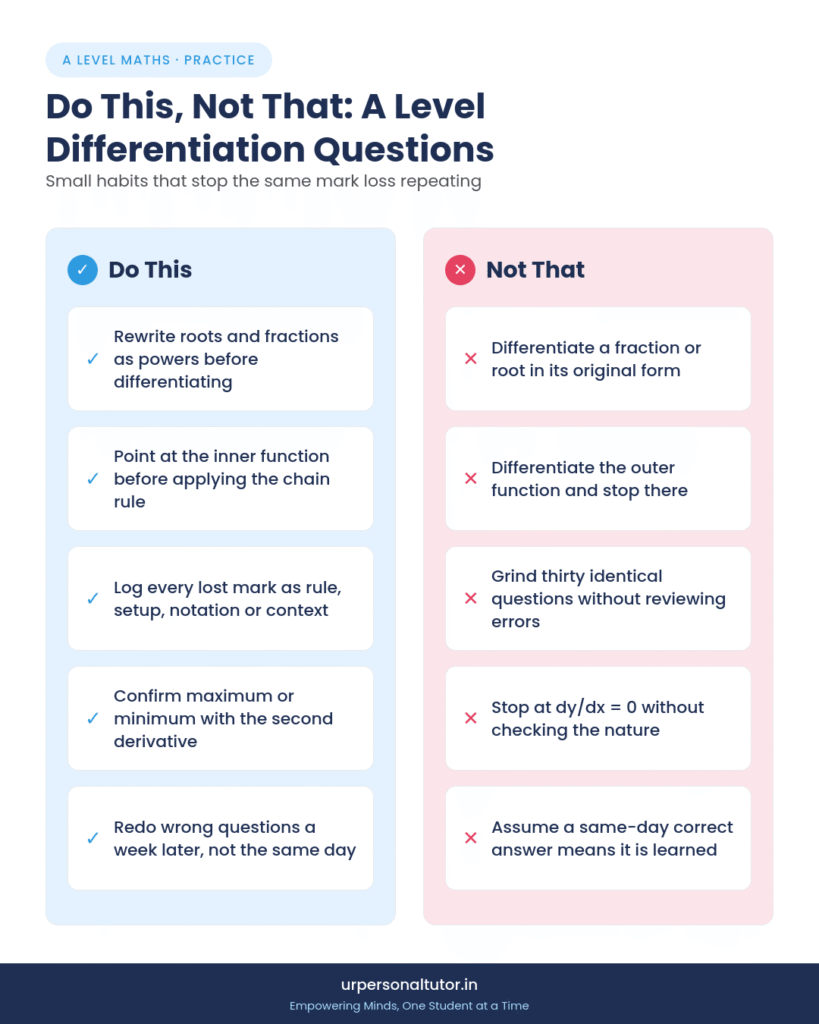
A habit that works: before writing anything, point at the inner function. A bracket, a power inside a trig function, a kx in an exponent. If you can point at one, an extra multiplier is waiting. Nested cases like e^(sin x) need the rule twice, so check that your answer carries one multiplier per layer.
Product and Quotient Rule Errors That Flip the Sign
In the quotient rule the numerator is v(du/dx) minus u(dv/dx), in that order. Reverse it and the whole answer changes sign. Under exam pressure, many students are safer rewriting u/v as u × v^(-1) and using the product and chain rules, which removes the order problem.
The product rule fails differently. Some students differentiate each factor and multiply the results, so y = x²e^x becomes 2x·e^x. The correct derivative is 2xe^x + x²e^x, which factorises to xe^x(x + 2). Factorising at the end pays off straight away, because setting dy/dx = 0 is then a one-line job.
[INSERT INFOGRAPHIC 1]
Why Easy A Level Differentiation Questions Still Lose Marks
Search for a level easy differentiation questions and you will find plenty of two and three mark items. Those are the ones students rush, and the errors are almost always in the setup rather than the calculus.
Not Rewriting Before Differentiating
y = 5/x² has to become 5x^(-2) before you touch it, giving −10x^(-3). For y = √x + 4/√x you need x^(1/2) + 4x^(-1/2) first, which gives (1/2)x^(-1/2) − 2x^(-3/2). Splitting (x² + 3x)/x into x + 3 turns a quotient rule question into a one-line answer.
Radians, Not Degrees
The result d/dx(sin x) = cos x holds only when x is in radians. If a question gives an angle in degrees, convert before differentiating. Calculator mode matters too when you evaluate a gradient at a point.
Exponentials and Logs
d/dx(e^(3x)) is 3e^(3x), but d/dx(3^x) is 3^x ln 3. And ln(kx) differentiates to 1/x, not 1/(kx), because ln(kx) = ln k + ln x and ln k is just a constant. Likewise ln(x²) rewrites as 2 ln x, so its derivative is 2/x.
First Principles Notation
Keep the limit notation on every line until h has genuinely been replaced by 0. Dropping it early often costs the notation mark even when the algebra is right.
Stationary Points, Tangents and Normals in A Level Differentiation Questions
Finding the Point but Not the Nature
Setting dy/dx = 0 gives x values, and that is only part of the marks. You also need the y-coordinate and a justification for maximum or minimum. A positive d²y/dx² means a minimum and a negative one means a maximum. If d²y/dx² = 0, the test tells you nothing, so check the sign of the gradient either side instead.
Tangent Versus Normal
The normal gradient is −1/m, where m is the tangent gradient. Two habits lose marks here: using m for the normal, and forgetting to find the y-value before substituting into y − y₁ = m(x − x₁). For increasing or decreasing intervals, solve dy/dx > 0 from a quick sketch of the quadratic, because dividing through by a negative number flips the inequality and students forget.
Rates of Change, Optimisation and Connected Questions
Optimisation questions have their own trap, which is the constraint. With a fixed volume, you must eliminate one variable before differentiating, show the result is a minimum, and then state the answer in context with units. That last step is often a separate mark.
Connected rates of change are the chain rule in disguise: dV/dt = dV/dr × dr/dt. The same calculus drives kinematics in A-Level Physics, where velocity is the derivative of displacement and acceleration is the derivative of velocity. Keeping track of which variable you are differentiating with respect to matters in both subjects.
Where A Level Differential Equations Questions Go Wrong
Solving differential equations relies on integration, but they sit in the same Year 2 calculus block and lose marks in predictable ways.
The classic slip is the missing + c. For dy/dx = ky, separate to (1/y) dy = k dx, integrate to ln|y| = kx + c, and only then apply the initial condition. Applying it before integrating, or adding + c to one side only, breaks the method. If the question wants y in terms of x, finish with y = Ae^(kx), where A = e^c.
Forming the equation from words trips people up as well. “The rate of decrease is proportional to the amount” means dP/dt = −kP with k positive. The negative sign belongs in the equation, not in your head.
How to Practise A Level Differentiation Questions Without Repeating the Same Errors
Small mixed sets beat thirty identical questions. After each set, mark against the mark scheme and log every lost mark under one label: rule, setup, notation or context. Within two weeks the log shows which error to drill. Redo the questions you got wrong a week later, since a correct answer on the same day proves very little.
Some students shorten that loop with weekly A-Level tuition, where a missing inner derivative gets caught as it is written instead of after marking. Either way, the aim is to see the same three or four mistakes disappear from your log.
Ready to Stop Losing Easy Marks?
Most students do not need more content. They need someone to spot which two or three habits are costing them. If you would like a tutor to go through your own working and find them, book a session with Ur Personal Tutor or browse more guides on the blog.
Frequently Asked Questions
Is differentiation only tested in the second year of A Level Maths?
No. AS content covers differentiating polynomials, tangents, normals, stationary points and first principles. The chain, product and quotient rules, trig, exponential and log functions, and implicit and parametric differentiation come in the second year.
Will the mark scheme accept an unsimplified derivative?
Usually yes, provided it is correct. The exceptions are questions that ask for a specific form or say “show that”, where every step must be visible.
Can I use my calculator to check a derivative?
Many approved scientific calculators can give the gradient of a function at a specific x value numerically, which makes a decent quick check. They will not show working, so method marks still depend on what you write.
Do exam boards test differentiation differently?
The pure content is set nationally, so AQA, Edexcel and OCR cover the same calculus. What differs is question style and how marks are split, which is a good reason to practise on your own board’s past papers.
In what order should I revise differentiation topics?
Start with polynomials and first principles, then stationary points and tangents. Move on to the chain, product and quotient rules, then exponentials, logs and trig, and finish with implicit and parametric differentiation, connected rates and differential equations. Working through A level differentiation questions in that order means each topic leans on one you have already secured