
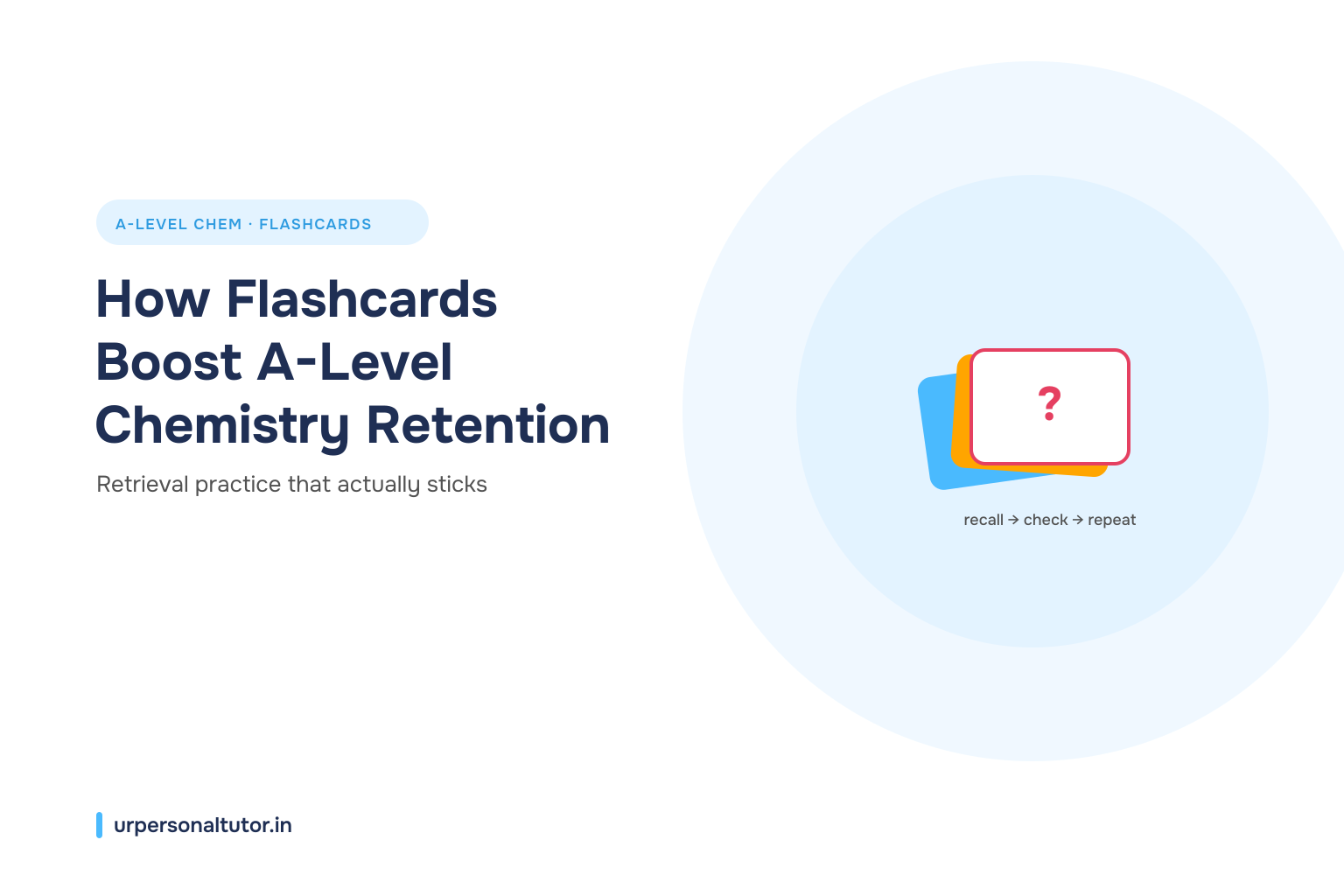
A-Level chemistry flashcards improve retention because they force retrieval practice, the act of pulling an answer out of memory rather than recognising it on a page. That single difference, retrieval instead of re-reading, is why students who use flashcards consistently tend to hold onto reaction mechanisms and definitions far longer than students who only reread notes or textbooks before a test.
Chemistry at A-Level piles up fast: definitions, mechanisms, trends across the periodic table, and a steady stream of named reactions that all sound similar after a while. A-Level chemistry flashcards work well here specifically because chemistry rewards short, precise recall far more than long-form explanation, and a flashcard is built for exactly that kind of retrieval.
Why Retrieval Beats Rereading for Chemistry
Rereading a page on electrophilic addition feels productive because the content is familiar by the third pass. That familiarity is misleading. Recognising a concept and being able to produce it from memory under exam conditions are different skills, and only one of them gets tested in an exam hall.
A-Level chemistry flashcards close that gap because every card demands an answer before it’s revealed, not after. Struggling to recall something and then checking the answer strengthens memory more than reading the same answer passively, a pattern well documented in cognitive psychology research on the testing effect. Chemistry topics with sharp, checkable answers, like functional group tests or ionic equation balancing, are especially well suited to this kind of practice.
Which A-Level Chemistry Topics Suit Flashcards Best
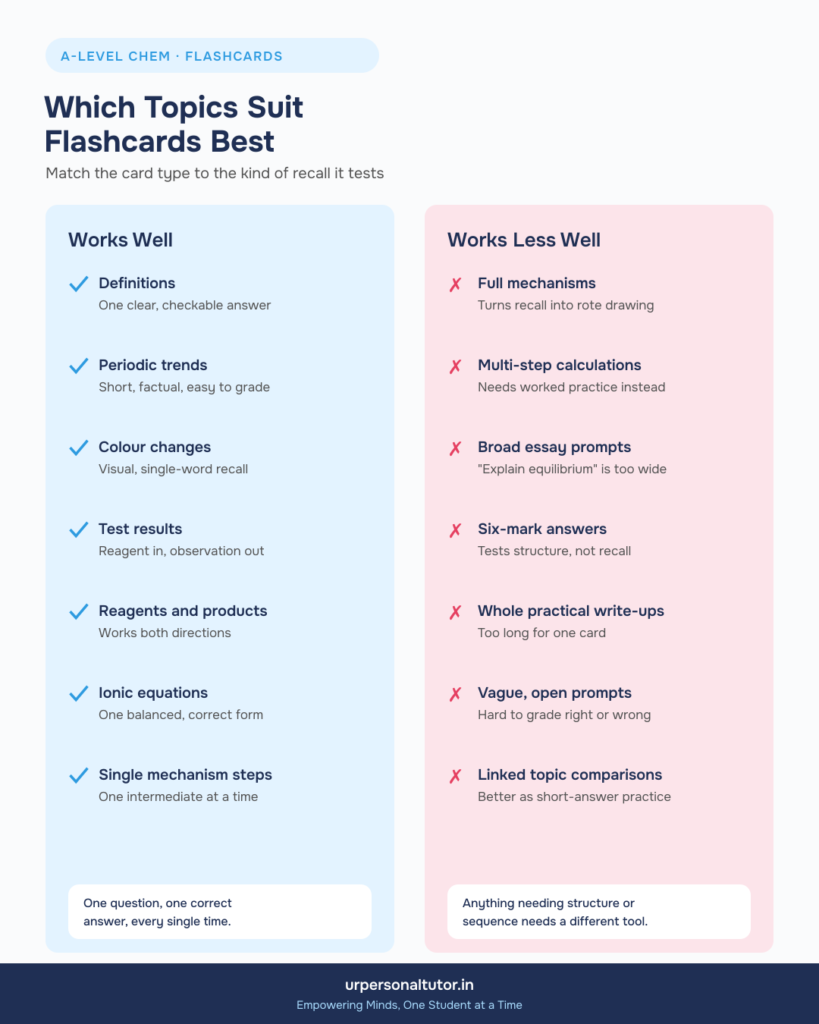
Not every topic benefits equally. Definitions, trends, colour changes, test results, and reaction conditions translate cleanly onto a card because they have a single correct answer. Organic mechanisms are trickier, since a mechanism is really a sequence, not a fact, and a flashcard tends to work better here when it asks for one step or one intermediate rather than the whole arrow-pushing sequence at once.
Physical chemistry calculations sit somewhere in between. A card asking for the equation and units behind Hess’s Law works well. A card that asks a student to solve a full multi-step calculation from scratch usually doesn’t, since that’s closer to a past paper question than a recall prompt.
Building a Deck That Actually Holds Up
A good flashcard asks one thing clearly. Vague prompts like “explain oxidation” invite vague answers that feel right without actually being checkable. A sharper version, “define oxidation in terms of electron transfer,” has one correct answer and makes it obvious immediately whether the recall was accurate or not.
Cards should also move in both directions where it makes sense. A card that shows a reagent and asks for the product, paired with one that shows the product and asks for the reagent, tests the same knowledge from two angles and catches gaps that one-directional cards miss entirely. Students building a revision routine around a fixed weekly rhythm, similar to the pacing suggested in a last-minute revision plan originally written for physics, tend to find the same spaced structure works just as well once flashcards replace passive review sessions.
Spaced Repetition and Why Timing Matters More Than Volume
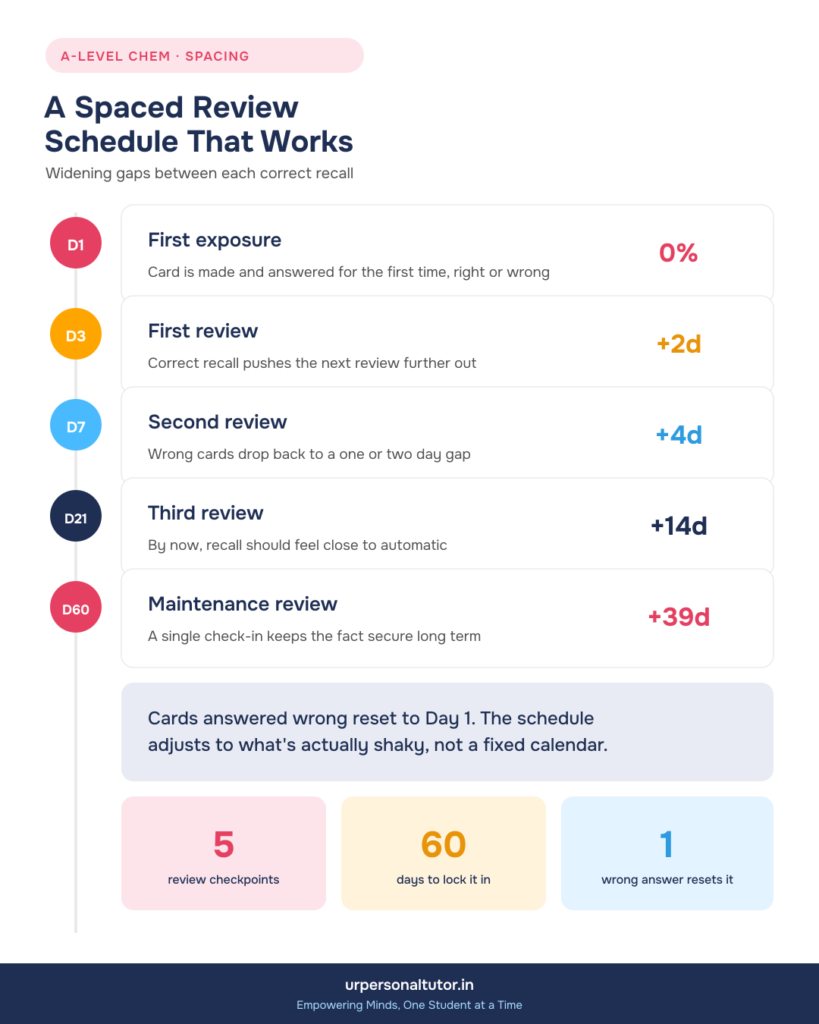
A-Level chemistry flashcards work best inside a spaced repetition system rather than a single deck reviewed daily from start to finish. Cards answered correctly should reappear less often, and cards answered incorrectly should resurface sooner, since the goal is spending time on what’s actually shaky rather than re-confirming what’s already solid.
This matters more in chemistry than students often expect, because forgetting curves for memorised facts, like transition metal colours or halogen displacement results, are steep. A fact reviewed once and never again fades within days for most students. The same fact reviewed at increasing intervals, a few days, then a week, then a month, tends to stick for the rest of the course.
Common Flashcard Mistakes That Undercut Retention
The most common mistake is making cards too broad. A card that says “explain the whole of equilibrium” on one side invites a rambling, unfocused answer that’s hard to grade as right or wrong. Breaking that into five or six narrower cards, covering Le Chatelier’s principle, Kc expressions, and specific shift scenarios separately, produces far more useful recall practice.
A second mistake is treating flashcard review as finished once every card has been seen once. A single pass through a deck barely counts as practice. The real gains come from repeated exposure spaced over weeks, not from card count on any single day.
A third mistake shows up around named reactions and mechanisms specifically. Students sometimes write the full mechanism as the answer to a single card, which turns retrieval into a memorisation exercise for an entire diagram rather than a test of understanding. Splitting a mechanism into its individual steps, each one its own card, keeps focus on understanding why each step happens rather than reciting a sequence by rote.
How Flashcards Fit Alongside Past Papers
Flashcards and past papers do different jobs, and A-Level chemistry flashcards work best as preparation for past paper practice rather than a replacement for it. Flashcards build the raw recall, definitions, trends, reagents, that past paper questions then test in applied, exam-style contexts. A student who’s strong on flashcards but has never practiced structuring a six-mark explain-and-justify answer will still lose marks on technique, not knowledge.
It helps to think of flashcards as the foundation layer and past papers as the stress test on top of it. Many of the common exam mistakes students make under timed conditions trace back to shaky recall rather than genuine misunderstanding, which is exactly the gap flashcards are built to close before a paper ever gets attempted.
Digital vs Physical Flashcards for A-Level Chemistry
Physical cards work well for anyone who benefits from the act of writing something out, since handwriting a definition or equation adds a small extra layer of encoding before the card even gets tested. Digital tools, particularly ones with built-in spaced repetition scheduling, remove the manual tracking involved in knowing which cards are due for review and which have been retired.
Neither format outperforms the other on its own. What matters more than the format is whether the deck gets reviewed consistently and whether cards are written narrowly enough to give a clear right or wrong answer. Grade boundaries under the current A-Level grading system leave little room for recall slips on the more factual sections of a chemistry paper, which is part of why consistent flashcard use tends to show up disproportionately in the marks gained on shorter, definition-based questions.
FAQs
How many A-Level chemistry flashcards should a student make per topic?
There’s no fixed number, but narrower is better than fewer. A topic like periodicity might reasonably produce fifteen to twenty focused cards rather than three broad ones, since narrow cards are easier to grade honestly as correct or incorrect.
Can flashcards help with organic chemistry mechanisms specifically?
Yes, but they work best when a mechanism is broken into individual steps or intermediates rather than tested as one long card, since testing an entire mechanism at once turns recall into memorisation of a diagram rather than understanding of a process.
Should flashcards be reviewed every single day?
Daily review isn’t necessary once a spaced repetition system is in place, since cards answered correctly are pushed further apart automatically. Forcing daily review of everything wastes time on material that’s already secure.
Do flashcards work for calculation-heavy chemistry topics?
They work best for the conceptual pieces of a calculation, like which equation applies or what units are expected, rather than for full multi-step problems, which are better practiced through worked questions and past papers.
Is it better to make flashcards alone or use a pre-made deck?
Making cards personally tends to produce stronger recall, since the act of deciding what to ask and how to phrase it is itself a form of processing the material, something a pre-made deck skips entirely.