
What Is an IGCSE Mark Scheme and Why Does It Matter?
An IGCSE mark scheme is the document examiners use to award marks on every question in a paper. It lists the exact answers, key terms and working that earn each mark, along with the alternatives that are accepted and the ones that are not. That makes it the most revealing revision resource you have, because it shows how marks are actually won instead of how a textbook explains a topic.
Most students use it only to tick or cross an answer. That wastes most of its value. Used properly, an IGCSE mark scheme tells you why a correct idea still scored zero, how many separate points a question wants, and which words the examiner is listening for.
How to Read a Cambridge IGCSE Mark Scheme
A Cambridge IGCSE mark scheme is laid out in rows, one per question or part-question. The columns usually give the question number, the answer, the marks available and a guidance column with extra notes. Read it with the guidance column open, since that is where examiners record what to accept, what to ignore and what to reject.
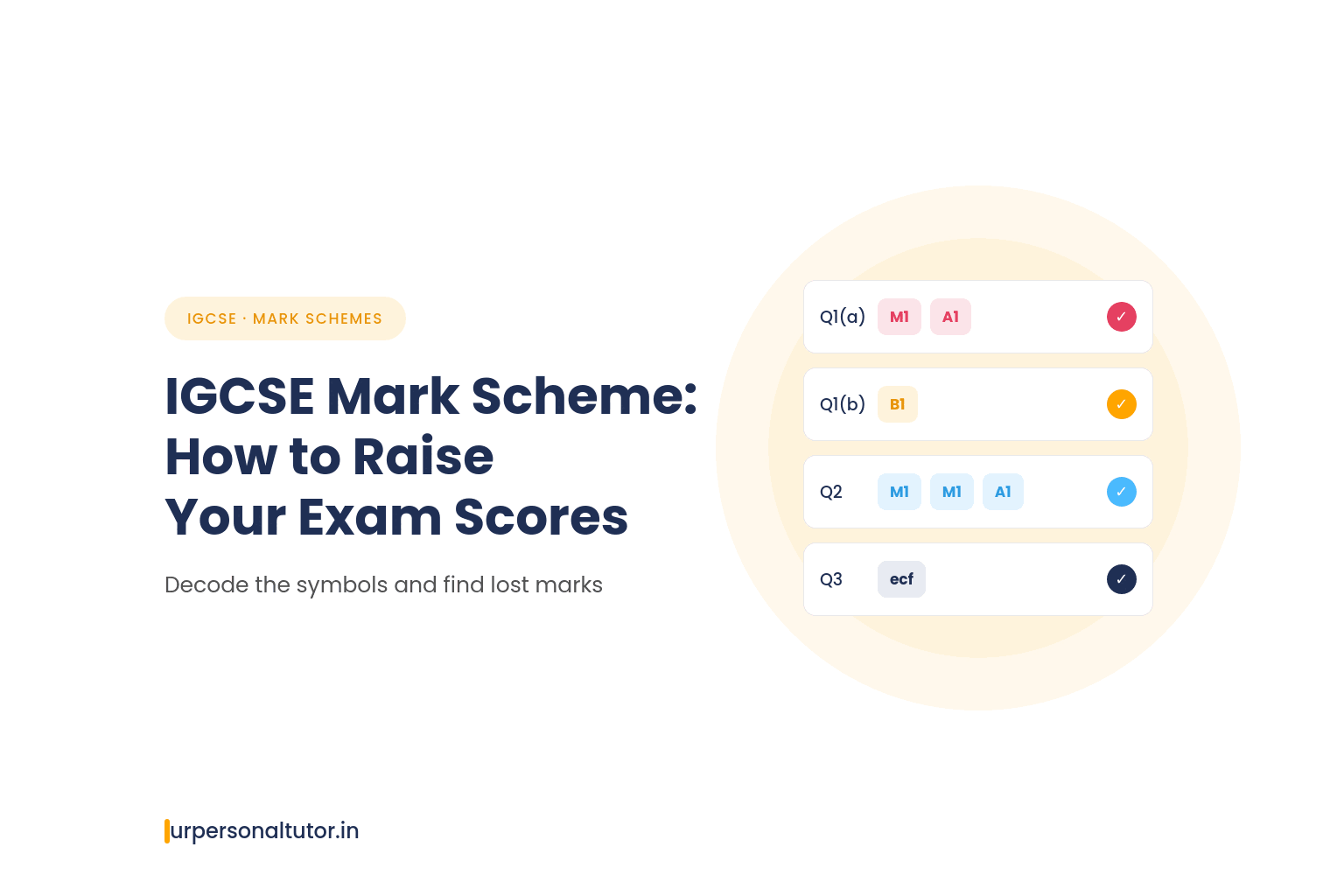
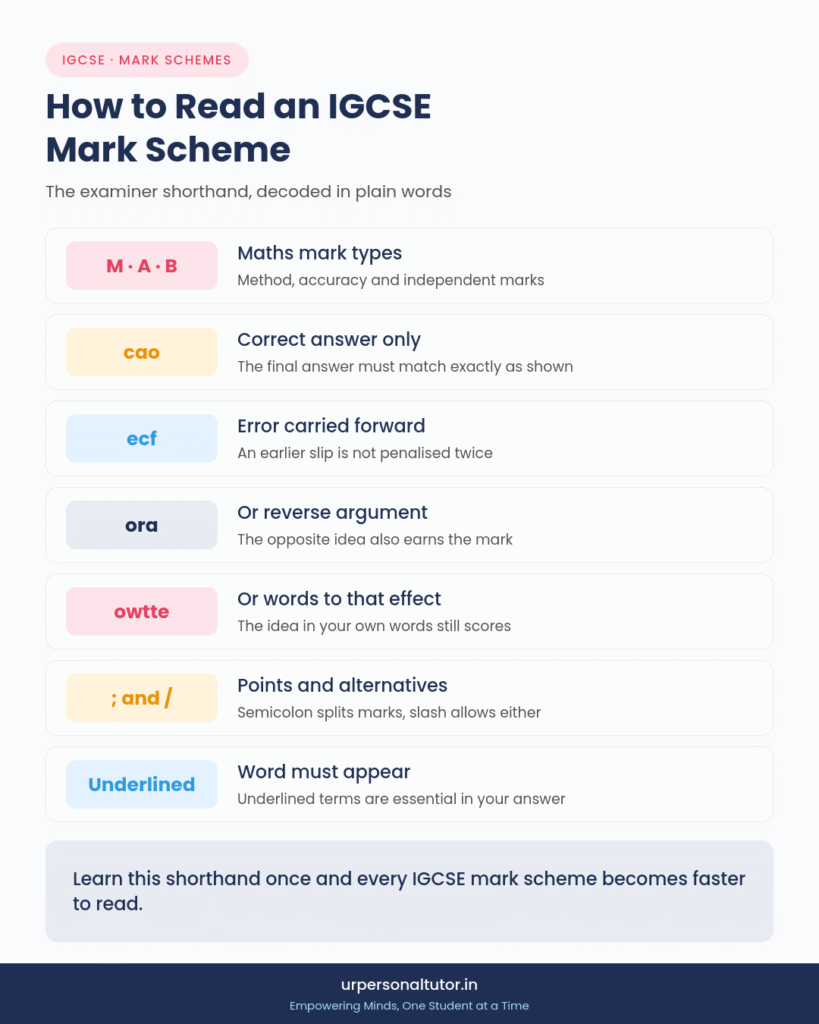
The shorthand takes one session to learn. In the sciences, a semicolon separates marking points, a slash shows alternative acceptable answers, and bracketed words are not essential. “ora” means the reverse argument is also credited. “ecf” means an error carried forward from an earlier step is not penalised twice, and “owtte” means the idea in other words still scores. Maths schemes add M for method, A for accuracy and B for an independent mark, while “cao” means the final answer must be correct as shown.
Marks Equal Points: Match Your Answer to the Mark Allocation
The number beside a question is the clearest hint you get. A 3-mark “explain” question wants three separate creditworthy points, not one point written out at length. Open the scheme and you can count them, usually one per line or per semicolon. A long paragraph that makes a single point collects a single mark, however well it is written.
After marking a few papers, patterns appear. A 2-mark “state” question wants two short facts. A 4-mark “describe” question usually wants a sequence with one mark per stage. Planning one point per mark before you write is a small habit with a noticeable return.
Using the IGCSE Mark Scheme Subject by Subject
Each subject rewards a slightly different habit, so it helps to know what to hunt for in the scheme.
IGCSE Maths Mark Scheme: Method Marks Save You
In an IGCSE maths mark scheme, method marks (M) are awarded for a correct approach even when the final answer is wrong. Showing working is worth real marks. A student who writes only “47” and is wrong gets nothing, while one who writes the correct substitution and slips on the arithmetic usually keeps the M mark. Compare your working line by line with the scheme and mark the point where yours stopped earning credit.
IGCSE Physics Mark Scheme: Exact Wording and Units
Physics schemes are strict about units and key words. “Increases” earns credit where “gets bigger” can be borderline, and a correct value with a missing unit often loses a mark. Checking your work against the IGCSE physics mark scheme exposes these gaps fast, especially on past papers by topic, because the same wording slips repeat across questions on one topic.
IGCSE Chemistry Mark Scheme: Precise Terms
An IGCSE chemistry mark scheme often wants a named particle or process, not a general idea. A rate question wants “more frequent collisions”, and “the reaction is faster” only restates the question. Test observations are another trap. Schemes want colours and states, such as “white precipitate forms”, not a conclusion like “it is a chloride”. Underlined words in the scheme must appear in your answer.
IGCSE Biology Mark Scheme: Marking Points and Key Terms
Biology schemes are the most list-like. A 4-mark question may list six or seven acceptable marking points, and you only need four. Seeing the full list shows which terms keep returning, such as named structures and processes like active transport. Build a short bank of those phrases for each topic and practise using them accurately.
IGCSE English Language Mark Scheme: Levels, Not Points
The IGCSE English language mark scheme works differently. Longer reading and writing responses are marked in levels that describe the quality of the work. The examiner picks the level that fits best, then places the mark within it. Read the level descriptors alongside your own answer and ask which one it honestly matches. The higher levels reward developed, controlled writing, and the descriptors spell out what that looks like in practice.
Turning Marks Into Grades
Marks are not grades. Cambridge converts raw marks to grades using thresholds published for each exam series, so the mark needed for a particular grade shifts a little from paper to paper. Understanding the IGCSE grading system shows what a weak habit is really costing you. Losing 2 marks a paper on units and 3 more on loose wording is easily enough to move a grade in a close subject.
A Simple Routine for Marking Your Own Past Papers
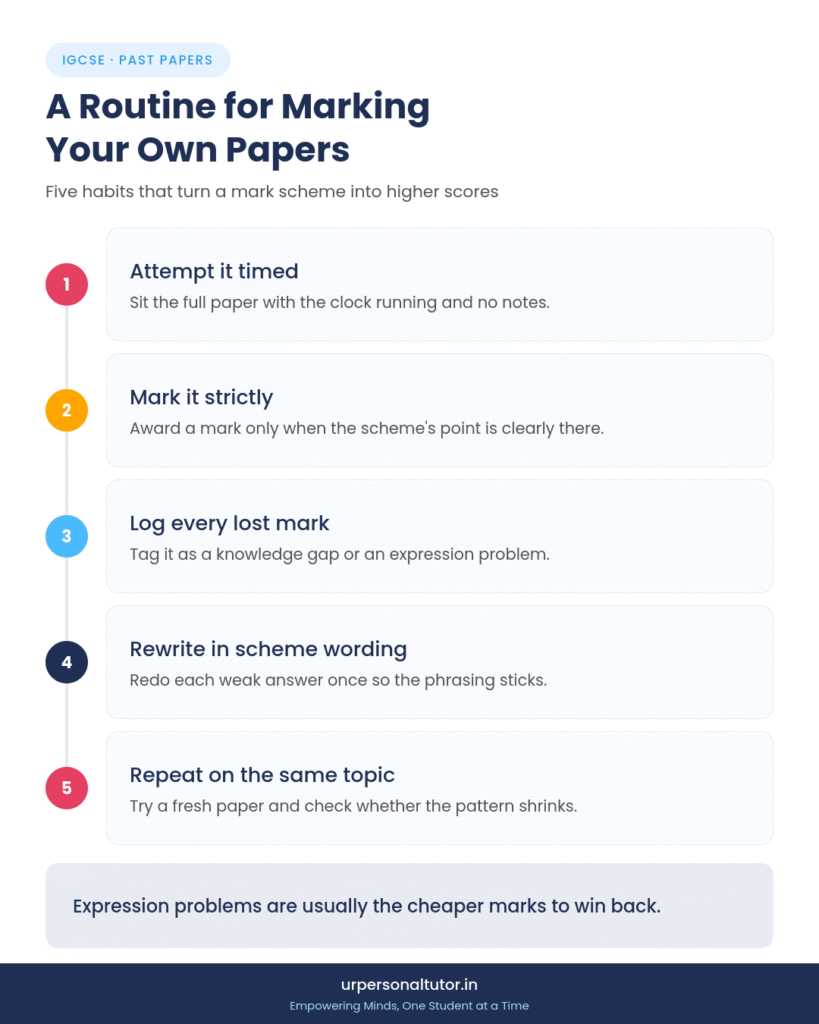
Do the paper under timed conditions, then mark it strictly with the scheme. Log every lost mark as either a knowledge gap or an expression problem. Expression problems include wrong wording, missing units and misread command words, and they are usually the cheaper ones to fix. After two or three papers the log usually points to just two or three recurring causes, not twenty different ones.
Be a harsh marker. When an answer is borderline, ask whether the examiner would have to guess your meaning. If so, no mark. Then rewrite the full answer once in the scheme’s wording so the phrasing sticks.
Common Mistakes Students Make With an IGCSE Mark Scheme
Peeking at the scheme before attempting a question defeats the point, since recall is exactly what you are training. Marking generously is just as damaging. If your answer says the right thing loosely and the scheme wants a specific term, that is a lost mark, and pretending otherwise only hides the gap until the real exam.
Some students also memorise scheme answers word for word. Questions change from paper to paper, so what transfers is the pattern of what earns marks, not a script.
When to Start Using Mark Schemes in Your Revision
Start earlier than feels necessary. Mark schemes help from the first topic tests of the course, not just in the final month. A sensible pattern is closely marked topic questions during the term, then full timed papers marked the same way once the content is covered. A 12-week revision plan, for instance, can put topic practice in the first half and full papers in the second, with the 12-week revision plan timing the switch.
Ready to Find Your Lost Marks?
Using an IGCSE mark scheme well is a skill, and it is far quicker with someone checking your marking and spotting the patterns you miss. If you’d like help building a routine around your own papers, book a session with Ur Personal Tutor or browse more exam guides on the blog.
Frequently Asked Questions
Where can I find a Cambridge IGCSE mark scheme?
Cambridge publishes mark schemes alongside past papers on its website, and schools can also reach them through Cambridge’s school portal. If a very recent series is not public yet, your teacher can usually help.
Why do different paper variants have different mark schemes?
Cambridge sets several variants of the same paper, each with its own questions. The two-digit paper code shows which one you have, so 22 means Paper 2, variant 2. Always pair your paper with the scheme carrying the same code.
What is the difference between a mark scheme and an examiner report?
A mark scheme says what earns marks. An examiner report explains how candidates actually performed, including common errors and advice. Reading both for the same paper is a strong combination.
Does a mark scheme help with practical and alternative-to-practical papers?
Yes. On papers that test practical skills, the scheme shows which observations, readings, graph features and conclusions earn credit, so it deserves the same careful marking as a written paper.
Can I use an IGCSE mark scheme from a different exam board?
Not reliably. Cambridge and other boards offering IGCSEs each use their own marking conventions and abbreviations. Stick to the scheme from the board that sets your paper.