
Good GCSE physics revision notes are built around recall, not copying. Notes that simply restate the textbook in slightly shorter sentences feel productive but rarely help on exam day, because reading and rewriting content is a passive activity. The notes that actually raise marks are the ones written in a student’s own words, organised by topic, and tested regularly rather than just reread.
That’s the short version. The rest of this guide covers how to structure notes properly, which methods work best for physics specifically, and how to avoid the mistakes that quietly waste revision time.
How to Structure GCSE Physics Revision Notes by Topic
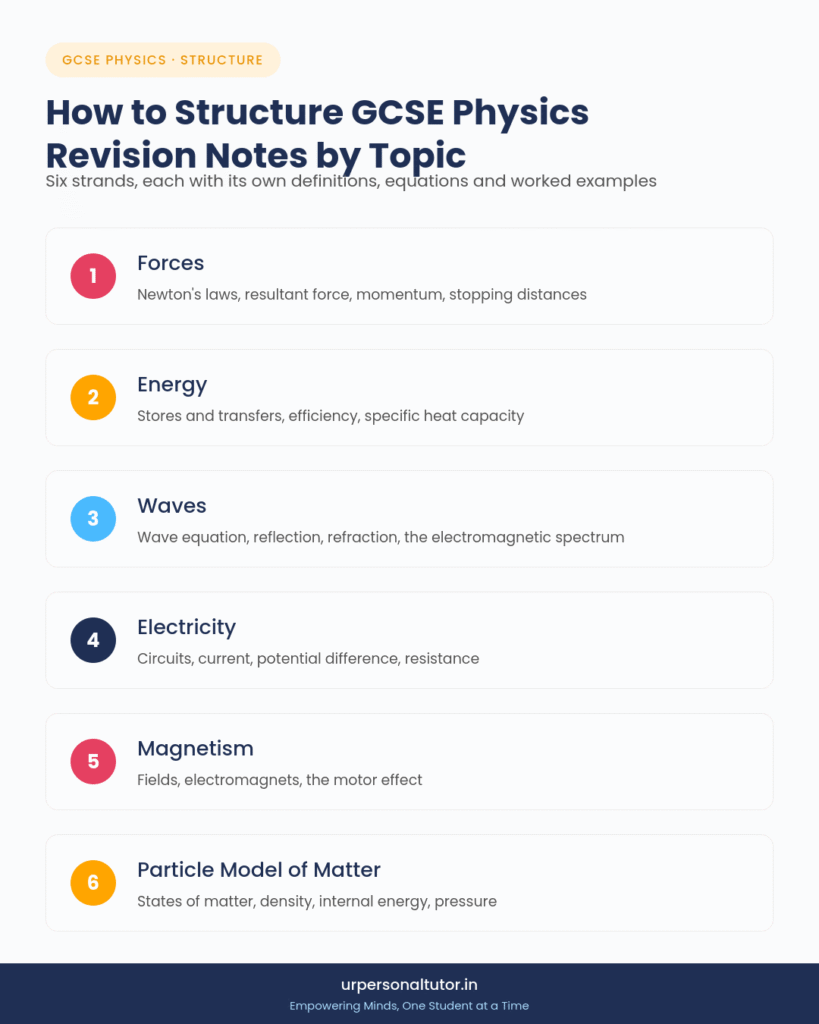
Physics rewards a topic-first structure more than a chronological one. Rather than following the order topics were taught in class, group GCSE physics revision notes under the specification’s main strands: forces, energy, waves, electricity, magnetism, and particle model of matter. Each strand should get its own section with key definitions, core equations, and two or three worked examples.
Starting from the actual physics syllabus rather than a textbook’s chapter order makes this easier, since exam boards weight topics differently and the syllabus shows exactly what each strand expects a student to know.
Within each topic, keep three consistent sections: definitions, equations, and common exam question types. This consistency matters more than students expect. When every topic follows the same internal layout, flipping between them during revision becomes automatic instead of requiring a mental reset each time.
Cornell Notes vs Mind Maps for GCSE Physics
Two formats dominate GCSE physics notes, and each suits a different kind of content. Cornell-style notes, with a narrow cue column beside the main notes and a summary strip at the bottom, work well for equation-heavy topics like electricity and forces, since the cue column becomes a natural self-test. Mind maps suit connected, conceptual topics like the particle model or energy transfers, where seeing relationships between ideas matters more than memorising a formula.
Mixing both within the same notebook is fine. Trying to force one format across every topic usually produces weaker notes than matching the format to what the topic actually needs.
Turning GCSE Physics Revision Notes Into Active Recall Practice
Notes only pay off once they’re tested, not just reviewed. A simple weekly habit works well: write the notes on Monday, then close the notebook and try to reproduce each section from memory by Thursday. The gaps that show up during that blank-page recall are the exact areas that need another pass, and they’re far more reliable indicators than “this feels familiar” while rereading.
Timed past-paper questions sharpen this further. Working through past papers organised by topic after finishing a set of notes shows whether the notes actually hold up under exam-style phrasing, which often differs from how a textbook explains the same idea.
Flashcards work as a lighter version of the same principle, particularly for equations and defined terms, though they shouldn’t replace full written recall for longer explain-style answers.
Common Mistakes Students Make With GCSE Physics Revision Notes
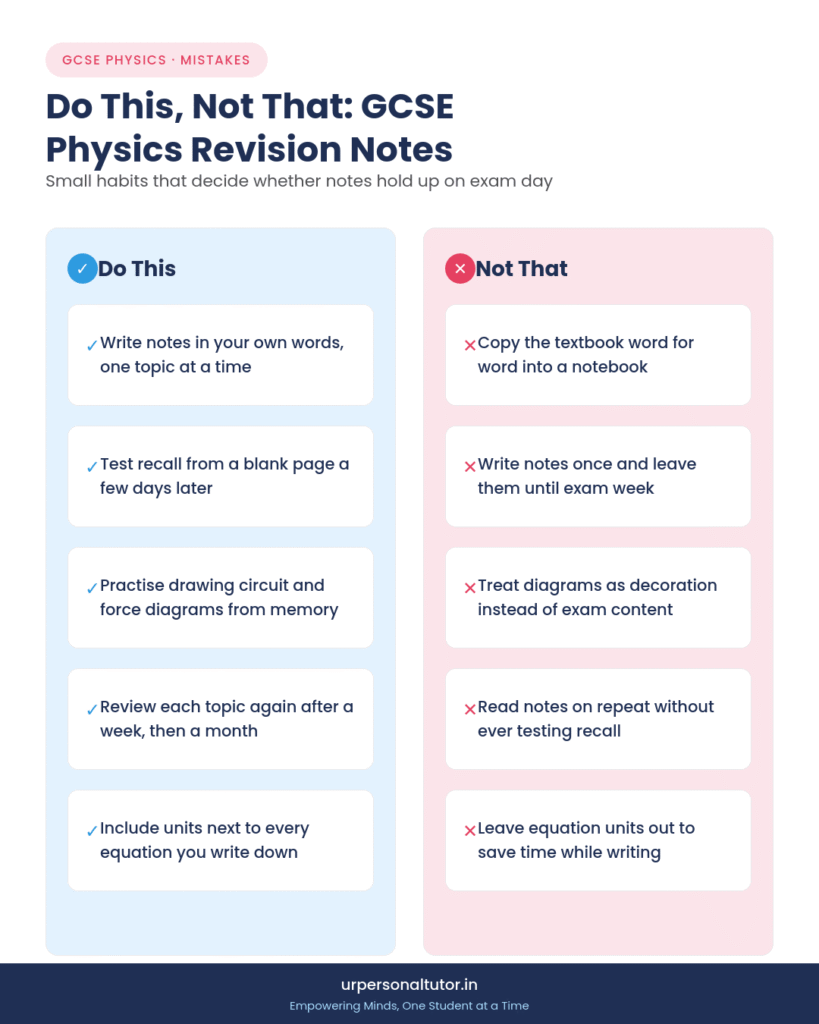
The most common mistake is copying directly from the textbook or slides without rephrasing. Notes copied word for word feel thorough but skip the step where understanding actually forms, since rewriting something in your own words forces the brain to process it rather than transcribe it.
A second mistake is writing notes once and never revisiting them until the week before exams. Physics concepts fade faster than students expect, especially formula-heavy topics, so a note written in October needs at least one refresh before December, not a single read months later.
A third mistake is treating diagrams as decoration rather than content. Circuit diagrams, ray diagrams, and force diagrams often carry as much exam value as the written explanation next to them, and skipping practice at drawing them from memory leaves marks on the table.
Building a Revision Guide You’ll Actually Use
A full GCSE physics revision guide doesn’t need to be elaborate. A ring binder or a single well-organised notebook, split by strand with consistent formatting, beats a scattered collection of loose pages every time. The goal isn’t volume. A tightly organised set of notes that gets reviewed weekly outperforms a much longer set that gets written once and forgotten.
Colour coding can help here too, as long as it’s kept simple. One colour per strand, used consistently across definitions, equations, and diagrams, makes flipping through notes during a quick pre-exam review much faster than plain black and white pages.
How Long Before Exams Should You Start
Most students get the best results starting structured revision notes around six to eight months before exams, not the final few weeks. This gives enough time to write notes, test them through recall, identify weak topics, and revisit those topics more than once. Starting late compresses all of that into cramming, which produces short-term recognition but weak long-term recall, exactly the opposite of what an exam under pressure requires.
Frequently Asked Questions
Should GCSE physics revision notes include past exam questions?
Yes, but as a separate testing step rather than mixed into the notes themselves. Keep notes focused on explanation and recall, then use past questions afterward to check whether the notes actually translate into exam performance.
How detailed should equation sections be?
Include the equation, the meaning of each symbol, correct units, and one worked example. Skipping units is a common reason marks get lost even when the underlying physics understanding is correct.
Is it better to write notes by hand or type them?
Handwriting tends to help retention more for physics specifically, since diagrams and equations are easier to sketch and annotate by hand than to format digitally. Typed notes work fine for text-heavy topics but struggle with diagram-based ones.
How often should notes be reviewed once written?
A rough rule that works for most students: review within 48 hours of writing, again after a week, and again after a month. This spacing matches how memory naturally fades and rebuilds.
Can revision notes replace textbook study entirely?
No. Notes work best as a condensed, testable summary of material already studied properly, not a replacement for working through the textbook or class material in the first place.