
The most effective way to use IGCSE physics past papers is to work through them topic by topic, not year by year. Pulling every electricity question from the last ten years and doing them back to back shows you exactly where your understanding breaks down, in a way that a full mixed paper never can. A full past paper tells you your overall score. Topical past papers tell you why that score is what it is.
That distinction matters more than most students realise. If you’re prepping for CAIE syllabus 0625, chances are you’ve already been told to “do past papers.” Fewer people explain that the order you do them in changes how useful they are. A structured 12 week revision plan usually builds topical practice in first, then moves to full timed papers closer to the exam, and there’s a reason for that sequencing.
Grades in IGCSE physics aren’t decided by how many topics you’ve covered. They’re decided by how consistently you apply the right method under exam conditions, and that consistency comes from repetition within a single topic before you mix everything together. Understanding the IGCSE grading system helps explain why: a few repeated errors in one area, say incorrect unit conversions in the mechanics section, can cost more marks across a paper than one entirely unfamiliar topic.
Why Sort IGCSE Physics Past Papers by Topic Instead of By Year
A full past paper mixes forces, waves, electricity, and thermal physics into one 75-minute sitting. That’s realistic exam practice, but it’s a poor diagnostic tool. If you score 62% on a mixed paper, you know something went wrong. You don’t know what.
Topical past papers isolate the variable. Do fifteen questions on moments and equilibrium in one sitting, and the pattern becomes obvious fast. Maybe you’re fine with the theory but keep forgetting to state units. Maybe you consistently misread diagrams showing pivot points. That kind of specific, repeated error is invisible in a mixed paper because you only see one moments question buried among twenty others.
This is why most experienced tutors recommend topical practice for the middle stretch of revision, roughly weeks four through nine of a longer plan, before switching to full timed papers. Students moving between exam boards sometimes ask how this compares to GCSE vs IGCSE revision approaches, and the honest answer is the topic-first method holds regardless of board. Topic-wise practice builds accuracy. Full papers build stamina and exam management. You need both, but not at the same time.
Where to Find IGCSE Physics 0625 Topical Past Papers
CAIE (Cambridge Assessment International Education) publishes the raw past papers by year and session on its official website, but they aren’t sorted by topic in that format. You’ll typically find IGCSE physics topical past papers through three routes.
Several exam-focused websites compile CAIE’s raw papers and re-sort every question by syllabus topic, cross-referencing the mark scheme so each question sits with its correct answer. This is the most common route students use, and it’s usually free or low-cost.
Tuition centres and individual tutors often maintain their own topic-sorted question banks, refreshed each year as new sessions are released. These sometimes include annotated mark schemes that flag common student errors, which raw CAIE papers don’t provide.
School physics departments occasionally distribute internally compiled topical sets, particularly for schools that have taught the 0625 syllabus for several years and have built up their own archive.
Whichever source you use, check two things before relying on it: that it covers the current syllabus version (0625 has had minor content updates over the years), and that the mark scheme is the official CAIE one, not a paraphrased version that might not match how examiners actually award marks.
A Practical Method for Working Through Topical Past Papers
There’s no need to complicate this. The method that works is simple, but most students skip parts of it.
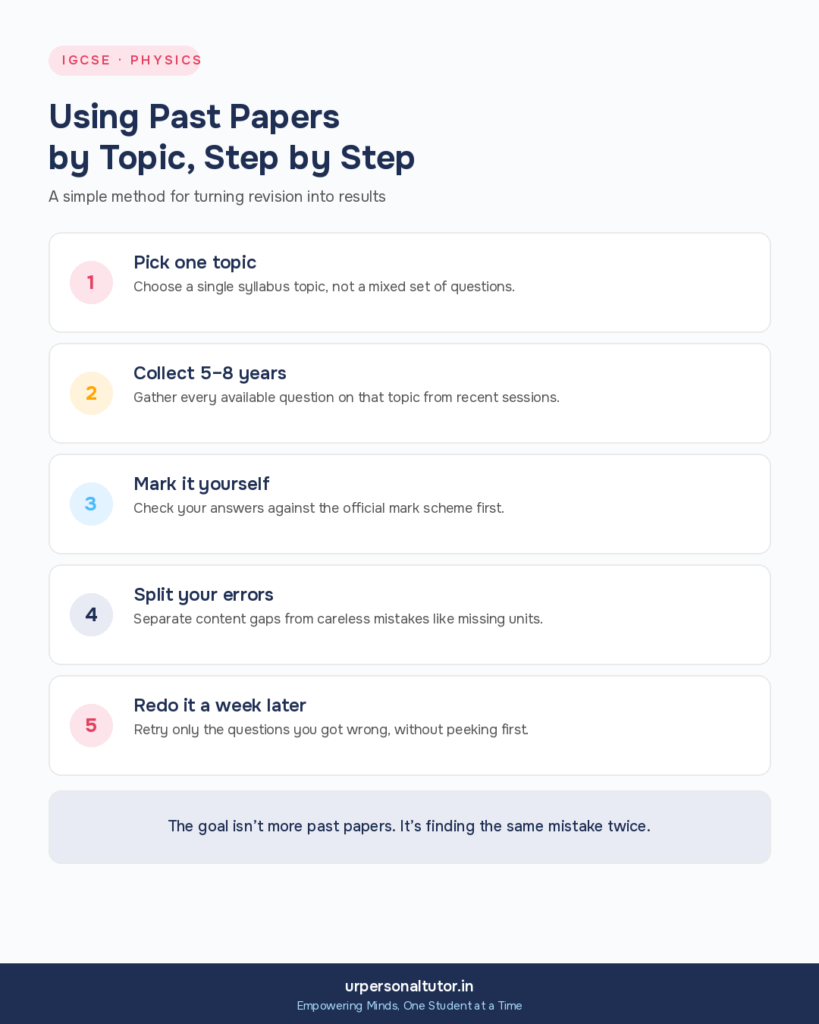
Pick one topic. Do every available question on that topic from the last five to eight years, not just the most recent one. Older papers sometimes phrase questions differently, and that variation is useful; it stops you from pattern-matching to a familiar question style instead of actually understanding the physics.
Mark your own work against the official mark scheme before checking any worked solution or asking anyone else. This step gets skipped constantly, and it’s the one that builds the skill you actually need in the exam room: knowing whether your own answer is right without someone telling you.
Once marked, separate your errors into two categories. Errors where you didn’t know the physics, and errors where you knew it but lost marks anyway, wrong units, missing working, a rushed final line. The second category is usually larger than students expect, and it’s the easiest to fix because it’s not about learning new content. It’s about tightening how you write answers.
Redo only the questions you got wrong, a week later, without looking at your previous answers first. If the same mistake shows up twice, that’s your actual weak point, not the topic you assumed was weak.
Common Mistakes Students Make with IGCSE Physics Past Papers
The biggest mistake isn’t skipping past papers. It’s doing them too early, before the underlying content is secure, and mistaking a low score for “I need more past papers” instead of “I need to revisit this topic in my notes first.” Past papers test application. They can’t teach you content you haven’t learned yet.
The second mistake is only ever checking the final answer, not the mark scheme’s method breakdown. IGCSE physics awards marks in stages: for the correct formula, correct substitution, correct working, and correct final answer with units. A student who gets the final number right but skips the substitution step on paper is still losing marks in a real exam, even though their answer “looks correct” when self-checking casually.
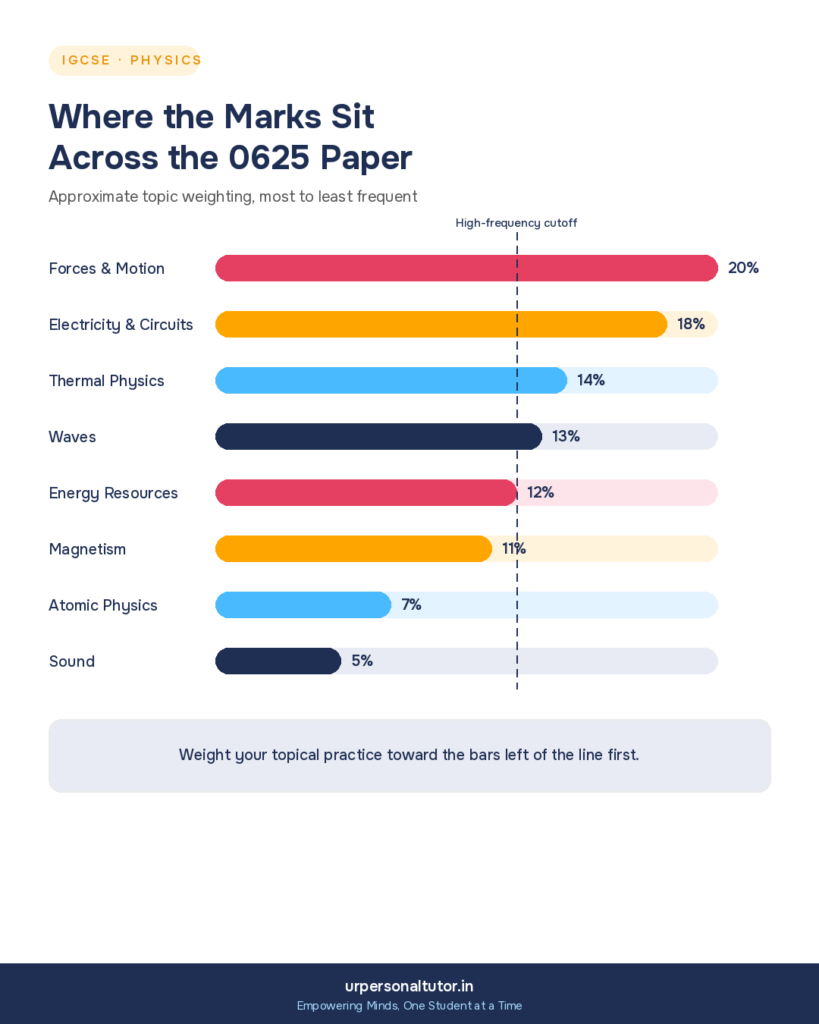
The third is treating every topic as equal, when they’re not. Some topics, particularly electricity and forces, appear more frequently and carry more marks across a typical 0625 paper than smaller topics like sound. If you have limited time before the exam, weighting your topical past paper practice toward the higher-frequency topics is a reasonable, deliberate choice, not corner-cutting, something one-to-one physics tuition can help calibrate to your specific exam date.
Bringing It Together
Past papers only work as a revision tool if you use them the way they’re designed to be used, and for most of the run-up to your exam, that means sorted by topic, not by year. Isolate the topic, mark it properly, separate content gaps from careless errors, and only move to full timed papers once individual topics feel solid. Get in touch if you’d like help building a topical revision plan around your actual exam date.
FAQs
How many years of IGCSE physics past papers should I use for topical practice?
Five to eight years is usually enough to see the range of ways a topic gets examined, without the exercise becoming repetitive. Going back further than ten years risks practising against an older syllabus version with different content weighting.
Should I time myself on topical past paper questions?
Not initially. The first pass through a topic should focus on accuracy and method, not speed. Timing becomes useful once you’re comfortable with the content and start doing full mixed papers, where pacing across the whole 75 minutes matters.
Can topical past papers replace full past papers entirely?
No. Topical practice fixes specific weak areas, but it doesn’t train you for the mental switching between topics that a real exam demands, or for managing your time across a full paper. Both types of practice serve different purposes and neither substitutes for the other.
Is it worth using topical past papers from other CAIE physics syllabuses, like A-Level, for extra practice?
Generally not for core revision. The 0625 syllabus has its own defined content boundaries, and A-Level physics questions often assume knowledge outside that scope. It can create confusion about what’s actually examinable rather than adding useful practice.