
IGCSE Math Syllabus at a Glance
The Cambridge IGCSE math syllabus (code 0580) has nine topic areas and two tiers. Core is aimed at grades C to G. Extended is aimed at grades A* to E and covers everything in Core plus harder material. Either way, you sit two externally marked papers, one without a calculator and one with, and there is no coursework.
Students often search for the IGCSE math syllabus expecting a simple topic list. The reality is a little more layered, because the tier you sit changes both the content and the ceiling on your grade. This guide walks through the topics, the paper structure and the practical differences, so you can plan revision around what is actually examined.
Everything below follows the revised syllabus used for the 2025, 2026 and 2027 exam series. If you are entered for a different year, check the Cambridge page for that series, because paper lengths changed in the revision.
The Nine Topics in the Cambridge IGCSE Maths Syllabus
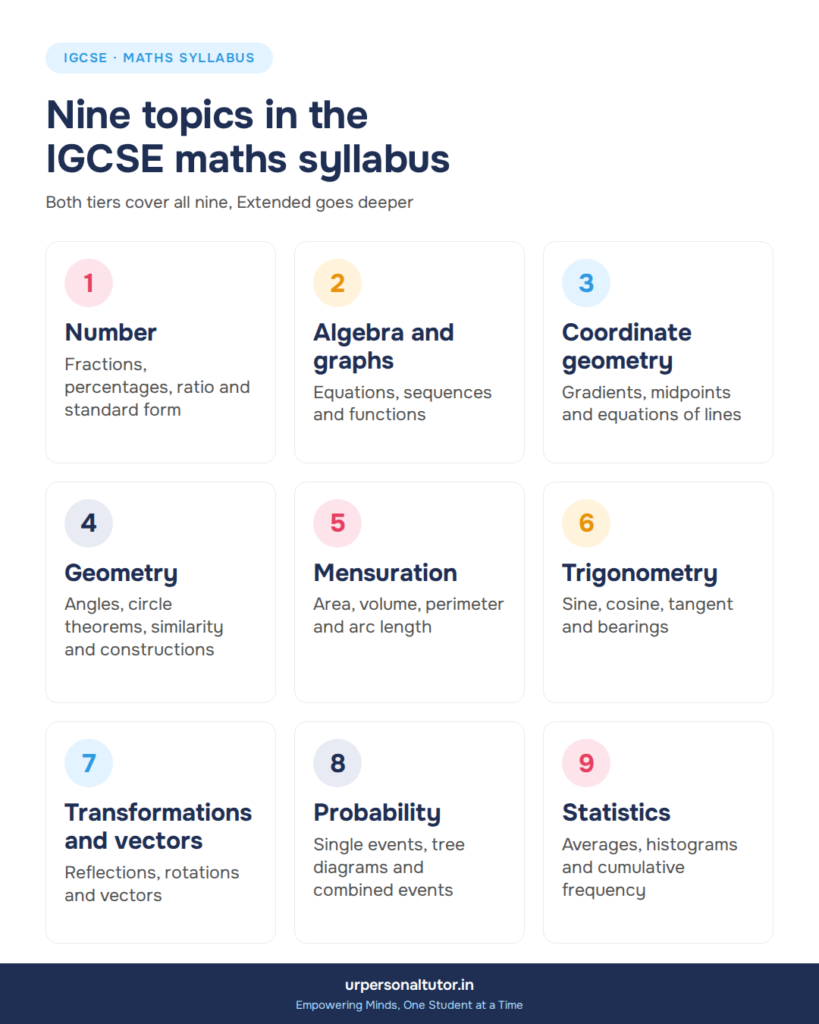
Cambridge groups the content into Number, Algebra and graphs, Coordinate geometry, Geometry, Mensuration, Trigonometry, Transformations and vectors, Probability and Statistics. Here is what each cluster looks like in practice.
Number, Algebra and Graphs
Number covers fractions, percentages, ratio, standard form and bounds, and it quietly supports every other topic. Algebra and graphs is the largest block of the IGCSE math syllabus, and it is where tier differences show up most clearly. Expect equation solving, sequences, inequalities, functions and the graphs that go with them. Extended adds surds, domain and range for functions, and an introduction to differentiation.
Geometry, Mensuration and Trigonometry
Geometry starts with angle facts and constructions. Core brings in basic circle properties, and Extended adds the full set of circle theorems. Mensuration is about perimeter, area and volume, with Core working on cuboids, prisms and cylinders and Extended adding pyramids, cones and spheres. Trigonometry begins with right-angled triangles, Pythagoras and bearings. Extended goes further with the sine rule, the cosine rule and problems in three dimensions.
Transformations, Vectors, Probability and Statistics
Transformations means translation, reflection, rotation and enlargement. Core now includes adding and subtracting vectors, while Extended pushes into vector geometry. Probability stays with single and combined events in Core, and Extended brings in conditional probability. Statistics gives Core students averages and charts, and Extended students get histograms, cumulative frequency and box-and-whisker plots.
IGCSE Extended Maths Syllabus vs Core: What Actually Changes
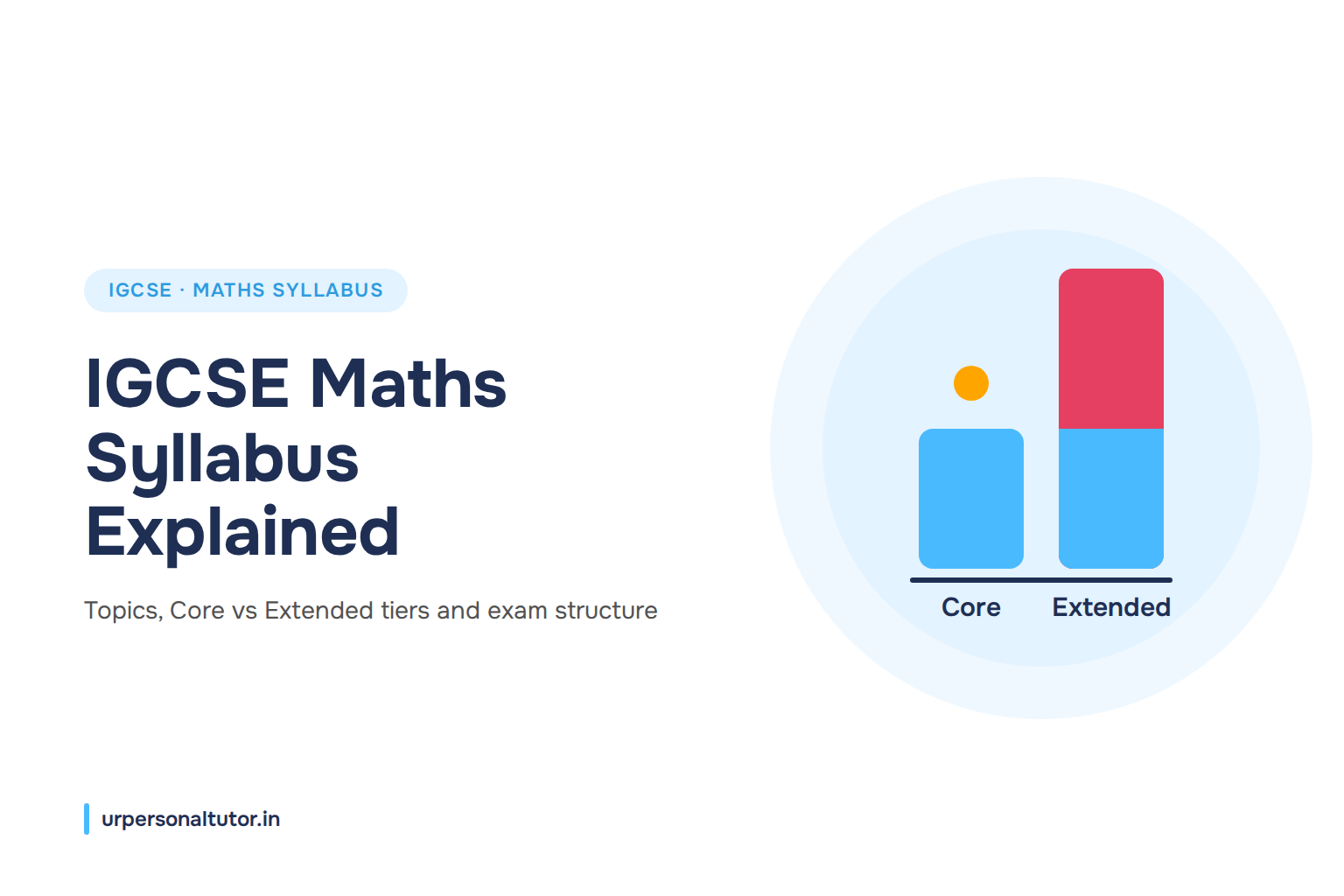
Extended includes all of the Core content and then adds more depth and extra topics. The grade ranges follow the IGCSE grading system, so a Core candidate cannot score above a C however well the papers go, while an Extended candidate can reach A* but risks an ungraded result if the paper goes badly.
Within the IGCSE math syllabus, the Extended tier adds growth and decay, linear programming, surds, functions with domain and range, conditional probability and vector geometry. None of these are exotic on their own. The jump comes from how often they are combined into longer, multi-step questions.
Choosing between the two tiers of the Cambridge IGCSE maths syllabus is a judgement about your current level and your next step, not about ambition. Extended is usually the right call for students aiming at grade B or above, or planning to continue to A Level Maths. Core suits students who want a secure pass and a solid base without the extra algebra load.
IGCSE Maths Exam Structure: Papers, Marks and Timing
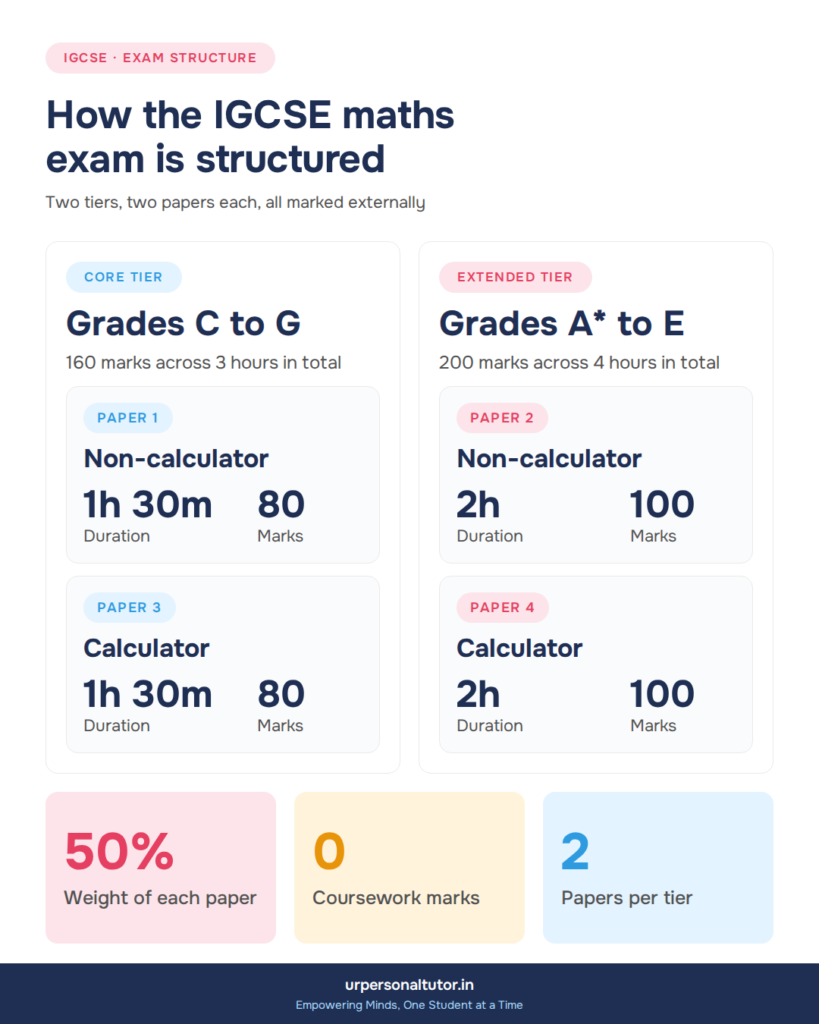
The exam structure of the Cambridge IGCSE maths syllabus is simple to describe and easy to underestimate. Each tier has two papers worth 50 percent each. The first paper in each tier is non-calculator, which surprises students who rely on their calculator for every fraction.
| Tier | Paper | Calculator | Duration | Marks |
|---|---|---|---|---|
| Core | Paper 1 | No | 1 hour 30 minutes | 80 |
| Core | Paper 3 | Yes | 1 hour 30 minutes | 80 |
| Extended | Paper 2 | No | 2 hours | 100 |
| Extended | Paper 4 | Yes | 2 hours | 100 |
That makes 160 marks in total for Core and 200 for Extended. The longer Extended papers also mean more time to think, but not proportionally more, so pacing matters. Both tiers are assessed entirely by written papers marked by Cambridge, with no coursework to cushion a weak exam day. Questions mix routine technique with problems set in unfamiliar contexts, so knowing a method is only half the job. You also need to spot which method a question is quietly asking for.
Where Students Lose Marks Despite Knowing the IGCSE Math Syllabus
Knowing the IGCSE math syllabus on paper and scoring well on it are not the same thing. The usual culprits are arithmetic slips on the non-calculator paper and algebra that goes wrong on line three and carries the error through the whole answer. Another leak is final answers with no working, which costs method marks even when the answer is right.
Algebra is behind most of it, because it sits underneath almost everything else in the course. That is exactly the kind of gap IGCSE tuition closes quickly, since a tutor can see the exact line where the method breaks instead of guessing from a wrong final answer.
Using the IGCSE Math Syllabus as a Revision Checklist
The official syllabus lists every learning outcome, and it is the most honest revision guide you have. Print the section for your tier and mark each outcome red, amber or green. Red outcomes get attention first, however uncomfortable they feel.
Extended students should check their Core outcomes before touching Extended-only content, since Core material shows up inside harder questions all the time. A shaky fraction method will sink a surds question just as easily as it sinks a Core one. Then work through past papers topic by topic rather than as full papers at the start, so you can see which outcomes keep costing marks.
Ready to Build a Maths Plan That Fits Your Tier?
Knowing the IGCSE math syllabus is only the start. Turning it into a schedule you can actually follow, with the right balance of Core foundations and Extended stretch, is where most students need help. If you would like a plan built around your own gaps, book a session with Ur Personal Tutor or explore more guides on the blog.
Frequently Asked Questions
Is the IGCSE math syllabus the same as GCSE maths?
No. UK GCSE maths uses Foundation and Higher tiers and numeric grades, while the Cambridge IGCSE uses Core and Extended tiers. The topics overlap heavily, but the paper structures and grading differ.
What is the difference between IGCSE Mathematics 0580 and 0980?
Code 0580 reports grades from A* to G. Code 0980 is the 9 to 1 graded version of the Cambridge IGCSE. Ask your school which code you are entered for, since the grade scale on your certificate depends on it.
Can I change from Core to Extended partway through the course?
Your school enters you for a tier when it submits exam entries, usually months before the exam. You cannot sit both, so raise the question with your teacher early rather than at the last moment.
How long does it take to cover the whole syllabus?
Most schools teach it over two years. For the final run-up, a 12-week revision plan gives enough time to revisit every topic at least twice without cramming.
Are formulas given in the exam?
Cambridge provides a formula sheet for Core papers and a separate one for Extended papers. Learn what is on yours so you do not waste revision time memorising formulas you will be handed.