
CBSE Class 12 Syllabus: Can You Really Revise It All in 90 Days?
Yes, but only if you stop treating every chapter as equal. Ninety days is enough to revise the full CBSE Class 12 syllabus once, properly, and the high-scoring parts a second time. It is not enough to reread every textbook page in order, which is what most students attempt and why most of them finish one subject well and rush the rest.
The timing works better than it sounds. CBSE theory papers have started in mid-February in recent years, and the 2027 date sheet is still awaited, so a plan that begins in the second half of October finishes with roughly four weeks in hand. Those weeks are not spare. They absorb practicals, pre-board exams and the bad week that every student has.
What follows is the version of the plan that works for students who are still attending school. It assumes five or six subjects, a printed syllabus, and roughly five focused hours on an ordinary day. If your load is lighter or heavier, the proportions still hold. Only the pace changes.
What the Revised Syllabus of Class 12 CBSE Actually Changes
CBSE published the 2026-27 syllabus on 1 April 2026, and it keeps the shape of recent years: a single annual exam with no term split, internal assessment sitting beside theory, and a clear lean toward application and competency-based questions instead of plain recall. The CBSE Class 12 curriculum is revised every session, so “new” usually means small edits to a familiar course.
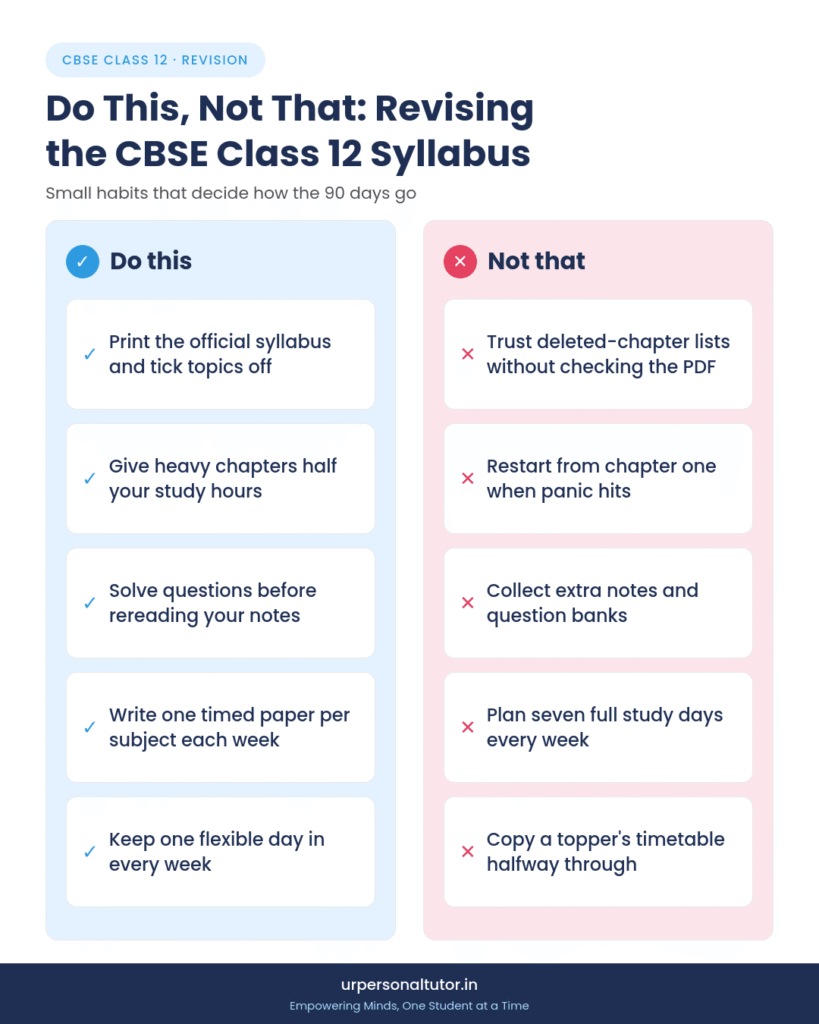
That is also why sources disagree. Some coaching sites publish long tables of deleted chapters while others report no cuts at all. If a page promises the CBSE new syllabus Class 12 with a neat list of removed topics, cross-check it against the subject PDF on the board’s academic website before dropping anything. Download that PDF and print it. A printed checklist you tick off will still be useful on day 70, when a mental one has long since blurred.
Sort the CBSE Class 12 Syllabus by Marks Before You Revise Anything
Marks decide where your hours go. Most theory papers carry 80 marks with 20 for internal assessment, while science subjects with practicals usually split 70 for theory and 30 for practicals. Those internal and practical marks come from files, projects and viva preparation, so confirm that record work is under control before day one. Nothing in a 90-day plan can recover it later.
Treat the Class 12 CBSE board syllabus as a marking map instead of a reading list. Sort each subject’s chapters into three piles: heavy chapters that appear in every paper and take real effort to relearn, medium ones you mostly remember, and short low-mark chapters you can finish in one sitting. Give the heavy pile about half your hours and the medium pile about a third. The short chapters share what is left.
A quick example shows how this plays out. In Physics, Current Electricity is a heavy chapter for most students because it mixes theory with long numericals, while a short chapter such as Communication Systems can be revised in an evening. In Maths, Integrals is a heavy pile on its own, since every later application depends on it. Your piles will differ, and that is the point. Two students with the same marks target can have completely different heavy chapters.
The 90-Day Plan for the CBSE Class 12 Syllabus
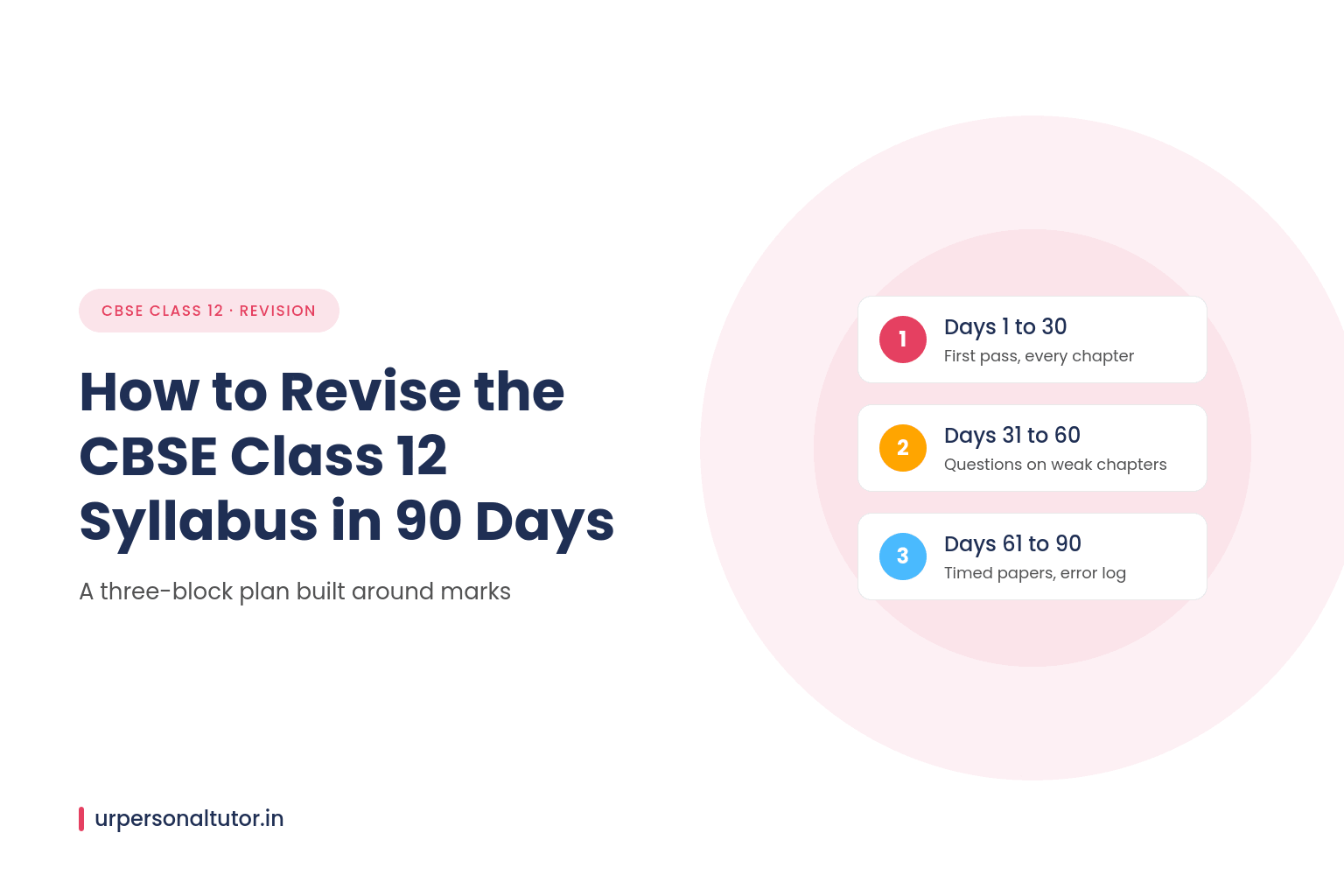
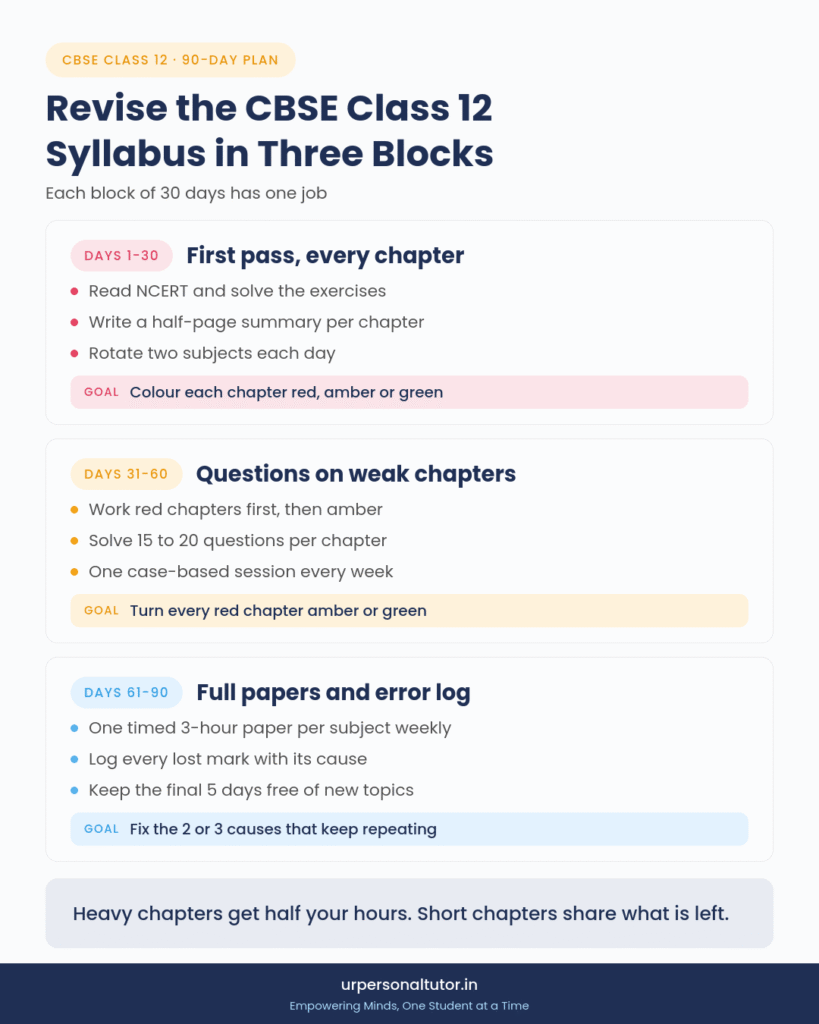
The plan runs in three blocks of thirty days. Each block has one job, and the job changes as the exam gets closer.
Days 1 to 30: One Honest Pass Through the CBSE Class 12 Syllabus
Read the NCERT chapter, solve its examples and exercise questions, and write a half-page summary of formulas, reactions, dates or key terms. Do not stop to perfect anything. The point is to find out which chapters actually feel shaky, because that list steers the next sixty days. Rotate two subjects a day so none goes cold for more than a couple of days.
By the end of this block, colour each chapter on your printed checklist: red if you could not solve its basic questions without the book, amber if you needed hints, green if it came back easily. Be strict. Most students rate themselves one shade too kind.
Days 31 to 60: Question Practice on the Weak Chapters
Revision without questions is recognition, and recognition fails under exam pressure. Work red chapters first, then amber, using exam-style questions instead of rereading. For Physics, solving chapter-wise important questions in short daily sets shows quickly which derivations and numericals you can reproduce cold. Maths and Chemistry respond to the same treatment: fifteen to twenty questions per chapter, checked against the solution the same day.
Give case-based and assertion-reason questions their own weekly session, because the paper now rewards application. Do this even for subjects you feel safe in. Safe subjects are where students lose marks to unfamiliar question styles.
Days 61 to 90: Full Papers and an Error Log
Move to timed three-hour papers, one per subject each week, written in exam conditions. After every paper, log each lost mark with a one-line cause: concept gap, calculation slip, misread question or unfinished paper. By the third week, the same two or three causes keep reappearing. Those are the last targets.
Keep the final five days free of new material. Reread summary sheets and the error log, and sleep properly.
Fitting the CBSE Class 12 Syllabus Into a Normal School Week
A plan only survives if it fits a week that already has school, tuition and the occasional family function in it. Use six study days and keep one flexible. On weekdays, give the first and longest session to the heaviest subject of the day while your head is clear, and keep a lighter subject for the evening. Saturdays work well for catching up on whatever slipped, and Sundays for one timed paper or a block of mixed questions.
The flexible day matters more than it sounds. Students who plan seven full days usually abandon the plan in week three, the first time something goes wrong. Students who plan six keep going, because a missed day has somewhere to land. Treat the CBSE Class 12 syllabus as a ninety-day commitment, not a ninety-day performance, and a lost afternoon stops being a crisis.
How to Revise Each Subject Group Without Rewriting the Textbook
Revising the CBSE Class 12 syllabus across five or six subjects means each paper needs a slightly different method. A single technique applied everywhere is how time disappears.
Maths and the Sciences
These subjects are problem-led, so revise them by solving. Keep one formula page per chapter and attempt questions before you check it. In Physics, derivations deserve separate attention because the board asks for them again and again. In Chemistry, learn named reactions and mechanisms from the reaction itself rather than from a table, since a table hides the reasoning an examiner wants to see. Biology students can apply the same logic to diagrams: redraw each labelled diagram from memory once a week instead of rereading it.
English and Humanities
Recall plus structure earns marks here. For English, revise each prescribed text by writing character, theme and author’s intent in five lines apiece, then practise the writing section in full. For Humanities subjects, build answers as short point-wise paragraphs with a heading each, since long unbroken answers cost both marks and time. Dates, definitions and diagrams belong on flashcards that take ten minutes a day.
If You Are Also Preparing for JEE or NEET
A JEE and NEET preparation schedule adds another layer, because both exams draw heavily on the same NCERT chapters. Trouble starts when one syllabus gets three or four fresh hours a day and the other gets whatever energy is left. Let the board plan above decide which Class 12 chapter you are on, and have entrance practice borrow that same topic in the same week so nothing is learnt twice. Entrance-only topics can wait for weekends.
Mistakes That Quietly Waste the 90 Days
The most expensive mistake is restarting the CBSE Class 12 syllabus from chapter one every time panic arrives. Early chapters end up revised five times and the final units not at all, which is the opposite of what the paper needs.
Collecting resources is another. Three sets of notes, two question banks and a stack of handouts feel productive, yet they split attention and delay actual solving. One textbook, one question source and your own summary sheets are enough.
Quieter but just as costly is comparing yourself with toppers around day 40. Someone else’s timetable fits someone else’s gaps, and swapping plans halfway usually means losing the work already done. Adjust your own plan using your error log instead.
Want a 90-Day Plan Built Around Your Own Subjects?
A generic calendar only goes so far. A plan that reflects your red and amber chapters, your school hours and your target score changes how the ninety days of CBSE Class 12 syllabus revision are spent.
Frequently Asked Questions
Is NCERT enough to cover the CBSE Class 12 syllabus?
For theory content, mostly yes, since board questions are built from NCERT concepts and examples. Where it falls short is practice volume. Maths and Physics need extra problems beyond the exercises, and English literature benefits from reading the prescribed texts more than once.
How many hours should I study each day during the 90 days?
Five to six focused hours on school days and eight to nine on weekends suits most students who also attend school or coaching. Short breaks between subjects usually help more than squeezing in one extra hour.
What if my school has not finished a chapter yet?
Start it yourself from the NCERT text and its exercise during the first block, and note your doubts for the teacher. Leaving an unfinished chapter until the last month is the riskiest way to handle it, because there is no time left to fix what you misunderstood.
Are CBSE sample papers better than previous year papers?
They do different jobs. Sample papers show the current question format and mark distribution, so they suit the final block. Previous year papers show which concepts repeat, so they work earlier, alongside chapter practice.
Can I finish the CBSE Class 12 syllabus on this plan if I have already been revising for a month?
Yes. Colour your chapters red, amber and green today, treat the thirty days you have done as the first block, and begin question practice on the weak ones. You lose nothing as long as the checklist is honest.