
The Simplest Revision Ideas GCSE Students Actually Stick To
The best revision ideas GCSE students can use aren’t complicated. A simple slot-based timetable, built around fixed subject blocks and honest time estimates, beats an elaborate colour-coded plan almost every time. Most timetables fail not because the idea was wrong, but because they were too ambitious from day one.
This guide walks through how to build a revision timetable that survives contact with a real school week, plus practical ways to turn passive reading into genuine progress.
Why Most GCSE Revision Timetables Fail Before Week Two
Ambition is usually the problem. Students block out six-hour Saturdays and two-hour weeknight sessions, then miss one day and abandon the whole structure out of guilt. A realistic timetable accounts for tiredness, other commitments, and the fact that concentration drops sharply after 40 to 50 minutes of focused work.
Among the revision ideas GCSE students try first, the most common mistake is treating the timetable as fixed rather than flexible. Students working with structured GCSE tuition tend to adjust their timetable weekly rather than sticking to a plan that no longer fits, and that flexibility is usually what keeps a revision schedule alive past the first fortnight.
Building Your Weekly Slot-Based Timetable
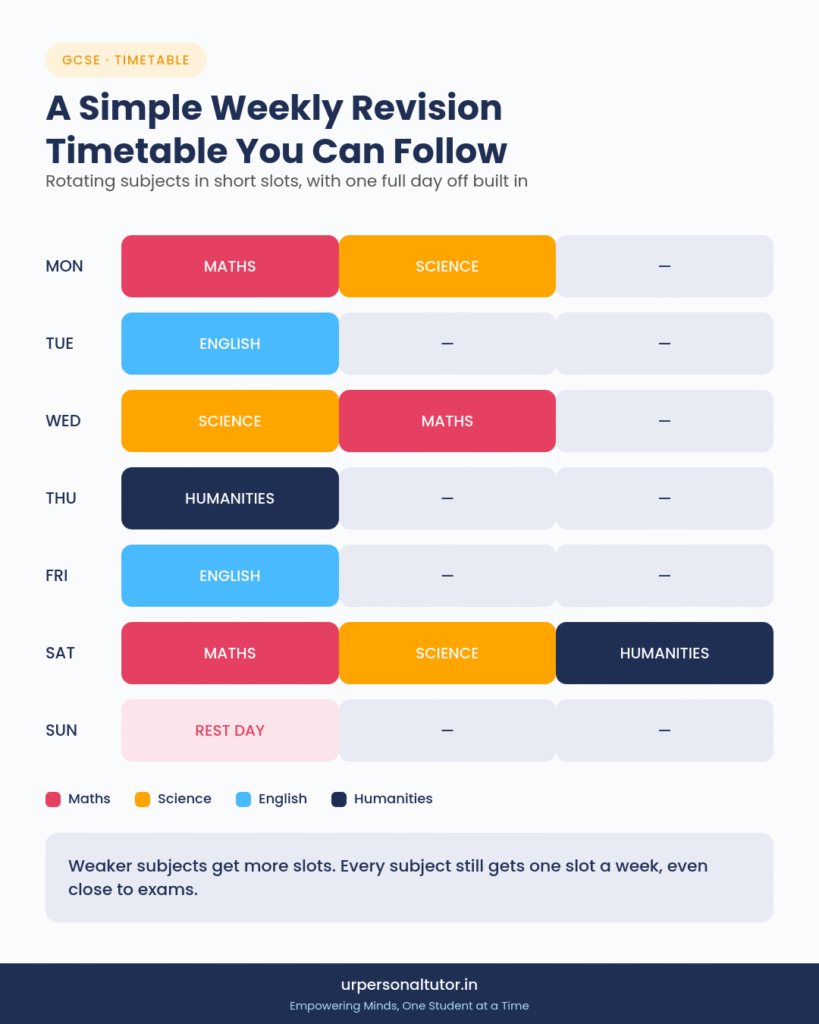
Start with total available hours, not subjects. Count actual free evenings and weekend blocks first, subtract time already used for sleep, meals, and downtime, and only then divide what’s left across subjects. Weaker subjects get more slots than strong ones, and every subject gets at least one slot a week even close to exams, so nothing goes cold.
A workable structure looks like four or five 45-minute sessions on weekdays and two or three longer blocks on weekends, with one full day off. That day off isn’t wasted time. It’s what makes the other six sustainable.
Rotating Subjects Instead of Marathon Sessions
Switching subjects every 45 to 60 minutes keeps concentration higher than sitting with one subject for three hours straight. Rotation also means a bad day in one subject doesn’t derail the whole session, since the next block is already a fresh start on something else.
Revision Ideas GCSE Students Can Use for Making Notes
Good gcse revision notes aren’t a copy of the textbook. They’re a condensed, exam-focused version built from what’s actually been forgotten during practice, not what feels comfortable to reread. Cornell-style notes, with a summary line at the bottom of each page, force that condensing to happen as the notes get written rather than months later.
For science subjects specifically, a lot of marks come down to precise recall of formulas and definitions rather than broad understanding. Keeping a running formula sheet alongside topic notes means revision time goes toward practising application instead of hunting for the right equation every time.
Turning GCSE Science Revision Notes Into Active Recall
Rereading notes feels productive but rarely is. The better test is closing the notebook and writing down everything remembered from a topic, then checking what got missed. That gap is exactly where the next revision session should focus.
Gcse science revision notes work best when paired with past paper questions on the same topic within a day or two of writing them. The combination of write, recall, then apply covers far more ground than any single method alone, and it’s one of the more reliable revision ideas gcse students report actually sticking with past the first fortnight.
How to Pass GCSE Without Burning Out
Knowing how to pass gcse subjects consistently usually comes down to spacing, not intensity. Reviewing a topic after one day, then a week, then a month, cements it far better than one long cram session close to the exam. Spaced repetition feels slower at first, since progress isn’t visible in a single sitting, but it holds up under exam pressure in a way that last-minute cramming rarely does.
Sleep and short breaks matter more here than most students expect. A tired brain forgets faster than it learns, so a revision plan that eats into sleep usually loses more than it gains.

Adjusting Your Timetable as Exams Get Closer
The right revision ideas GCSE students need in September look different from what works six weeks out from exams. Early on, the timetable should prioritise full topic coverage. Closer to exams, it should shift almost entirely to past papers, timed practice, and revisiting the specific gaps recall sessions have already flagged.
Students preparing across IGCSE boards often find a structured countdown genuinely helpful here, and a 12-week revision plan gives a useful template for how that final stretch should be weighted, even for students on a slightly different board.
Common Mistakes That Wreck a Revision Timetable
A few habits quietly undo even a well-built plan. Copying a friend’s exact timetable rarely works, since it was built around their strengths and gaps, not yours. Checking how far ahead classmates are can do more harm than good too, and it’s worth remembering why it helps to stop comparing yourself with toppers rather than measuring progress against someone else’s pace.
Another common mistake is treating revision ideas gcse students find online as a complete plan rather than raw material. A technique only works once it’s adapted to an individual subject list, energy patterns, and exam board.
Frequently Asked Questions
How many hours a day should GCSE revision take?
There’s no universal number, but two to three focused hours on a school evening and four to five on a weekend day, split across rotating subjects, is realistic for most students without crowding out sleep or downtime.
Should revision timetables be the same every week?
No. A timetable should shift as exams approach, moving from broad topic coverage early on to timed past papers and targeted gap-filling in the final weeks before exams.
What’s the difference between revision notes and class notes?
Class notes capture everything covered in a lesson. Revision notes are a condensed, exam-focused rewrite built from what’s actually been forgotten during practice, which makes them far more useful in the final weeks.
Is it normal to fall behind on a revision timetable?
Yes, and it doesn’t mean the plan has failed. A timetable that can absorb a missed day or a bad week without collapsing entirely is doing its job. Rigid all-or-nothing plans are the ones that actually break down.
How early should GCSE revision start?
Starting light topic review from the beginning of the final year, rather than waiting for study leave, spreads the workload enough that the final weeks can focus on practice instead of first-time learning.