
The CIE A Level Physics syllabus (9702) is built from 25 topics split across two stages: 11 topics at AS Level and 14 further topics that make up the full A Level. This same syllabus code covers exams sitting in 2025, 2026 and 2027, so students preparing right now are working from the version that will still be current for the 2026-27 exam series. Below is the complete topic-wise breakdown, how the papers are weighted, and where students typically lose easy marks.
What Is the CIE A Level Physics Syllabus?
Cambridge International sets the 9702 A Level Physics syllabus, and it is designed to run over two years. The syllabus expects roughly 180 guided learning hours to complete AS Level and about 360 hours for the full A Level, which works out to a genuinely content-heavy course once mechanics, fields, and quantum physics are all stacked together. Unlike some exam boards that revise their specifications every couple of years, Cambridge has kept version 1 of this syllabus unchanged since September 2022, and it applies without significant modification through the 2025, 2026, and 2027 series. That stability matters for planning. A student starting Class 11 this year and a student sitting finals next year are studying the identical topic list.
AS Level vs Full A Level: How the Syllabus Splits
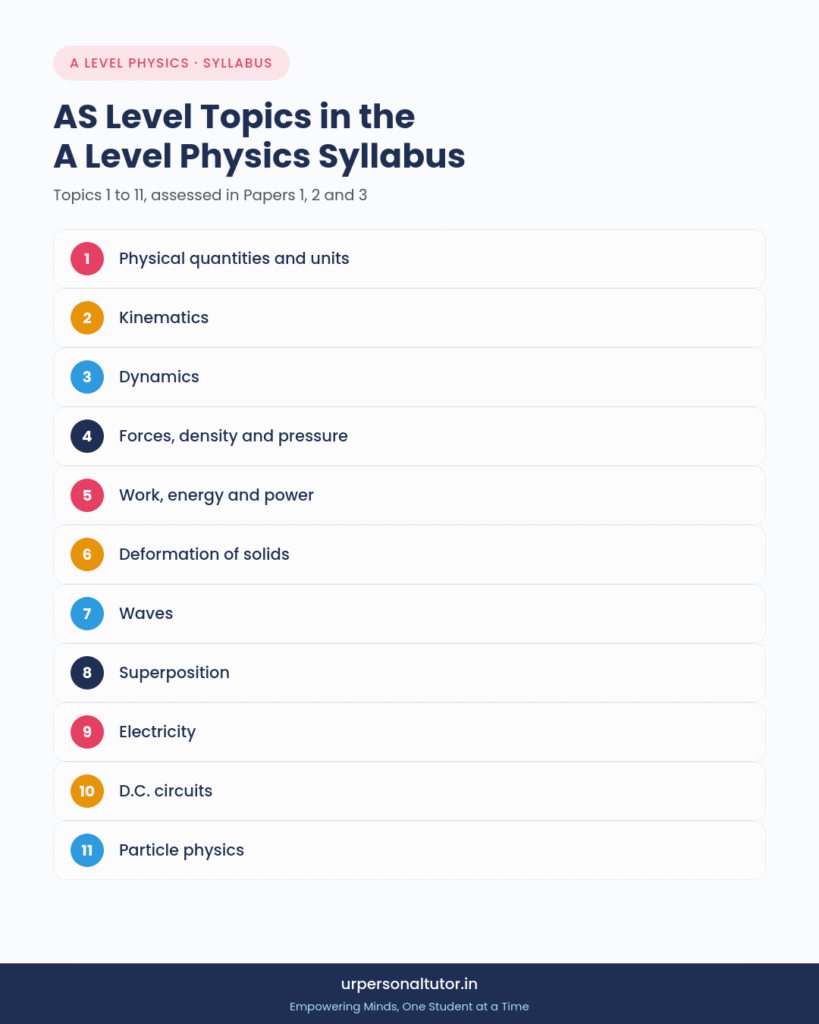
Every student following the A Level Physics syllabus studies the AS Level content first. Those 11 topics form the foundation, and they’re assessed on their own if a student is only taking AS Level, or carried forward if they continue to the full A Level in year two.
AS Level Topics (1-11)
- Physical quantities and units
- Kinematics
- Dynamics
- Forces, density and pressure
- Work, energy and power
- Deformation of solids
- Waves
- Superposition
- Electricity
- D.C. circuits
- Particle physics
A Level Only Topics (12-25)
Once AS Level content is secure, the second year adds another 14 topics that push into circular motion, fields, and modern physics.
- Motion in a circle
- Gravitational fields
- Temperature
- Ideal gases
- Thermodynamics
- Oscillations
- Electric fields
- Capacitance
- Magnetic fields
- Alternating currents
- Quantum physics
- Nuclear physics
- Medical physics
- Astronomy and cosmology
Topics 22 through 25 tend to surprise students the most, since medical physics and astronomy rarely feature in national curricula before this stage. They’re conceptually different from mechanics and circuits, so leaving them for the final weeks of revision is a common trap. It’s one of several common mistakes in A Level Physics that show up every exam season.
Cambridge A Level Physics Syllabus: Exam Structure and Papers
The Cambridge A Level Physics syllabus is assessed across five papers, and how they combine depends on whether a student is certifying at AS Level or full A Level.
Paper 1 is multiple choice, 40 questions in 1 hour 15 minutes, drawing only on AS Level content. Paper 2 is AS Level structured questions worth 60 marks. Paper 3, Advanced Practical Skills, is a two-hour lab paper testing measurement, data presentation, and analysis rather than theory recall. Students who complete only AS Level sit Papers 1 to 3.
Students continuing to the full A Level add Paper 4, a two-hour structured paper worth 100 marks that draws on both AS and A Level content, and Paper 5, Planning, Analysis and Evaluation, which tests the higher-order skill of designing an experiment and interpreting data under exam conditions rather than in a lab.
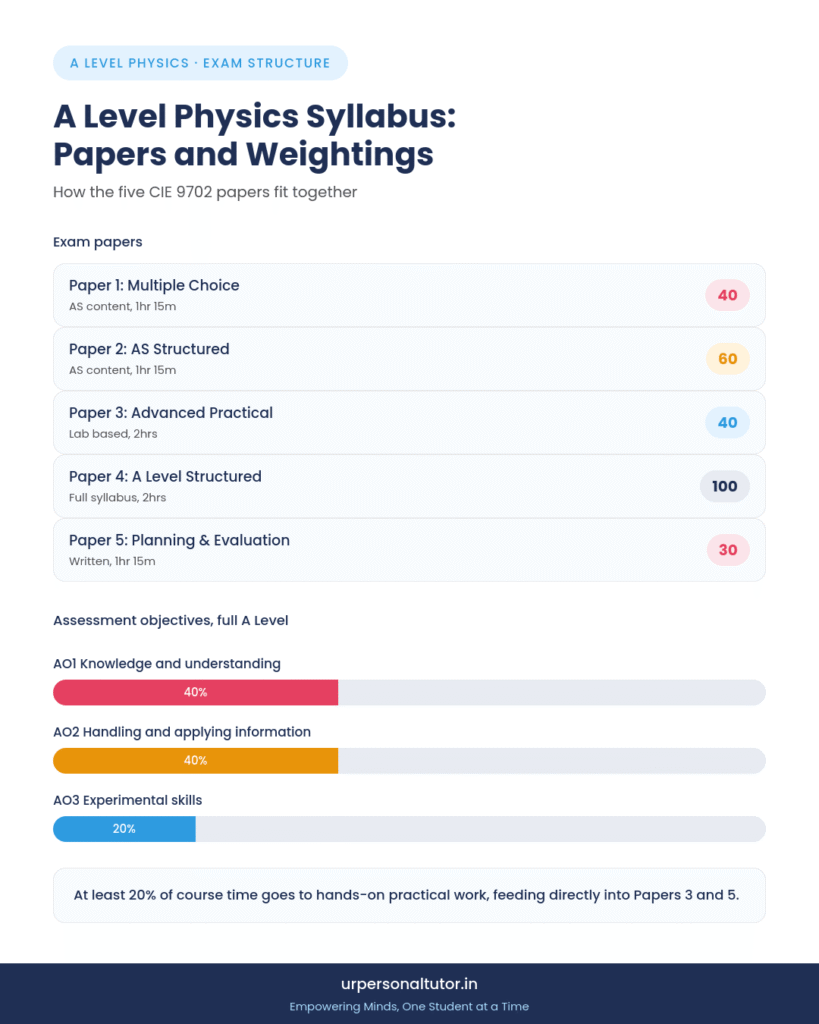
Across the full qualification, knowledge and understanding (AO1) and applying information (AO2) each carry 40% of the marks, while experimental skills (AO3) carry the remaining 20%. That last figure catches a lot of students off guard. Cambridge also expects at least 20% of total teaching time to be spent doing practical work, not watching it demonstrated, which is exactly the skill set Papers 3 and 5 are built to test.
How the IGCSE A Level Physics Syllabus Connects
The IGCSE A Level Physics syllabus progression is intentional. Several AS Level topics, including forces, energy transfers, and colour and the electromagnetic spectrum, are explicitly listed as assumed knowledge carried over from IGCSE or O Level Physics. Students arriving from a different curriculum, or from a gap year, often find the first term of AS Level moves fast precisely because Cambridge assumes that foundation is already solid rather than teaching it from scratch.
Using Topical Questions for the A Level Physics Syllabus
Revising by full past papers only tests students on whatever topics happened to come up that year. Working through topical questions for A Level Physics, meaning questions sorted by syllabus subtopic such as 13.2 or 20.3, is a far more reliable way to spot which of the 25 areas are actually weak before an exam does it for you. It also matches how the syllabus itself is structured: every topic is broken into numbered subsections with precise, testable learning outcomes, so a topical bank of questions maps cleanly onto gaps a student can name and fix.
Timing that practice matters just as much as choosing it. Anyone starting their last 30 days A Level Physics revision needs a different rhythm than term-time study, with topical gaps closed before full papers begin.
Getting Support With the A Level Physics Syllabus
A tutor who works through the syllabus topic by topic, rather than reteaching whatever a textbook chapter happens to cover that week, closes that gap faster than self-study alone. Choosing the right one-to-one physics tuition comes down to exactly this kind of syllabus-first approach.
FAQs
How many topics are in the CIE A Level Physics syllabus?
Twenty-five in total. Eleven make up AS Level, and a further fourteen are added for the full A Level, covering everything from circular motion and gravitational fields through to astronomy and cosmology.
Is the A Level Physics syllabus changing for 2026 and 2027?
No. The current version, published in September 2022, applies without significant change across the 2025, 2026 and 2027 exam series, so students preparing now are on the same content that will be examined next year.
How much of the A Level Physics syllabus is practical, rather than theory?
Experimental skills make up 20% of the overall assessment weighting through Papers 3 and 5, and Cambridge expects at least a fifth of total course time to be spent on hands-on practical work rather than theory lessons.
Can a student self-study the CIE A Level Physics syllabus without a school lab?
Private candidates can enter for 9702, but Cambridge is direct about the risk: without regular access to practical work, students struggle to perform well on Papers 3 and 5 specifically, since those papers test lab-based skills that reading alone doesn’t build.
Do AS Level and A Level students sit the same exam papers?
No. AS Level candidates sit Papers 1 to 3 and are graded a to e. Full A Level candidates add Papers 4 and 5, sit a combination of five papers across the two years, and are graded A* to E.