

IGCSE Physics Formula Sheet: Every Equation You Need (0625)
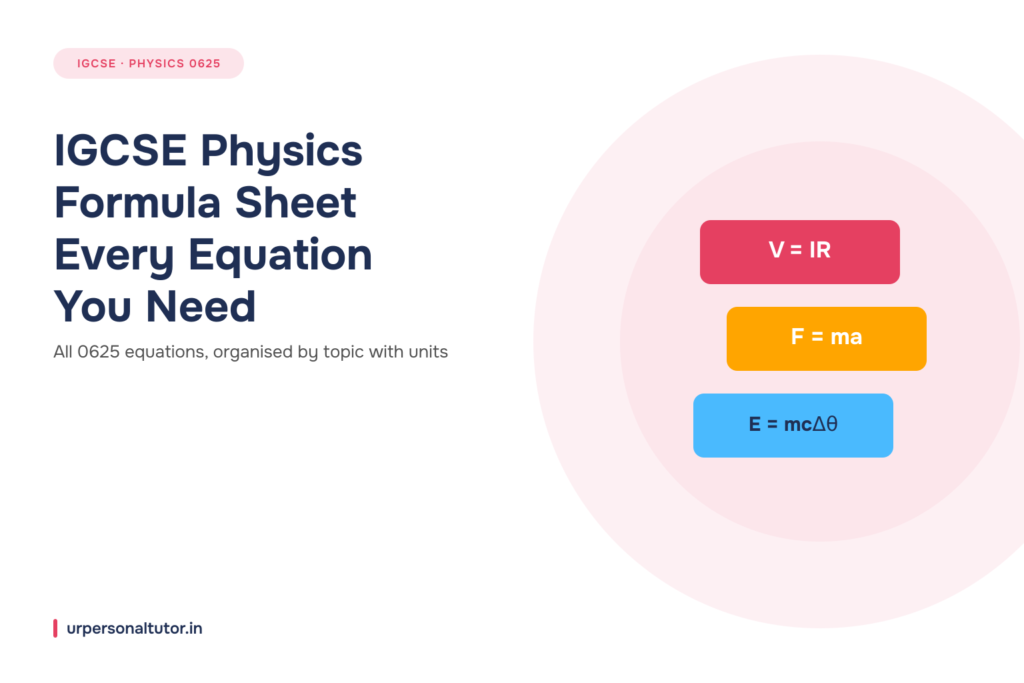
There is no formula sheet handed out in the IGCSE Physics exam. That surprises a lot of students, because A-Level Physics gives you a data booklet and GCSE Combined Science gives you an equations page, but Cambridge 0625 does not. Every equation on this page has to live in your head by the time you walk into the exam hall. This IGCSE physics formula sheet exists to make that job manageable, organised by topic the way the syllabus is examined, with the units examiners actually deduct marks for when you leave them out. I tutor students through 0625 every week, and the question I get most often isn’t “what’s the formula for X.” It’s “why did I lose a mark when my answer was right.” Nine times out of ten the number was correct and the unit was missing, or the formula was rearranged wrong under pressure. Knowing a formula is different from being able to pull it out cold in the middle of a six-mark question. That gap is what mock tests exist to close. You don’t win an exam you haven’t rehearsed for, and a formula you’ve only read once isn’t the same as one you’ve actually used to solve a problem. Why an IGCSE physics formula sheet matters more here than in most subjects Physics at IGCSE level rewards structure. Marks are awarded for the correct formula, the correct substitution, and the correct unit, often as three separate ticks on the mark scheme. A student who memorises this IGCSE physics formula sheet properly, including units, typically picks up two or three extra marks per paper just from that final step. That’s often the difference at a grade boundary. The formulas below cover both Core and Extended content for 0625. Extended-only formulas are marked. If you’re sitting Core, skip those and focus on the rest. The formula load here is also heavier than most students expect coming from GCSE and IGCSE physics being treated as interchangeable, when the exam structures actually differ quite a bit. Motion and forces Momentum questions catch students out because “conserved” gets treated as a vague idea rather than an equation you set up before and after a collision. Write total momentum before equals total momentum after, then substitute. It’s mechanical once you’ve done it a dozen times. Work, energy and power Efficiency questions almost always give you numbers in the wrong units on purpose, kilowatt-hours mixed with joules, minutes mixed with seconds. Convert everything to base SI units before you touch the formula, not after. Thermal physics Specific heat capacity and specific latent heat use the same letter Q for energy, and students routinely mix them up on a change-of-state question. The rule is simple: if the temperature is changing, use mcΔθ. If the temperature is staying the same while the substance melts or boils, use mL. Waves and light Electricity V = IR is the single most-used formula on the whole paper, and it’s also the one students rearrange incorrectly under time pressure. Practise all three rearrangements, for V, for I, and for R, until none of them require thinking. Electromagnetism Nuclear physics Nuclear physics at 0625 is mostly conceptual rather than formula-heavy, but half-life calculations come up almost every year. The number of half-lives that have passed equals the total time elapsed divided by the length of one half-life. Each half-life halves the count rate. A count rate of 800 counts per minute becomes 400, then 200, then 100, and so on, with no separate equation to memorise, just the halving pattern applied correctly. The myth: “if I have the formula sheet, I’ll get full marks” This is worth addressing directly because a lot of students search for an IGCSE physics formula sheet expecting it to function like an open-book exam aid. It won’t, because Cambridge doesn’t allow one in the hall. Having the list in front of you while revising is genuinely useful. Mistaking that for exam-day support is where marks get lost. The honest version is this: this page will get every formula into your revision notes, but only repeated practice, ideally under timed conditions, moves it from “I recognise this” to “I can produce this correctly in ninety seconds while also reading the question properly.” How to actually use this IGCSE physics formula sheet Reading a list of equations once will not make them stick. What works, based on what I see move grades for students I teach, is this: copy the formula out by hand rather than just reading it, apply it to three past-paper questions from different years, then come back two days later and write it from memory with no notes in front of you. Repeat that cycle weekly as part of a proper igcse revision plan rather than cramming it into the week before the exam. Students who do this consistently stop losing marks on substitution and units, because the formula stops being something they’re trying to recall and becomes something they just do. Pair this IGCSE physics formula sheet with topic-by-topic past paper practice rather than doing formulas and papers as separate activities. A formula only proves useful once you’ve had to decide, unprompted, which one a question is actually asking for. That decision-making is the part most students haven’t practised, even when they know every equation on this list. FAQs Is a formula sheet provided in the IGCSE Physics exam? No. Cambridge does not issue a formula booklet for 0625, which is different from A-Level Physics. Every equation, including unit conversions, has to be recalled from memory during the exam. How many formulas do I actually need to know for IGCSE Physics Core versus Extended? Core students need roughly 20 formulas across mechanics, energy, thermal physics, waves and electricity. Extended students need those plus around 8 to 10 additional ones, including momentum, Boyle’s Law, refractive index by speed, and the transformer equations. Do I lose marks for not including units in physics calculations? Yes, and it’s one of the most common
How to Solve IIT JEE Physics Problems: A Framework Every Student Should Learn

How to Solve IIT JEE Physics Problems Without Getting Stuck Halfway If you’ve ever stared at a JEE physics problem for ten minutes without writing a single line, you’re not alone. Most students who struggle with JEE physics aren’t missing formulas. They’re missing a method. Knowing how to solve IIT JEE physics problems isn’t about memorising more equations. It’s about having a repeatable process you can apply the moment you read a question, so you’re never starting from zero. This is the gap between students who score 40 marks in physics and students who score 90+. The second group isn’t smarter. They’ve just internalised a system. Why Most Students Get JEE Physics Wrong Walk into any JEE coaching class and you’ll hear the same complaint from students: “I understand the chapter, but I can’t solve the problems.” This happens because chapter understanding and problem-solving are two completely different skills. You can watch a hundred videos on rotational mechanics and still freeze on a torque question in the exam. That’s because solving problems requires pattern recognition, decision-making under pressure, and the ability to break a messy real-world scenario into clean physics variables. None of that comes from passive reading. Here’s what typically goes wrong: students jump straight into writing equations before they’ve understood what the question is actually asking. They mix up given values with what needs to be found. They apply a formula that worked in a similar-looking problem without checking if the conditions actually match. And when the first approach fails, they don’t know how to pivot, so they either guess or give up. If any of that sounds familiar, the fix isn’t more practice for the sake of practice. It’s a framework that forces you to think before you calculate. The Framework: How to Solve JEE Advanced Physics Problems Easily This is the same four-part approach we teach students working toward JEE Advanced, and it works whether you’re solving a straightforward NCERT-level question or a multi-concept JEE Advanced problem that combines kinematics with energy conservation. Read the Problem Twice Before Touching Your Pen The first read is to understand the scenario. What’s physically happening? A block sliding down an incline, a charge moving through a magnetic field, a gas expanding in a container — picture it. The second read is to extract information: what’s given, what’s asked, and what’s implied but not stated directly, like assuming frictionless surfaces unless mentioned otherwise. Students who skip this step often solve for the wrong quantity or miss a constraint that changes the entire approach. Draw It Before You Solve It Physics is visual. A quick diagram with labelled forces, velocities, or fields does more for your understanding than three re-reads of the question. This is especially true for mechanics and electromagnetism, where the direction of vectors changes the entire solution. If you’re solving JEE Advanced physics problems that involve multiple bodies or multiple stages, like a collision followed by circular motion, a diagram keeps your variables from getting tangled. Identify the Governing Concept, Not Just the Chapter This is where most students go wrong. A question might sit in the “rotational motion” chapter but actually be testing energy conservation with a rotational twist. Ask yourself what physical principle is actually being tested. Conservation of momentum? Newton’s second law? Work-energy theorem? Once you name the real concept, the correct formula usually follows on its own. This single habit is one of the fastest ways to improve how you solve IIT JEE physics problems, because it stops you from pattern-matching to the wrong chapter. Solve, Then Sanity-Check Once you’ve worked through the calculation, check your answer against reality. Does the velocity make sense given the setup? Are the units correct? Is the sign of your answer physically meaningful? A negative time value or a velocity greater than the speed of light is a clear sign something went wrong upstream, and catching it here saves you from carrying an error into a multi-part question. Applying This Framework Under Exam Pressure Knowing the framework is one thing. Using it in three minutes per question during JEE Advanced is another. The way to close that gap is timed practice, not untimed practice. When you solve problems without a clock, you’re training patience, not speed. Set a timer for each question based on its difficulty level, and if you go over, stop and analyse why. Was it the concept identification step that took too long? Was your diagram too messy to work from? Pinpointing exactly where you lose time tells you which part of the framework needs more repetition. It also helps to keep a small log of mistakes by type: silly calculation errors, wrong concept applied, misread question, or ran out of time. Most students find that 60-70% of their errors fall into just one or two categories. Fixing that one category can move your score more than solving another hundred random problems. How Many Problems Should You Actually Practice? There’s no shortcut around volume. Recognising patterns in JEE physics questions comes from exposure, and exposure comes from solving a genuinely large number of problems across every chapter. If you’re wondering exactly how many questions to target per chapter,this breakdown is a useful next read once you’ve got the framework down. Balancing This With Board Exam Pressure A lot of JEE aspirants worry that focusing this much on problem-solving technique will eat into board exam preparation time. It doesn’t have to. The framework above actually helps with board exams too, since it builds the same conceptual clarity CBSE and other boards test for, just applied with less time pressure. And if you’re currently juggling both, splitting your study hours between JEE and boards without falling behind on either is its own challenge worth planning around properly. Staying Consistent With This Framework The framework only works if you know how to be consistent in physics studies, not just when you remember to. Students who use it for a week and then drop back into old habits
CBSE Physics Derivations: A Step-by-Step Learning Strategy for Students
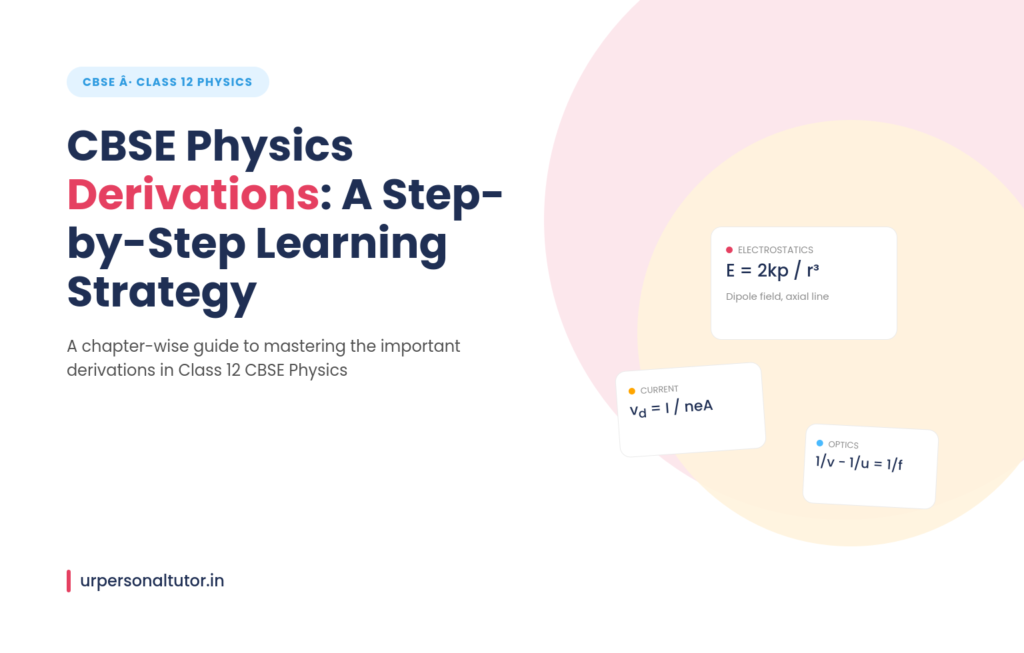
Derivations decide a bigger chunk of the Class 12 CBSE Physics board exam than most students realise. If you’re looking for the important derivations physics class 12 CBSE syllabus actually asks for, the short answer is: they’re concentrated in five chapters — Electrostatics, Current Electricity, Magnetic Effects of Current, Electromagnetic Induction, and Optics — and they’re worth anywhere from 3 to 5 marks each, sometimes appearing twice in a single paper in slightly different forms. The rest of this guide breaks down exactly which ones matter, why they trip students up, and how to actually get them into long-term memory instead of forgetting them the week after a test. What Are Important Derivations in Physics Class 12 CBSE? A derivation, in the context of CBSE Physics, is a step-by-step mathematical proof that connects a physical principle to a usable formula. Think of the derivation for electric field due to a dipole, or the expression for drift velocity in a conductor. These aren’t formulas you memorise in isolation. They’re logical chains, and the board specifically rewards students who can reproduce that chain, not just the final equation. Out of the full Class 12 syllabus, roughly 15 to 18 derivations show up repeatedly across sample papers and previous years’ boards. That’s the real, working list of important derivations physics class 12 CBSE students should prioritise if time is tight. A handful of these are near-guaranteed appearances every year, and a good tutor will usually flag those in the first week of a term rather than waiting until revision season. Are Derivations Included in the Physics 11th Syllabus CBSE? Yes, and this catches a lot of students off guard. Are derivations included in physics 11th syllabus CBSE? They are, and skipping them in Class 11 creates a real problem a year later. Concepts like rotational motion, gravitation, and thermodynamics in Class 11 lay the mathematical groundwork for Class 12 topics such as electromagnetic induction and AC circuits. A student who never properly derived the expression for escape velocity in Class 11 will often struggle with the orbital velocity derivation in Class 12, simply because the underlying calculus habits were never built. Part of this comes down to how sudden the jump from Class 10 to Class 11 actually is, with two dense textbooks landing at once and far less hand-holding than before. If your Class 11 foundation feels shaky, it’s worth going back and redoing a handful of those derivations before diving into the Class 12 list. It takes a weekend, not a semester, and it removes a lot of friction later. Chapter-Wise List of Important Derivations Physics Class 12 CBSE Here’s where most study guides go wrong — they list every derivation in the textbook without any sense of priority. A more useful approach is grouping by chapter and marking which ones appear most consistently in board papers. Electrostatics and CapacitanceElectric field due to a dipole on axial and equatorial lines, potential energy of a dipole in a uniform field, and capacitance of a parallel plate capacitor with and without a dielectric. These three alone have appeared in some form in nearly every recent board paper. Current ElectricityDerivation of drift velocity and its relation to current, and the condition for balance in a Wheatstone bridge. Students often memorise the final formula here without understanding why the bridge balances, which becomes obvious the moment an examiner tweaks the question slightly. Magnetic Effects of Current and MagnetismForce on a current-carrying conductor in a magnetic field, torque on a current loop, and the magnetic field due to a solenoid using Ampere’s Circuital Law. This last one is dense, and it’s one students consistently underprepare for. Electromagnetic Induction and Alternating CurrentMotional EMF, self and mutual inductance of coils, and the expression for average and RMS values of AC. These build directly on Class 11 rotational and oscillatory motion, which is exactly why weak Class 11 fundamentals resurface here. Ray Optics and Wave OpticsLens maker’s formula, mirror formula using the sign convention, and the derivation for fringe width in Young’s double slit experiment. Optics derivations tend to be shorter but require careful geometry, which is a different skill from the algebra-heavy electricity derivations. Together, this chapter-wise breakdown covers the bulk of the important derivations physics class 12 CBSE examiners return to year after year. Printing this list and ticking off each one as it’s mastered is a small habit that makes revision measurably faster closer to exams. How to Practice CBSE Physics Derivations Effectively How to practice CBSE physics derivations without it turning into rote copying is the real question. Rewriting a derivation from the textbook five times in a row feels productive, but it mostly builds short-term recognition, not recall. A better method: Write the derivation once while looking at the book, understanding every substitution as you go. Then close the book and attempt it from memory. Wherever you get stuck, that’s the exact point you don’t understand yet — not a gap to paper over with more copying, but a signal to go back to the underlying concept. Spacing this out matters more than most students expect. A derivation revisited after one day, then again after four days, then again after ten, sticks far better than the same derivation practised five times in one sitting. This is standard spaced repetition, and it works particularly well for physics because each derivation has a logical sequence your brain can reconstruct rather than just recall. Diagrams deserve separate attention. In derivations involving fields, forces, or optics, the diagram often carries half the marks. Practising the diagram alongside the algebra, not as an afterthought, is one of the fastest ways to pick up easy marks that get left on the table. How to Tackle Derivations CBSE Physics During Exams How to tackle derivations CBSE physics under actual exam pressure is a different skill from practising them at home. Time is tighter, and a blank moment feels much bigger than it actually is. A few things help. Start with
Choosing the Right Physics Tutor for GCSE, IGCSE, A Level, or IB

One-to-one physics tuition works because it removes the biggest weakness of the classroom: pace. A tutor sitting across from one student can slow down on Newton’s third law until it actually clicks, then speed through momentum because the student already gets it. That flexibility is the whole argument for hiring a physics tutor in the first place, and it’s worth understanding before you start comparing names and price lists. This guide walks through what actually matters when choosing between GCSE, IGCSE, A Level, IB, CBSE, NEET, and JEE physics tutors, what one to one physics tuition should look like in practice, and which claims about tutoring are worth ignoring. Why One to One Physics Tuition Works Better Than Group Classes A physics classroom with 25 students has one teacher and one pace. If a student is still stuck on resolving forces on an inclined plane, the class has usually already moved on to circular motion. Nobody stops. Nobody can, not with that ratio. One to one physics tuition flips that. The lesson bends around the student instead of the other way round. A tutor can spend forty minutes on one sticky concept if that’s what’s needed, or blitz through three topics in twenty minutes if the student already has the groundwork. Mistakes get caught in real time, not three weeks later on a marked test paper. There’s also the question of what a student is comfortable admitting out loud. In a group, few students want to say “I don’t actually understand momentum conservation” in front of classmates. In personal physics coaching, that admission costs nothing. It’s just the starting point for the lesson. Physics Tuition for Exam Preparation: GCSE, IGCSE, A Level, IB Exam boards differ enough that tutoring approaches shouldn’t be identical across them. Good physics tuition for exam preparation adjusts to the specific syllabus, command words, and mark scheme style of whichever board a student is sitting. GCSE and IGCSE Physics Tutoring GCSE and IGCSE physics reward precision in short-answer questions. Students lose marks not because they don’t understand physics but because they write “the speed goes up” instead of “the speed increases because resultant force acts in the direction of motion.” A tutor working on GCSE or IGCSE content should be drilling exact terminology and mark-scheme phrasing alongside the concepts themselves, since examiners are marking against specific keywords. A Level Physics Tuition A Level physics tuition needs a different gear. The maths content jumps sharply, calculus-based mechanics shows up, and questions start layering two or three concepts into a single problem. A tutor here should be pushing past “what is the formula” toward “why does this formula apply in this scenario and not that one.” Past paper practice matters enormously at this stage, more than it did at GCSE, because A Level questions are unpredictable in structure even when the content is familiar. IB Physics Tuition IB physics tuition has its own quirks: internal assessments, the extended essay if a student picks physics, and a syllabus that moves between Higher Level and Standard Level content depending on the paper. A tutor supporting IB students needs to understand how IA marking criteria work, not just the physics itself, because a strong lab write-up can matter as much as strong exam technique come final grades. What to Look for in Personal Physics Coaching Not every physics tutor is the right fit for every student, and price is a poor way to judge that. A few things matter more. Subject depth beyond the syllabus helps. A tutor who only knows the specification as written tends to teach to the test and struggles the moment a student asks “but why” about something slightly outside the mark scheme. Someone with a physics degree or teaching background usually has that extra depth in reserve. Communication style matters just as much as knowledge. A brilliant physicist who explains everything in dense technical language isn’t much use to a 15-year-old struggling with circuits. The best personal physics coaching adapts explanations to how a specific student actually thinks, sometimes with analogies, sometimes with diagrams, sometimes just by working through more examples than the textbook offers. Structure and accountability round it out. One to one physics tuition without any homework, tracked progress, or clear sense of what’s improving over six weeks tends to plateau. A tutor should be able to point to specific weak topics from three sessions ago and show that they’ve been addressed. CBSE, NEET, and JEE Physics Tutors: Choosing for Competitive Exams Students preparing for Indian board and entrance exams face a different kind of pressure, and the tutor selection criteria shift accordingly. CBSE Physics Tutor A CBSE physics tutor needs to be fluent in the NCERT curriculum specifically, since board exam questions lean heavily on NCERT phrasing and diagram conventions. Numerical problem-solving speed matters here too, since CBSE physics papers reward students who can work through calculations quickly and cleanly under time pressure. NEET Physics Tutor NEET physics carries less weight proportionally than biology in the overall exam, but it’s often where students lose the marks that separate a good rank from a great one. A NEET physics tutor should be relentless about formula recall under pressure and fast elimination of wrong options in multiple-choice questions, since NEET rewards speed as much as accuracy. JEE Physics Tutor JEE physics concepts are a different animal again. Questions are deliberately layered and often require combining two or three physics principles in one problem, sometimes with a maths trick buried inside. A JEE physics tutor worth hiring should be setting problems that mimic that layered difficulty regularly, not just working through standard textbook questions, because JEE rarely asks anything in its standard form. Common Myths About Physics Tutoring A few beliefs about tutoring circulate that are worth correcting honestly, since believing them can lead to picking the wrong tutor or the wrong format. Myth: any tutor who is good at physics will be good at teaching it. Subject knowledge and teaching ability are separate skills.
IB Exam Preparation Checklist: Time Management Tips for IB Exams
The fastest way to build a working IB exam preparation checklist is to work backwards from your exam dates, block out revision hours by subject difficulty rather than personal preference, and protect at least one full rest day every week. Students who plan this way consistently report less panic in the final month, because the heaviest content gets tackled while there’s still room to fix gaps. The rest of this guide breaks down exactly how to structure that timetable, subject by subject, without burning out before results day. What an IB Exam Preparation Checklist Should Cover A proper IB exam preparation checklist isn’t just a to-do list of topics. It has four moving parts: content coverage, past paper practice, IA and EE deadlines, and rest scheduling. Miss any one of these and the other three suffer. Students who focus purely on rereading notes tend to freeze on exam day because they’ve never timed a Paper 2 under real conditions. Students who only grind past papers sometimes skip foundational topics they assumed they knew. A checklist that actually works has three columns running side by side: what to revise, how you’ll test that revision, and when the IA or EE deadline sits in relation to exam crunch. Six subjects, TOK, the extended essay, and CAS hours all compete for the same 24 hours in a day. Writing them down in one place, rather than juggling them in your head, is what separates a calm April from a chaotic one. Building Your IB Revision Timetable Months Before Exams Most schools hand out the exam timetable around January for a May session. That gives you roughly sixteen weeks, and the mistake almost every student makes is treating those weeks as equal. They aren’t. The first eight weeks should be about closing content gaps and rebuilding weak topics from scratch. The last four weeks should be almost entirely past papers, timed and marked against the actual IB grade boundaries. Start your IB revision timetable by listing every subject and giving each one a rough difficulty score out of ten, based on your current grades and your gut feeling about which papers scare you. Higher Level Maths or IB Physics exam prep usually eats more hours than Standard Level Spanish, so don’t split your sixteen weeks evenly across six subjects. Give the harder HL subjects two extra hours a week from week one. A realistic weekly structure for someone taking three HL and three SL subjects looks like eighteen to twenty-two hours of focused revision, spread across five or six days, not seven. Cramming every evening including Sundays is how motivation collapses by week six. Build the rest day in from day one instead of adding it later as damage control. How to Prepare for IB Exams Subject by Subject Knowing how to prepare for IB exams changes depending on the subject, and treating Biology revision the same way you’d revise Maths is a common time sink. Sciences and Maths reward repetition through problem sets; you genuinely improve by doing more questions, not by rereading the syllabus guide a fourth time. Humanities and languages reward structured recall, meaning flashcards, timed essay outlines, and vocabulary drilling matter more than passive rereading. For HL Maths, spend the bulk of your hours on past paper questions sorted by topic, then move to full timed papers once you’re scoring consistently above 60% on individual topic sets. For English or History, build a bank of ten to fifteen practice essay plans rather than writing full essays every single time. A plan takes twenty minutes and teaches you structure; a full essay takes ninety minutes and often just repeats what the plan already proved you know. Sciences with a practical component need lab report review folded into the schedule too, since IA marks carry weight independent of the written exam. Don’t let internal assessments quietly vanish from your checklist just because they feel less urgent than the exam itself. Time Management Tips for an IB Exam Preparation Checklist Good time management for IB exams starts with knowing your actual working speed, not your ideal one. Time yourself on a single Paper 1 section before you build your full schedule. If a 45-minute paper genuinely takes you 65 minutes including checking, your revision plan needs to include speed drills, not just content review. Break each revision session into 50-minute blocks with a 10-minute gap, and cap total daily study at around six hours on weekdays and eight on weekends during peak revision weeks. Beyond that, retention drops sharply and mistakes creep into practice papers that would never happen in the real exam. Keep a physical or digital tracker where you tick off completed topics; the visual progress matters more for motivation than most students expect. Protect sleep even during the final fortnight. Seven hours a night sounds obvious, but it’s the first thing students sacrifice, and it’s also the thing most strongly linked to recall performance in the exam hall itself. A tired brain forgets formulas it knew perfectly well two days earlier. Common Time Management Mistakes During IB Exam Preparation The single biggest mistake is starting an IB exam preparation checklist without dates attached to each task. “Revise Chemistry” sitting on a list with no deadline gets pushed indefinitely. Every task needs a specific day and a specific outcome, such as “complete Paper 2 Chemistry, Section A, by Thursday.” Another frequent error is over-revising strong subjects because they feel comfortable, while avoiding the subject that actually needs the most work. If Economics HL terrifies you, that’s exactly where your extra hours belong, not in the SL subject where you’re already predicted a 6. Students also underestimate how long past paper marking takes. Marking a Paper 2 essay properly against IB criteria can take longer than writing it. Budget that time in the checklist rather than assuming the paper is “done” the moment the writing stops. IB Exam Study Guide: Balancing IA, EE, and Exam Revision A working IB exam study
Common Mistakes Students Make in A Level Physics (And How to Fix Them)

The mistakes that cost students the most marks in A Level Physics are rarely about intelligence. They’re about habits: skipping units, memorising formulas without understanding where they come from, running out of time in the exam hall, treating practicals as an afterthought, and leaving extra support until three months before the exam. Fix these and most students move up at least a full grade boundary. This article walks through each one, with what to do instead. The Units and Significant Figures Trap This is the single most common way students lose marks in A Level Physics, and it happens even to students who understand the physics perfectly well. A calculation comes out correct to three significant figures, but the answer is written down as 4.5 instead of 4.53, or the unit is left off entirely. Examiners are instructed to penalise this. On some questions, that’s an easy mark thrown away for no reason connected to physics ability at all. The fix is boring but effective: write the unit next to every number as you go, not just at the end, and get into the habit of carrying one extra significant figure through intermediate steps before rounding at the final answer. Memorising Formulas Instead of Understanding Them A Level Physics rewards understanding over recall in a way GCSE Physics revision strategy often doesn’t. Students who learn the equation sheet by heart but never ask why the equation looks the way it does tend to freeze the moment a question presents information in an unfamiliar order. Take something like the equation linking force, mass, and acceleration. A student who has only memorised F = ma will struggle the moment a question gives them momentum change over time instead. A student who understands force as rate of change of momentum can rearrange on the spot. This is why questions phrased as “explain why” or “derive an expression for” catch out the students who crammed rather than learned. Physics at this level is less about recall and more about knowing which relationship applies and why. Weak Exam Technique Under Time Pressure Even strong students lose marks purely on technique. Long-answer questions in A Level Physics are marked against a points scheme, and many students write answers that contain the right idea but never state it in the specific way the mark scheme expects. Vague phrasing like “the force increases” without saying what causes the increase, or writing “because of friction” without naming the surfaces involved, often earns zero marks even when the underlying understanding is there. Timing is the other half of this. Six-mark extended response questions need roughly a mark a minute, and students who spend eight minutes perfecting a three-mark calculation early in the paper often arrive at the final question with no time left. Practising past papers under a strict clock, not just working through questions untimed, is what actually builds this skill. Underestimating the Practical Endorsement Some students treat the required practicals as a formality to get through rather than genuine exam preparation, and this backfires twice over. First, the practical endorsement itself is a pass/fail requirement that sits alongside the written grade, so it can’t simply be ignored. Second, and more overlooked, a large chunk of the written exam draws directly on practical work: uncertainty calculations, graph analysis, and evaluating experimental methods all show up as exam questions, not just lab tasks. A student who genuinely understood why they used a set square to check a ruler was vertical, or why they repeated a reading five times instead of three, tends to answer these exam questions far more confidently than one who just followed a worksheet. Revising Physics the Wrong Way Rereading notes and highlighting textbooks feels productive but does very little for A Level Physics specifically, because the subject tests application far more than recognition. Passive revision creates a false sense of familiarity that collapses the moment a question is phrased differently from how it appeared in the notes. What actually works is closer to active retrieval: doing past paper questions cold, checking against the mark scheme, and specifically tracking which topics keep causing errors with a study schedule for A-level physics. Electricity, circular motion, and anything involving graphs of motion tend to be repeat offenders for most students, so a revision log that flags these patterns is worth more than another read-through of the specification. Waiting Too Long to Get Extra Support By the time many students reach Year 13, gaps from Year 12 have compounded. A shaky grasp of vectors from the mechanics unit doesn’t just affect mechanics; it resurfaces in fields, in circular motion, in almost every topic that follows. Students often wait until a mock exam result forces the issue, which leaves far less runway to close the gap before the real exam. This is where A level physics tuition tends to make the biggest difference early rather than late. A short block of focused sessions in Year 12, targeted at the specific topic that’s shaky, is usually far more effective than a longer, more general course started in Year 13 under pressure. If a student already knows exactly which topic is the problem, an a level physics private tutor can go straight at that gap instead of re-teaching the whole syllabus from the start. What It Actually Takes to Get an A* in Physics A Level Students often assume an a* in physics a level comes down to raw ability, but the pattern that actually shows up among top scorers is more mundane: consistent past paper practice from early in the course, a habit of checking units and significant figures automatically, and genuine comfort with the required practicals rather than a rushed run-through before the exam. None of these are talent-dependent. They’re built. Book a Session If any of the mistakes above sound familiar, the fix usually isn’t more hours of revision. It’s revising the right things, the right way. Get in touch to book a session and find out exactly where
GCSE vs IGCSE: Which Curriculum Needs More Academic Support?

IGCSE generally demands more academic support than GCSE, mainly because of its wider syllabus, greater independent-study load, and heavier weighting on final exams rather than coursework. GCSE students still need help, particularly with exam technique and time management under the newer 9-1 grading system, but the sheer breadth of an IGCSE grading system and syllabus — especially in Maths, Sciences, and English — tends to catch families off guard. Below, we break down exactly where each curriculum puts pressure on students and where tutoring makes the biggest difference. What Is the Real GCSE vs IGCSE Difference? The GCSE (General Certificate of Secondary Education) is the standard qualification taken by students in England, Wales, and Northern Ireland, usually between Year 10 and Year 11. The IGCSE (International GCSE) is Cambridge International’s version of the same qualification, designed for schools outside the UK, including a large number in India, the UAE, and Southeast Asia. On paper, the two look similar. Both are typically taken at age 14 to 16. Both feed into A Levels, IB, or other pre-university programmes. The real GCSE vs IGCSE difference shows up in three places: syllabus content, assessment style, and coursework weighting. GCSE has moved almost entirely toward terminal exams, meaning a student’s final grade in most subjects rests on exams sat at the end of Year 11. IGCSE, depending on the exam board and subject, still allows coursework or a mix of components in subjects like English and some sciences, though even here the trend has shifted toward exam-heavy assessment in recent years. This distinction matters more than most families realise when deciding where extra academic support should go. GCSE vs IGCSE Difficulty: Which One Is Actually Harder? There’s no single answer that applies to every subject, but IGCSE syllabuses are usually written with more content per subject, particularly in Maths, Physics, Chemistry, and Biology. A typical IGCSE Maths syllabus, for instance, includes topics like matrices, vectors, and set notation that don’t always appear at the same depth in GCSE Maths. That said, GCSE’s grading system (9-1, with 9 being the highest) is often described by students as unforgiving. A single careless error in an exam can shift a grade band because so much weight sits on one sitting. So when people ask about igcse vs gcse difficulty, the honest answer is: IGCSE tends to be harder in terms of content volume, while GCSE can feel harder in terms of exam pressure and margin for error. Where a student struggles usually depends on their learning style. A student who works well with steady, cumulative revision over two years often does fine with IGCSE’s breadth. A student who needs more structured, exam-focused preparation closer to test dates sometimes finds GCSE’s terminal-exam model more manageable, provided they get consistent support building up to it. IGCSE Maths vs GCSE Maths: Where Students Struggle IGCSE Maths vs GCSE Maths is one of the most searched comparisons, and for good reason. Parents moving a child from a CBSE or ICSE school into an international curriculum, or vice versa, often assume the maths content lines up neatly. It doesn’t always. IGCSE Maths (particularly the Extended tier from Cambridge or Edexcel) covers a broader range of topics at a faster pace, and problems are frequently set in unfamiliar, applied contexts rather than the more predictable question formats seen in GCSE papers. Students accustomed to formulaic practice sometimes struggle with the wording and multi-step reasoning IGCSE questions demand. GCSE Maths, by comparison, has a narrower syllabus but tests it more intensively, with a strong emphasis on problem-solving questions that combine two or three topics in a single question. A student weak in algebra, for example, will find that weakness exposed repeatedly across a GCSE Maths paper, since algebra threads through so many question types. In our tutoring sessions, the most common gap we see isn’t a lack of raw ability. It’s a mismatch between how a student was taught to approach maths problems and how the specific exam board expects those problems to be answered. That gap closes quickly with targeted, board-specific practice. IGCSE English vs GCSE English: Different Skills, Different Support Needs The igcse english vs gcse english comparison brings its own quirks. GCSE English Language and Literature (in the UK system) lean heavily on close textual analysis of a fixed set of prescribed texts, often Shakespeare, a 19th-century novel, and a modern play or novel, alongside unseen poetry and prose comprehension. IGCSE English, especially IGCSE First Language English for non-native or international students, places more emphasis on comprehension, summary writing, and directed writing tasks such as letters, articles, and speeches. Some IGCSE English syllabuses include a spoken language component that GCSE has largely dropped from formal assessment. Students moving between the two systems sometimes lose marks simply because they’re applying the wrong exam technique. A student trained for GCSE-style literary analysis can over-analyse an IGCSE comprehension passage instead of answering the question directly. A student used to IGCSE’s more functional writing style can under-develop the literary commentary a GCSE examiner expects. This is one area where a tutor familiar with both syllabuses genuinely earns their keep, because the fix is almost always about technique rather than raw language ability. Which Curriculum Needs More Academic Support: GCSE or IGCSE? Pulling this together, IGCSE usually needs more sustained academic support across the two-year period, simply because there’s more content to cover and less room for a student to coast on strong exam technique alone. Families with children on an IGCSE track often benefit from starting structured support in Year 9, well before the exam years begin, to build the subject depth the syllabus demands. GCSE students, meanwhile, benefit most from support that intensifies closer to exams, focused on past-paper practice, timing, and precision under the 9-1 grading system. Both approaches work. What doesn’t work is applying one strategy to the other curriculum. A GCSE-style cramming approach applied to IGCSE’s broader syllabus tends to leave gaps; an IGCSE-style slow-build approach applied to GCSE can
Why You Cannot Crack NEET Without Physics: The 540/720 Math Nobody Tells You
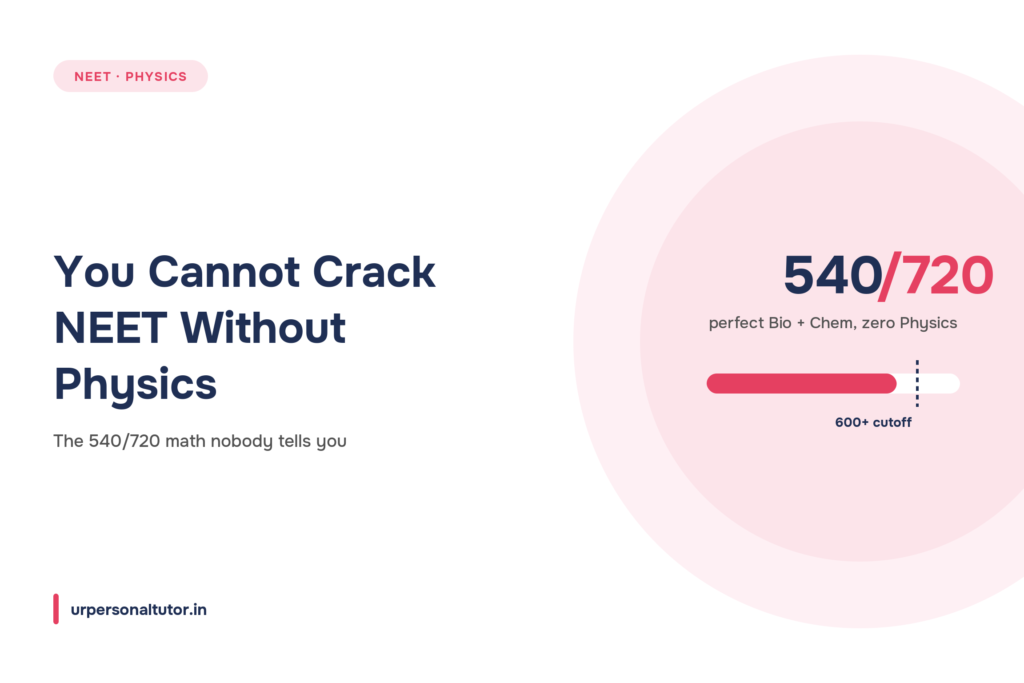
You cannot crack NEET by studying only Biology and Chemistry, and the arithmetic proves it in one line: a perfect 360/360 in Biology plus a perfect 180/180 in Chemistry gives you 540 out of 720, and in most years 540 is not enough for a government MBBS seat in the general category. Recent cutoffs for government college admission have hovered well above that range. In other words, even the impossible best-case scenario of 100 percent in Bio and Chem can leave you without the seat you worked two years for. That single calculation should end the most common NEET mistake I see: treating Physics as an optional subject you will “manage somehow.” The Most Common NEET Mistake: Neglecting Physics Walk into any NEET batch and you will find the same pattern. Students love Biology because it rewards the reading and memorising they are already good at. Chemistry gets decent attention because half of it is also memory-friendly. Physics gets pushed to “later” because it involves calculation, formulas, and conceptual thinking that feels alien to a biology-inclined mind. Then the mock tests arrive. Bio: 320 plus. Chemistry: 150 plus. Physics: 70. And the student concludes “I am just not a physics person,” studies even less physics, and the gap widens. Here is the reframe: NEET Physics is not harder than Biology. It is differently hard. Biology demands volume of memory. Physics demands depth of understanding on a much smaller set of ideas. The entire NEET Physics syllabus runs on maybe 60 to 70 core concepts. Compare that with the thousands of facts Biology expects. You are already doing the harder memory task. Physics asks for less material, understood better. Why 540/720 Is Not Enough: The Real Cutoff Math Let’s put the numbers in one place: Government MBBS seats in the general category typically demand scores in the 600 plus territory, and the safest zone is higher still. Now see what Physics contributes at different levels, assuming a strong 320 in Biology and 150 in Chemistry (realistic for a hardworking student): Physics is not one-fourth of your NEET marks. It is the deciding fourth. Bio and Chem scores cluster tightly among serious aspirants because everyone studies them. Physics is where ranks separate. How to Actually Study NEET Physics: Core Principles and Diagrams The students who turn their Physics score around all make the same two changes. 1. Understand the core principle before touching formulas Do not start a chapter by listing formulas. Start by asking what the chapter is fundamentally about. Newton’s laws are about how forces change motion. Thermodynamics is about energy bookkeeping. When you understand the principle, formulas become obvious consequences instead of random symbols to memorise. Memorised formulas fail the moment a question is phrased differently. Understood principles never do. 2. Draw a diagram for every single question This is the highest-impact habit in NEET Physics, and biology students skip it the most. Before solving, draw the situation: the block, the forces as arrows, the circuit, the ray of light. A drawn diagram converts a scary word problem into a simple visual you can reason about. Most Physics errors are not calculation errors. They are visualisation errors, where the student solved a different problem than the one asked. The diagram prevents exactly that. 3. Follow the right sequence Build in this order: NCERT theory, NCERT examples, previous year NEET questions for that chapter, then coaching material. NEET Physics leans heavily on NCERT-level concepts asked cleverly. Previous year questions teach you the exam’s actual taste faster than any thick book. 4. Give Physics prime time daily Physics gets your freshest hour of the day, every day, no exceptions. One daily hour of fresh-mind Physics beats four hours of tired-mind Physics on Sunday. Consistency dissolves fear. Most “physics phobia” is just unfamiliarity that was never given a fair chance. A 90-Day Physics Recovery Plan for Bio-Strong Students If Physics is currently your weakest subject, run this: Students who complete this honestly usually move from the 60 to 80 range into the 120 to 140 range, which by the math above is often the difference between no seat and a government seat. I specialise in fixing Physics for NEET aspirants who are strong in Biology but stuck below 100 in Physics mocks. If that sounds like you or your child, the 540/720 math says we should talk sooner rather than later. Frequently Asked Questions Can I crack NEET without studying Physics? No. Even a perfect score in Biology and Chemistry totals only 540/720, which is generally below the score needed for a government MBBS seat in the general category. Physics marks are mathematically necessary, not optional. How many marks should I target in NEET Physics? Target at least 130 to 140 out of 180. Combined with strong Biology and Chemistry scores, this puts your total in the 600 plus range where government college seats become realistic. Why is NEET Physics considered so difficult? Because it tests conceptual application and calculation rather than memory, which feels unfamiliar to biology-inclined students. In reality it has far less material than Biology. It only requires a different method: understanding core principles and drawing diagrams for every question. Is NCERT enough for NEET Physics? NCERT is the essential base and covers the concepts NEET tests, but you must add previous year questions and sufficient practice volume on top of it. NCERT theory plus 250 to 300 solved questions per chapter is a reliable combination. How can I improve NEET Physics in 3 months? Focus on mechanics for the first month, electricity and magnetism the next, then the formula-light scoring chapters like modern physics. Study Physics daily during your freshest hour, and draw a diagram before solving every question. Most students add 40 to 60 marks with this approach.
The 300 Questions Rule: How Many Problems Should You Solve Per Chapter to Crack Competitive Exams?

You should solve a minimum of 300 questions per chapter if you are serious about JEE, NEET, or any competitive exam. Not because 300 is a magic number, but because that is roughly the volume at which you stop meeting new question patterns and start recognising old ones in new costumes. Below that number, every test question feels unfamiliar. Above it, you walk into a test having already met most questions’ cousins. And here is the second truth that goes with it: your early test scores at your coaching institute will be low, and that is completely normal. Competitive exam preparation is a process. Nobody scores well in the beginning, including the students who eventually get top ranks. Let me explain both, because misunderstanding either one is how good students quit. Why Your Early Institute Test Scores Are Low (And Why That’s Normal) In school exams, you knew the question paper’s personality. Ten marks of definitions, a numerical from the solved examples, a diagram question. Preparation meant covering a known pattern. Competitive exams have no such courtesy. Each question is unique and demands its own approach. Two questions from the same chapter can require completely different lines of thinking. A student who “completed” the chapter by reading it thoroughly still scores 40 percent on an institute test and wonders what went wrong. Nothing went wrong. Reading a chapter teaches you the concepts. Only solving questions teaches you how concepts get twisted, combined, and disguised in exams. There is no shortcut through this. Colourful scores in institute tests come months into the process, not weeks. If you are scoring low right now, you are not failing. You are in the unavoidable early stage that every ranker went through and most quitters gave up in. Why 300 Questions Per Chapter Is the Benchmark Think of the 300 questions as a ladder: By the time you cross 300 well-chosen questions, something shifts. You look at a new question and think “this is that pulley type with friction added” instead of “I have never seen this before.” That recognition is the entire difference between a 60 percentile student and a 95 percentile student. How to Solve 300 Questions Without Wasting Time Volume without method is just tired hands. Follow these rules: 1. Attempt before you peek Give every question an honest 5 to 10 minutes before touching the solution. The struggle is the workout. Reading solutions directly builds recognition without ability, which collapses in the exam hall. 2. Maintain a mistake notebook Every wrong answer goes into a notebook with one line: what trap did I fall into? Re-solve these questions after a week. Your mistake notebook is worth more than any reference book, because it is a book written specifically about your weaknesses. 3. Mix timed and untimed practice Untimed practice builds depth. Timed practice builds exam temperament. Do both. Around 70 percent untimed learning and 30 percent timed testing works well in Class 11. 4. Quality sources only NCERT, your coaching modules, previous year papers, and one good reference book per subject. Five books solved shallowly lose to two books solved completely. It’s Okay to Be Called a Nerd One more thing, and I say this to every batch. Somewhere in the next two years, someone will call you a nerd for solving questions on a Saturday night. Wear it. The friends calling you boring in Class 11 will be asking which coaching you took when your result comes. It is far better to be called a nerd for two years than to spend the years after that wishing you had been one. Being cool has never gotten anyone a rank. Being consistent has gotten every ranker theirs. I track every student’s per-chapter question count and mistake patterns, so practice is targeted instead of random. If your child is stuck at the same test score for months, the fix is usually in how they practise. Get in touch. Frequently Asked Questions How many questions should I solve per chapter for JEE or NEET? A minimum of 300 questions per chapter, spread across NCERT-level basics, coaching material, previous year questions, and advanced mixed problems. This volume ensures you have seen nearly every question pattern the exam can throw at you. Why are my coaching institute test scores so low? Because competitive exam questions are unique and application-based, and early in preparation you have not yet seen enough patterns. Low early scores are a normal, universal stage. Scores improve steadily as your solved-question count per chapter grows. Is solving previous year questions enough for JEE and NEET? Previous year questions are essential but not sufficient on their own. They work best as the third stage of practice, after basics and standard material, and should be followed by mixed-concept advanced problems. Together this naturally crosses the 300 question mark. How long does it take to see improvement in mock test scores? Most students see meaningful improvement in 2 to 3 months of consistent daily problem solving. Students who only read theory without solving see little improvement regardless of time spent. Should I solve questions daily or in weekend batches? Daily. Problem solving is a skill like sport, and 25 questions a day for six days beats 150 questions on Sunday. Daily practice also keeps older chapters alive in memory
Why 10th Class Toppers Struggle in Class 11: The Foundation Class Gap Explained

10th class toppers struggle in Class 11 for one uncomfortable reason: they are no longer competing on the same starting line. A large chunk of their new classmates have been attending foundation classes since Class 8, which means those students have already seen vectors, mole concept, and advanced problem solving two or three years before you opened your first Class 11 book. You did not suddenly become weak. The race changed. The bigger question is what you do about it, because you cannot go back and join a foundation batch in Class 8. The honest answer: the gap is real, but it is closable within 4 to 6 months of the right kind of work. I have watched non-foundation students overtake foundation students by the end of Class 11 more times than I can count. What Foundation Students Actually Have That You Don’t Let’s be precise about the advantage, because vague fear is worse than a clear picture. A student who did foundation coaching from Class 8 typically has: Notice what is NOT on this list: intelligence, talent, or any permanent ability. Every item above is exposure and repetition. Both can be acquired. What Foundation Students Don’t Have Here is what nobody tells you. Foundation students carry their own risks: Familiarity is not mastery. In every batch I have taught, the rank list at the end of Class 12 looks very different from the rank list in the first month of Class 11. Are Foundation Classes From Class 8 Really Inevitable? No, but let me not sugarcoat it either. If you are aiming for JEE or NEET and starting fresh in Class 11, foundation students have a head start you must actively close. Pretending the gap does not exist is how toppers spiral. Acknowledging it and working a catch-up plan is how they recover. If you are a parent of a Class 8 or 9 student reading this: a good foundation course helps, but it is not compulsory for success. What is compulsory is that whenever your child starts, they start seriously. How to Catch Up in Class 11 Without Foundation Coaching This is the plan I run with my non-foundation students: 1. Front-load the first four chapters The early Class 11 chapters (units and measurement, vectors, kinematics in Physics; mole concept in Chemistry) are the tools every later chapter uses. Spend extra time here even if it means being temporarily slower than the class. A strong base makes every later chapter faster. 2. Solve volume, deliberately Foundation students’ real edge is repetitions. Match it by solving 250 to 300 questions per chapter, starting from NCERT level and climbing to previous year JEE or NEET questions. You are not doing extra work. You are doing the work they spread over three years, compressed. 3. Stop comparing test scores for the first six months Their head start shows up most in early institute tests. Compare your own score month over month instead of comparing yourself to a foundation student in July. By the second half of Class 11, the field levels out for those who worked. 4. Use your board-exam discipline Toppers have one massive asset: they know how to study consistently. Foundation students who never developed discipline lose to disciplined late starters all the time. Your work ethic is transferable. Your syllabus knowledge just needs to catch up. 5. Get targeted help for weak spots A personal tutor or a doubt-solving arrangement matters more for late starters than for anyone else, because you do not have three years of slack to figure things out alone. Every doubt cleared in 48 hours is a week saved later. The Mindset Shift That Decides Everything The toppers who sink in Class 11 are usually not defeated by the syllabus. They are defeated by the identity crisis. They went from being the best in the room to being average, and instead of adjusting their method, they start believing they were never good. You were good. You are still good. You are just early in a longer race, standing next to people who started running before you. The finish line is in Class 12, not in the first unit test. If your child topped 10th and is suddenly struggling in 11th, the problem is almost never ability. I build personalised catch-up plans for late starters. Book a free assessment session. Frequently Asked Questions Why do 10th class toppers fail in Class 11? They usually don’t fail, they fall behind temporarily. The main causes are competition from peers with foundation coaching since Class 8, a syllabus 3 to 4 times bigger, and application-based testing that their memorisation-heavy 10th class methods cannot handle. With adjusted methods, most recover within one to two terms. Are foundation classes from Class 8 necessary for JEE or NEET? No. They provide a genuine head start in exposure and problem-solving practice, but thousands of students crack JEE and NEET every year starting fresh in Class 11. The head start can be closed in 4 to 6 months with high-volume, structured practice. Can a student without foundation coaching beat foundation students? Yes, and it happens regularly. Foundation gives exposure, not guaranteed mastery. A disciplined Class 11 starter who solves enough questions and clears doubts fast frequently overtakes foundation students by the end of Class 11, especially those who became complacent. How long does it take to catch up with foundation batch students? For a hardworking student, roughly 4 to 6 months of focused effort. The gap is largest in the first term of Class 11 and typically closes by the start of Class 12 for students who maintain daily problem solving. Should my Class 8 or 9 child join a foundation course? Join one if the child is genuinely interested and the institute is good, but do not join out of fear alone. An unmotivated child in a foundation batch for three years often burns out before the exams that matter. A motivated Class 11 starter with the right support does fine