

Why Class 11 Feels So Overwhelming After 10th (And How to Handle Two Books Per Subject)

Class 11 feels overwhelming because the syllabus genuinely is 3 to 4 times bigger than Class 10. In 10th, you had one book covering all of science. In 11th, Physics alone has two NCERT books. So does Chemistry. So does Biology or Maths. You are not imagining the jump. It is real, it is steep, and every student in your class is feeling it, including the ones who look calm. The good news? The students who do well in Class 11 are not the ones who avoid this shock. They are the ones who adjust their study method in the first two to three months instead of using their 10th class approach on an 11th class syllabus.I have taught this transition for years, and the same pattern repeats every single batch. Let me walk you through what actually changes and what to do about it. What Actually Changes From Class 10 to Class 11 In Class 10, one science book covered Physics, Chemistry and Biology together. Chapters were short. Questions were predictable. You could revise the entire science syllabus in a week before boards.In Class 11, here is what you are looking at: And it is not just volume. The nature of the content changes. Class 10 tested memory. Class 11 tests understanding. A question in 10th asked you to state Newton’s second law. A question in 11th asks you to apply it to a block on an inclined plane with friction, connected to a pulley. Why Even Toppers Feel Lost in the First Few Months If you scored 90 percent plus in 10th and now feel like you understand nothing, you are in the majority. This happens for three reasons:The pace is faster. Schools and coaching institutes cover in one week what your 10th class teacher would have stretched over a month.Concepts stack on each other. If you did not fully understand vectors in the first month, kinematics becomes hard. If kinematics is shaky, laws of motion feel impossible. Class 10 chapters were independent. Class 11 chapters are a chain.Marks drop suddenly. Students who never scored below 90 start seeing 60s and 50s in unit tests. That number is not a verdict on your ability. It is feedback on your method. Struggling with the Class 11 jump? I work one-on-one with students to rebuild their study method in the first term, before shaky basics turn into a shaky year. Reach out for a free first session. How to Handle Two Books Per Subject Without Burning Out Here is the system I give every new Class 11 student: 1. Study in topics, not chapters A Class 11 chapter is too big to be one study unit. Break each chapter into 4 to 6 topics and finish one topic per sitting. “Complete Thermodynamics” is a bad goal. “Understand the first law and solve 10 questions on it” is a good goal. 2. Revise the same day, every day Do not run three books per subject in month oneMany students panic-buy reference books and try to run NCERT, a coaching module and HC Verma simultaneously from day one. Start with NCERT plus your coaching material. Add advanced books only after the basics are stable. 3. Accept slower progress as normal In 10th, you finished a chapter in two days. In 11th, a chapter may take two weeks. That is not you falling behind. That is the syllabus being what it is. 4. Get your doubts cleared within 48 hours Because concepts stack, an uncleared doubt today becomes three uncleared doubts next week. Whether it is your school teacher, a tutor, or a friend, do not sit on doubts. The First 90 Days Decide Your Class 11 Students who fix their study method by October usually stabilise and do well across both years. Students who keep waiting for Class 11 to “start feeling like Class 10” lose the whole year waiting.Your marks in the first three months do not predict your board result or your entrance exam rank. Your habits in the first three months do. Frequently Asked Questions 1.Is Class 11 harder than Class 10?Yes, significantly. The Class 11 syllabus is roughly 3 to 4 times larger than Class 10, with two books per subject, faster teaching pace, and application-based questions instead of memory-based ones. Almost every student experiences a drop in marks initially. Why do Class 11 students score less than they did in Class 10?Because the testing style changes from recall to application. Students who used memorisation-heavy methods in 10th see the biggest drop. Marks recover once study methods shift toward concept understanding and daily problem solving. How many hours should a Class 11 student study? Around 4 to 5 hours of self-study on school days and 6 to 8 hours on holidays works for most students, provided the hours are focused. Consistency matters far more than marathon sessions. Ten focused hours a week beats thirty distracted ones. Can I manage Class 11 without coaching? Yes, if you are disciplined with NCERT, solve enough practice questions, and have someone to clear doubts quickly. Coaching provides pace and structure, but plenty of students do well with school plus a personal tutor plus self-study. When should I start preparing for JEE or NEET? Class 11 itself is the start. Both exams draw roughly half their questions from the Class 11 syllabus, so studying Class 11 properly is entrance preparation. You do not need to have started in Class 8 to compete, but you cannot afford to treat Class 11 as a rest year.
We Don’t Plan to Fail, We Fail to Plan: A Realistic Study Timetable for Class 11
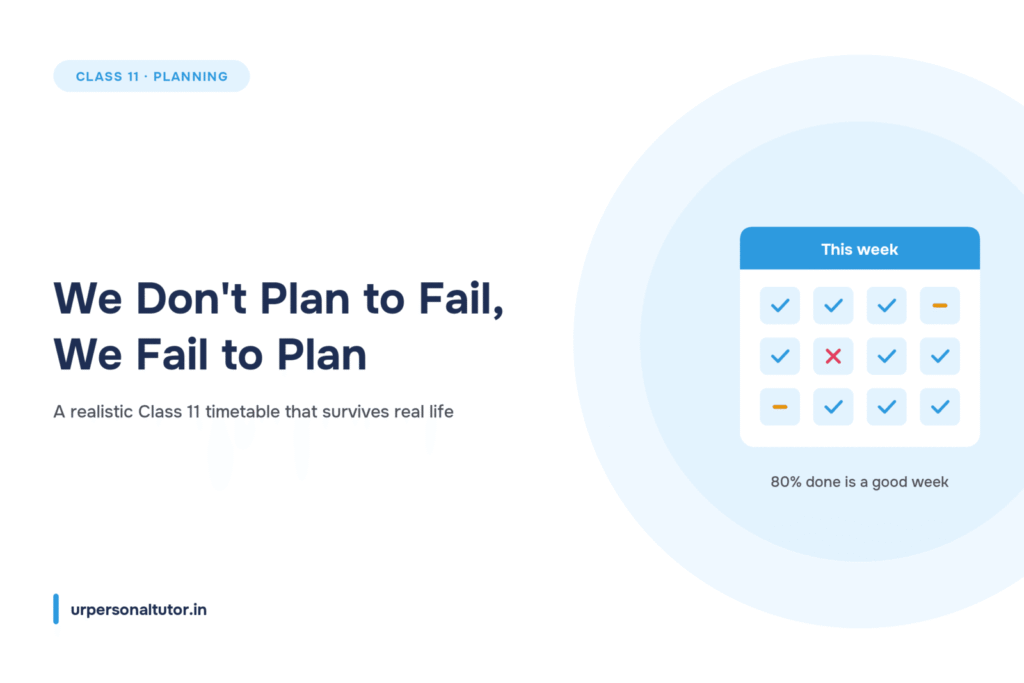
Nobody plans to fail in Class 11, but most students fail to plan, and here is the part almost no one talks about: even among students who do make a plan, the majority fail at execution. A beautiful colour-coded timetable made on Sunday night is abandoned by Wednesday, guilt sets in by Friday, and by the next Sunday the student makes another beautiful timetable. I have watched this cycle eat entire academic years. So this post gives you two things, because you need both: a realistic Class 11 timetable that accounts for school, coaching, and being human, and an execution system that keeps you on it past Wednesday. Why Most Study Timetables Fail by Wednesday Student timetables fail for predictable reasons: A Realistic Class 11 Timetable (School Plus Coaching Days) Here is a frame that survives contact with real life. Adjust timings to your schedule; keep the structure. Weekdays (school plus coaching): That gives roughly 2.5 to 3 focused self-study hours on the heaviest days, which is honest and sustainable. Weekends and holidays: The Weekly Balance Formula for PCB or PCM Across a week, split self-study time roughly like this: Most students do the opposite: they give the most hours to their favourite subject because it feels productive. Feeling productive and becoming rank-worthy are different things. Ranks are decided by your weakest subject, so your timetable should attack it. How to Execute the Plan You Made (The Part Everyone Skips) Planning is a Sunday activity. Execution is a system. Use these five rules: 1. Plan tasks, not hours Every study slot gets a completable task: a question count, a topic, a test. You end each slot knowing clearly whether you did the thing or not. Clarity is what keeps momentum honest. 2. Follow the 80 percent rule A week where you complete 80 percent of planned tasks is a successful week. Chasing 100 percent creates the guilt-abandon cycle. Consistency at 80 beats perfection that quits. 3. Keep a buffer slot Reserve one evening or half-day per week for spillover. Missed tasks go there instead of silently dying. A plan with a buffer bends. A plan without one breaks. 4. Review for 10 minutes every Sunday Before making next week’s plan, check this week’s: which tasks got skipped and why? Was it the plan’s fault (too ambitious) or execution’s fault (phone)? Fix the actual cause. A plan that never gets reviewed never improves. 5. Make the phone boring during study slots Most execution failure is one device. Study slots mean phone in another room, or app blockers on. Willpower is not a strategy. Distance is. Balance Is Built Weekly, Not Daily One last reframe. Students try to balance all subjects every single day and feel like failures when a day goes entirely to one subject. Balance across a week, not a day. A Monday that is all Physics is fine if the week’s totals respect your formula. Zoom out to the week and the pressure drops while the output rises. I don’t just teach subjects, I build and monitor each student’s weekly plan, so execution stops depending on teenage willpower. If your child keeps making timetables and breaking them, that is fixable. Reach out. Frequently Asked Questions What is the best study timetable for a Class 11 student? The best timetable gives 2.5 to 3 focused self-study hours on school-plus-coaching days and 6 to 7 hours on holidays, allocates 40 percent of self-study time to your weakest subject, includes a weekly buffer slot for missed tasks, and schedules tasks rather than vague subject hours. How many hours should a Class 11 JEE or NEET aspirant study? Around 3 focused self-study hours on weekdays and 6 to 8 on weekends, on top of school and coaching. Total weekly self-study of 25 to 30 focused hours is sufficient for most aspirants. Focus quality matters more than raw hours. How do I balance school, coaching and self-study in Class 11? Revise coaching topics the same evening they are taught, use school free periods for homework so evenings stay free for entrance preparation, keep weekends for your weakest subject and weekly tests, and balance subjects across the week rather than within each day. Why do I make timetables but never follow them? Usually because the timetable is overambitious, schedules vague hours instead of specific tasks, and has no buffer for real life. Switch to task-based planning, aim for 80 percent completion instead of 100, and add one weekly buffer slot. Execution improves almost immediately. Which subject should get the most study time in Class 11? Your weakest subject should get around 40 percent of self-study time, because entrance ranks are limited by your weakest subject, not lifted by your strongest. For most NEET aspirants that means Physics gets prime time daily.
Last 30 Days Before A-Level Physics: A Realistic Revision Plan
Thirty days before A-Level Physics is enough to move your grade. A tutor’s realistic plan: diagnose with a cold paper, topic sprints, full rehearsals, then taper.
The IGCSE Exam, Demystified: A 12-Week Revision Plan That Actually Works
A tutor’s 12-week IGCSE revision plan: an honest topic audit, past paper practice with markschemes, an error log, and a weekly rhythm that survives school.
How to Score a 7 in IB Physics: Examiner-Style Marking Insights
IB Physics is not marked on understanding, it is marked on what you write. A tutor walks through examiner-style marking insights that turn a 6 into a 7.
IGCSE Grading System Explained for Indian Parents

The IGCSE grading system explained for Indian parents: A* to G and 9 to 1 grades, grade thresholds, Core vs Extended tiers, and what counts as a pass.
IGCSE vs CBSE: Which Board Is Right for Your Child in India?
IGCSE vs CBSE compared for Indian parents: syllabus, difficulty, fees, exam style, and a simple framework to choose the right board for your child.
Effective Time Management Tips for CBSE Physics Preparation
Time management is the key in preparing for CBSE Physics. The topic needs grip over it, regular practice and the ability to solve questions in a said limited time. So students who take to studies in the right manner can cover this gargantuan syllabus quickly and fare well in their exams. So here are some great time management tips for students to prepare for CBSE Physics. Create a Realistic Study Plan How to Create an Effective Revision Timetable- The first thing you need to do to manage your time wisely is to “Make a Realistic study plan” and be very DETAILED about it. Devise a plan to discuss your CBSE Physics syllabus into small parts and decide which chapter or section should be discussed on which day. Do not aim for too great a target, this might be frustrating and liable to burnout. Focus on hard subjects initially, give more TIME to them but also keep time for revision as well practice. Build discipline and consistency by sticking to your schedule as closely as you can. Understand the Weightage of Each Chapter The marks distribution of Physics in CBSE varies from one chapter to another. In board exams, some topics like Mechanics, Electricity and Optics usually carry more weight. Having the distributive idea of marks will guide you to give more time to important topics and also prevent you from spending more time in less significant areas. Most of You Are Surely Neglecting the High-Weightage Chapters, But That’s Fine; However STOP Ignoring Them Completely. Focus on Conceptual Clarity That is because Physics is a conceptual subject, and you are not supposed to learn this subject by memorizing formulas and definitions. Before doing this, you need to know the basics of each concept to manage your time effectively. The more you understand, the less time spent floundering during practice sessions. Do not revisit the topic again and again after getting confused once try to get even a doubt related to that topic under your belt as soon as possible if not from teachers then by referring good resources, or use reference books. Regular Practice of Numerical Problems Thus, numerical problems are also a big part of Physics and you can score full on them. Include solving numerical problems in your regular studies to make your time management better. This helps you to practice problem solving after completion of each topic which will let you revive the memory. Practice various types of sums, approaches from easier to difficult ones. This way, you can identify your shortcomings and make the approach to solve questions in the live test more efficient. Time Yourself During Practice Sessions But time management also means training under the pressure of a clock ticking down. If you feel confident on the topic, translate that confidence into timing yourself with questions and past papers. This can give you a feel for the pressure to solve questions within a stipulated time. Allocate time to solving each set of problems and be as consistent as you can be. Practice makes you quicker and more accurate with time. Use Short Breaks Wisely Though it may feel counterintuitive, taking a short break for rest every couple of hours will benefit the mind more than studying 8 straight hours. Fatigue kicks in, degrading the quality which you learn and the way that you are able to problem solve. Take a 5-10 minutes short break after every 45-50 minutes of focused study. Take this time to relax, move, or do anything that is not related to studying. This improves your concentration when you get back to studying and prevents burnout. Revise Regularly Being the opposite of boring, revision is how you will remember what you have studied and revising in time would actually mean utilizing every hour efficiently giving a great hike to your scores. However, rather than putting off your revision until the 11th hour, factors in some regular revisions appear throughout your preparation. Assign yourself time at the end of every week to review what you have learned. This will help keep the material front of mind and lessen any dependence upon procrastinating until last minute cramming. Solve Previous Years’ Question Papers To effectively manage your time, you can solve the previous year question papers. These papers tell you the levels of questions, pattern of exam, and students get to know most of the chances that there are constantly how much marks weightage allocated on which topics. By attempting these papers under exam-like situations you will learn where actually that one hour was vanishing. This way you can find out where to put in more effort and at the same time understand how to ease yourself while giving your actual exam. Focus on Weak Areas You may feel compelled to spend more time on the ones you know but that is not good use of your time. Spend more time with these but do not sacrifice other topics entirely. Focus on your most difficult areas and spend time untangling that there. Kids do come up with different kind of questions and with time, you experience a feeling that now they are gaining confidence while solving these problems which ultimately provides a balanced preparation. Avoid Multitasking Though multitasking is counterproductive in the case of studying CBSE Physics. It causes distraction in attention and loss of productivity. Don’t focus on more than one task or topic at once to save time. Focus: Whatever u r reading for a chapter, doing numbers or revising it focus on that thing completely. This means more in-depth work, and you won’t just skip around learning about everything only to never understand any of it. Stay Consistent and Maintain a Study Routine For any time management to work, consistency is key. Instead of reading only when it is near exams or doing last-minute studies, keep studying to read. Make a specific time daily for Physics Preparation. This will give you discipline and make sure that you are systematically covering the
Common Mistakes to Avoid in CBSE Physics and How to Overcome Them
Physics is one of the most challenging yet fascinating subjects in the CBSE (Central Board of Secondary Education) curriculum. For students aiming to score well, understanding concepts is essential, but so is mastering problem-solving skills. Often, students make common mistakes in Physics that cost them marks despite their hard work and preparation. This blog will highlight these mistakes and provide actionable strategies to overcome them. 1. Misunderstanding Fundamental Concepts Mistake: One of the most common mistakes students make is not having a clear understanding of the fundamental concepts. Physics builds on basic principles like Newton’s Laws, the concept of force, motion, and energy. If these are misunderstood, it leads to errors in solving even simple problems. How to Overcome: 2. Inadequate Practice with Numericals Mistake: Physics is not just about theory—solving numerical problems is critical. Many students focus more on theory, neglecting numerical problems, which leads to mistakes in exams due to lack of practice. How to Overcome: 3. Forgetting Units and Significant Figures Mistake: Forgetting to mention units or using incorrect units in final answers is a frequent error. Similarly, students often overlook significant figures, which leads to inaccurate results. How to Overcome: 4. Improper Use of Formulas Mistake: Blindly memorizing formulas without understanding their derivation or applicability is another common mistake. Students often confuse formulas or apply them in the wrong contexts, leading to incorrect answers. How to Overcome: 5. Neglecting Diagrams and Graphs Mistake: In physics, diagrams and graphs play an important role in explaining concepts like optics, electromagnetism, and motion. Students often neglect these visual tools or draw them inaccurately, which leads to loss of marks. How to Overcome: 6. Confusing Vector and Scalar Quantities Mistake: Many students confuse vector quantities (which have both magnitude and direction) with scalar quantities (which have only magnitude). This leads to incorrect calculations, especially in problems involving force, displacement, and velocity. How to Overcome: 7. Not Reviewing the Answer Sheet Mistake: A significant number of mistakes in physics exams happen because students rush through their answers and do not review their work. Errors such as missing a minus sign, wrong calculation, or incorrect application of a formula often go unnoticed. How to Overcome: 8. Misinterpreting the Question Mistake: Many students lose marks by misinterpreting the question, especially in lengthy word problems. Sometimes, the actual demand of the question is missed due to misunderstanding key terms or phrases. How to Overcome: 9. Overlooking Assumptions and Conditions Mistake: Some physics problems come with certain assumptions, such as “frictionless surface” or “ideal gas.” Students often overlook these conditions, resulting in wrong answers. How to Overcome: 10. Over-Reliance on Rote Learning Mistake: Many students resort to rote learning, especially in theoretical chapters like Electromagnetism, without fully grasping the concepts. This becomes problematic when application-based or higher-order thinking questions are asked in the exam. How to Overcome: Conclusion By avoiding these general mistakes, you can in fact enhance your percentage into CBSE Physics exam to a great extent. Understand the concepts Follow a regular practice regimen Revise your solutions properly Physics as a discipline demands clarity of thought and precision, hence work towards making that possible by constant systematic study and disciplined practice. So, with consistent efforts and proper strategies, you can perform well in CBSE Physics to score as much as you want.
How to Balance Physics Preparation for JEE and Board Exams Simultaneously
Preparation for JEE and board exams can sometimes prove to be difficult, especially in Physics. The two exams have varying formats and require dissimilar preparation strategies. The board exams are more oriented towards theory and appearance, while JEE tests a student’s ability to comprehend ideas easily and deal with time system pressure. You can succeed in both by effectively managing your time and resources. How to Balance JEE & Board Preparation for Physics? Understand the Exam Patterns and Syllabus The syllabus and exam pattern of Physics for JEE and board exams must be clearly known in the first step to balance the preparation. For board exams, the syllabus is more defined and it comes from NCERT textbooks. It focuses more on concepts, derivations and definitions. JEE (Main and Advanced), on the other hand is more about conceptual clarity, principle application and numerical problem solving skills. Since the underlying subject matter of both exams is identical, in a perfect world your preparation should be aligned around common concepts that are well-sorted for you to address both exams. Do remember that there is a major change not only in subjects and concepts but also different patterns of exam. Board exams are basically descriptive and JEE test is completely objective SO whole approach has to be changed likewise Prioritize NCERT Textbooks When it comes to board exams, nothing can beat NCERT Physics textbooks. They are sufficient for all the board syllabus and also give a base to JEE preparation. Revise the NCERT Physics book very well as many questions in case of both boards exams and JEE are from these concepts only. Try to get the derivations, laws, and theories given in textbooks. Once you are good with these, it will be easier to use those principles in JEE level problems. If you do ncert it will be a basic sort of all concepts for both exams. Strengthen Conceptual Clarity Clarity — One of the most effective tactics to have a balanced preparation for Physics is having your concepts clear. While in Board Exams as well as in JEE, the comprehension of Physics concepts is very important but the level of application can vary. Spend time in developing clear concepts of the basic principles. This will help you during theory based questions for boards and application based questions for JEE. Make sure you do Mechanics and Electromagnetism extremely well, also ensure Modern Physics is to the mark as it is highly useful for both exams. Once a concept becomes super clear, you will be able to solve simple board exam questions and even the toughest JEE problems effortlessly. Create a Balanced Study Plan To balance the study of two major exams you will need a structured and disciplined plan. Just make sure you study for board exams in time slots when you actually planned to do so and other time.keep it strictly reserved for JEE preparations. Admittedly, you need to find a balance, but your study timetable should also be flexible enough that you are able to adjust it according to what makes sense for your progress and comprehension. Spend a few hours daily to revise board exam topics by writing answers to them more efficiently and clearly with less time. Ditt and Heffron problems solving, Advanced numericals up to JEE level; Practice the Mock tests and you are there. Strike a chord where you are attending to grain related along with JEE-related stuff every day without forcing too much. Solve Past Papers for Both Exams It is very important to solve last year’s questions papers for board as well as JEE preparation. In board exams, you can practice questions from previous years in the same way as you always get an idea of types of questions and pattern of exam. This will also help you to manage the proper time in the other part of the paper. However, practicing JEE previous year papers will make you aware of the question levels plus where you lag and will force you to solve within a time limit. You should regularly practice through papers for both exams in order to create a balance in your preparation. Focus on Numerical Practice Physics is a numerical subject and demands much practice in terms of numerics, especially for JEE. Because board exams lay stress on theoretical knowledge yet you have to answer the numericals part of your syllabus also. Numerical Problems :-practicing numeric problems improves problem solving ability which is most important for JEE. To keep our preparatory mix ideal, we should solve the optimum number of numericals related to both the Board-level and the JEE level. All in all, to boost confidence first resort to board exam level problems and subsequently move on to JEE advanced type of problems. By solving the numerical daily, you can improve speed and accuracy and the ability to solve any type of question which will boost your confidence regarding the exam. Take Mock Tests Regularly Practicing mock tests has to be the integral part of balancing Physics for these two different exams. And in Board exams, practice for Mock tests which would give you a clear idea of what to write where and focus on time management and the way you present your answer. This will aid you in writing long answers within the given time limit. Get your practice on, for JEE do objective based mock tests to improve speed and accuracy. Mock tests allow you to evaluate your preparation and find out the gaps which you need to work on. Including both the mock tests formats in your schedule will give enough practice for both exams without having to feel that you are compromising on one of them. Review and Revise Regularly Proper revision on a regular basis is the most important part of time management for both types of exams. The key to not just scoring well but also revising the board exam syllabus regularly to keep a firm hand on the key concepts and theories. Draft