

A Level Physics Syllabus 2026-27: Topic-Wise Breakdown (CIE 9702)
The CIE A Level Physics syllabus (9702) is built from 25 topics split across two stages: 11 topics at AS Level and 14 further topics that make up the full A Level. This same syllabus code covers exams sitting in 2025, 2026 and 2027, so students preparing right now are working from the version that will still be current for the 2026-27 exam series. Below is the complete topic-wise breakdown, how the papers are weighted, and where students typically lose easy marks. What Is the CIE A Level Physics Syllabus? Cambridge International sets the 9702 A Level Physics syllabus, and it is designed to run over two years. The syllabus expects roughly 180 guided learning hours to complete AS Level and about 360 hours for the full A Level, which works out to a genuinely content-heavy course once mechanics, fields, and quantum physics are all stacked together. Unlike some exam boards that revise their specifications every couple of years, Cambridge has kept version 1 of this syllabus unchanged since September 2022, and it applies without significant modification through the 2025, 2026, and 2027 series. That stability matters for planning. A student starting Class 11 this year and a student sitting finals next year are studying the identical topic list. AS Level vs Full A Level: How the Syllabus Splits Every student following the A Level Physics syllabus studies the AS Level content first. Those 11 topics form the foundation, and they’re assessed on their own if a student is only taking AS Level, or carried forward if they continue to the full A Level in year two. AS Level Topics (1-11) A Level Only Topics (12-25) Once AS Level content is secure, the second year adds another 14 topics that push into circular motion, fields, and modern physics. Topics 22 through 25 tend to surprise students the most, since medical physics and astronomy rarely feature in national curricula before this stage. They’re conceptually different from mechanics and circuits, so leaving them for the final weeks of revision is a common trap. It’s one of several common mistakes in A Level Physics that show up every exam season. Cambridge A Level Physics Syllabus: Exam Structure and Papers The Cambridge A Level Physics syllabus is assessed across five papers, and how they combine depends on whether a student is certifying at AS Level or full A Level. Paper 1 is multiple choice, 40 questions in 1 hour 15 minutes, drawing only on AS Level content. Paper 2 is AS Level structured questions worth 60 marks. Paper 3, Advanced Practical Skills, is a two-hour lab paper testing measurement, data presentation, and analysis rather than theory recall. Students who complete only AS Level sit Papers 1 to 3. Students continuing to the full A Level add Paper 4, a two-hour structured paper worth 100 marks that draws on both AS and A Level content, and Paper 5, Planning, Analysis and Evaluation, which tests the higher-order skill of designing an experiment and interpreting data under exam conditions rather than in a lab. Across the full qualification, knowledge and understanding (AO1) and applying information (AO2) each carry 40% of the marks, while experimental skills (AO3) carry the remaining 20%. That last figure catches a lot of students off guard. Cambridge also expects at least 20% of total teaching time to be spent doing practical work, not watching it demonstrated, which is exactly the skill set Papers 3 and 5 are built to test. How the IGCSE A Level Physics Syllabus Connects The IGCSE A Level Physics syllabus progression is intentional. Several AS Level topics, including forces, energy transfers, and colour and the electromagnetic spectrum, are explicitly listed as assumed knowledge carried over from IGCSE or O Level Physics. Students arriving from a different curriculum, or from a gap year, often find the first term of AS Level moves fast precisely because Cambridge assumes that foundation is already solid rather than teaching it from scratch. Using Topical Questions for the A Level Physics Syllabus Revising by full past papers only tests students on whatever topics happened to come up that year. Working through topical questions for A Level Physics, meaning questions sorted by syllabus subtopic such as 13.2 or 20.3, is a far more reliable way to spot which of the 25 areas are actually weak before an exam does it for you. It also matches how the syllabus itself is structured: every topic is broken into numbered subsections with precise, testable learning outcomes, so a topical bank of questions maps cleanly onto gaps a student can name and fix. Timing that practice matters just as much as choosing it. Anyone starting their last 30 days A Level Physics revision needs a different rhythm than term-time study, with topical gaps closed before full papers begin. Getting Support With the A Level Physics Syllabus A tutor who works through the syllabus topic by topic, rather than reteaching whatever a textbook chapter happens to cover that week, closes that gap faster than self-study alone. Choosing the right one-to-one physics tuition comes down to exactly this kind of syllabus-first approach. FAQs How many topics are in the CIE A Level Physics syllabus? Twenty-five in total. Eleven make up AS Level, and a further fourteen are added for the full A Level, covering everything from circular motion and gravitational fields through to astronomy and cosmology. Is the A Level Physics syllabus changing for 2026 and 2027? No. The current version, published in September 2022, applies without significant change across the 2025, 2026 and 2027 exam series, so students preparing now are on the same content that will be examined next year. How much of the A Level Physics syllabus is practical, rather than theory? Experimental skills make up 20% of the overall assessment weighting through Papers 3 and 5, and Cambridge expects at least a fifth of total course time to be spent on hands-on practical work rather than theory lessons. Can a student self-study the CIE A Level Physics
How to Stop Comparing Yourself With the Class Topper

If you want to stop comparing yourself with toppers, the fastest fix is to change what you measure. Toppers are a moving target you don’t control. Your own baseline from last month is a target you do control, and it’s the only one that actually tells you if you’re improving. That answer is simple to write down and hard to live by, especially in Class 11 and 12, where every test result gets whispered about within a day. So let’s get into why the comparison happens in the first place, what it costs you, and what a better habit looks like. Why Comparing Yourself With Toppers Feels So Automatic Rank lists do something to the brain that quiet, private progress never does. A rank is public, instant, and easy to read. Your own growth over eight weeks is slow, invisible day to day, and needs context to understand. Given the choice between a number that ranks you against thirty classmates and a trend line only you would bother to plot, most students default to the number. There’s also a structural reason self comparison in studies is so hard to switch off. Coaching institutes post merit lists on notice boards. Parents ask “where does so-and-so stand this time.” WhatsApp groups circulate marks within hours of a test. None of this is designed maliciously, but it trains your attention toward other people’s outcomes instead of your own inputs, which is exactly backwards if you’re trying to actually get better at physics or chemistry. The Real Cost of Constant Comparison Here’s what gets missed: comparing yourself with toppers doesn’t just feel bad, it actively distorts your study decisions. A student who is 15 marks behind the topper in one test might panic and switch strategies overnight, abandoning a method that was three weeks from paying off. Meanwhile a student who is scoring close to the topper might get complacent and stop reviewing weak chapters, because “I’m basically at the top anyway” feels like a finish line rather than a snapshot. Both reactions come from reading the wrong signal. A single test rank tells you where you stood relative to a specific group on a specific day. It says nothing about whether your revision cycle is working, whether you’re retaining concepts three weeks later, or whether your accuracy on numericals is trending up or down. Chasing that number pulls attention away from the metrics that actually predict long-term scores. There’s a quieter cost too. Students who spend energy on self comparison in studies report less energy left for the studying itself. Worrying about someone else’s rank is a full mental task. It uses the same working memory you’d otherwise spend on a tricky mechanics problem or an organic chemistry mechanism. How to Stop Comparing Yourself With Toppers in Practice Start by writing down your own numbers before you look at anyone else’s. Accuracy percentage on your last test, chapters revised this week, hours spent on your weakest topic. Once you have that on paper, it becomes your reference point instead of a classmate’s marks, and it’s a lot harder to feel behind when you’re measuring yourself against a moving number you actually understand. Rank and mastery are not the same thing, even though they get treated as interchangeable. Rank tells you your position in a group on one day. Mastery tells you whether you can solve a problem type without hints, under time pressure, three weeks after you first learned it. Only one of those is fully within your control, and it’s the one worth tracking week to week. Mock test scores are noisy by nature, so judge them in threes, not one at a time. A three-attempt trend filters out an unusually good or bad day and shows you the direction you’re actually heading. If your accuracy has moved from 62% to 68% to 71% across three mocks, that’s real signal. Someone else’s single high score isn’t. If your own scores have genuinely stalled, the honest fix is almost always more targeted repetition, not more talent. Most plateaus trace back to too few practice questions on a specific chapter type rather than any real ceiling on ability, and that’s a fixable, boring problem rather than a scary one. Set a private target instead of a relative one. “Improve my thermodynamics accuracy by 10% this month” survives contact with a bad test day. “Beat Aditi’s score” doesn’t, because it depends on Aditi’s day going worse, which isn’t something you should be rooting for anyway. Peer Pressure in NEET Preparation: A Special Case NEET preparation has a comparison problem that’s sharper than most other exams, because the gap between a good rank and a missed seat can be a handful of marks. That pressure makes peer pressure in NEET preparation feel constant. Every mock test becomes a referendum, every WhatsApp forward of someone’s AIR projection becomes a small crisis. The fix isn’t to ignore your peers entirely, since some healthy competition genuinely helps focus. The fix is to separate information from pressure. Knowing a friend’s mock scores are strong can tell you what’s achievable and even what study pattern is working for them. Letting that same information make you doubt your own preparation timeline is where it turns harmful. One habit worth building here is asking what a strong scorer is doing differently in their revision schedule, not just what score they got. The score is an outcome you can’t copy directly. The schedule behind it is a method you actually can. What Toppers Are Not Telling You The class topper’s position looks stable from the outside, but it rarely is. Ranks shift constantly across two years of Class 11 and 12. A first-rank student in September is often not the first-rank student in January, because syllabus depth and exam pace both increase later in the course, and not everyone’s early habits scale up with them. The takeaway isn’t that toppers are frauds. It’s that a rank is a snapshot of one moment, not
Integrated Course vs Regular School for JEE: Which One Actually Works After Class 10?

Neither an integrated course nor a regular school guarantees a JEE or NEET rank on its own. The integrated model buys you a tighter syllabus and less commuting. Regular school paired with outside coaching buys you a broader academic base and more choice in who teaches you physics. The right answer depends on how your child actually studies, not on which brochure sounds more impressive. Most families researching this are stuck between three options after class 10: join an integrated school that bundles board curriculum with entrance coaching under one roof, stay in a regular school and add a coaching institute on the side, or stay in regular school and bring in private tuition instead of a large coaching batch. All three can work. All three can also fail a student who picks the wrong one for their learning style. What “Integrated” Actually Means An integrated school timetables coaching classes into the school day itself. Physics, chemistry and maths periods double as JEE or NEET prep, often taught by coaching faculty rather than regular school teachers. The pitch is efficiency: no separate commute, no clash between school homework and coaching assignments, one calendar instead of two. In practice, integration varies a lot between institutions. Some genuinely merge the two syllabi so a single physics class covers board concepts and JEE-level problem solving together. Others just run a school in the morning and a coaching batch in the afternoon under one building, with almost no coordination between the two faculties. It’s worth asking a school directly how their integration works before assuming the label means what you think it means. Regular School Plus Coaching: The Traditional Route This is still the most common path in most Indian cities. School handles board exams, attendance and internal assessments. A separate coaching institute, joined either in class 11 or sometimes from class 9, handles JEE or NEET-specific problem solving. The upside is choice. You can pick a coaching institute based on its actual results and teaching quality rather than accepting whichever faculty your school has hired. If a batch or a teacher isn’t working, switching is usually easier than switching schools mid-year. The downside is the load. Two institutions mean two sets of tests, two homework schedules, and a lot more travel time on some evenings. Study timetables for class 11 students that account for this dual load tend to matter more here than the choice of institute itself. Integrated Course vs Regular School for JEE: The Real Trade-offs Strip away the marketing and the comparison comes down to three things: time, teaching quality, and flexibility. Time favours integrated schools. Students save two to four hours a week that would otherwise go to commuting between school and a coaching centre. Over two years that adds up to real study hours, assuming the student actually uses the saved time to study rather than to rest. Teaching quality is genuinely mixed on both sides. A well-run integrated programme has faculty who understand exactly how the board syllabus connects to entrance-level questions, which can make transitions smoother. A weak integrated programme rushes through concepts because the timetable is packed, leaving gaps that surface later in class 12. Regular school plus a strong coaching institute often gives deeper subject teaching precisely because the two are separate systems competing to prove their own worth. Flexibility clearly favours the regular school route. If a student’s board performance starts slipping because all the energy is going into JEE prep, a separate tutor or coaching batch can be adjusted or dropped without uprooting the student’s entire school life. In an integrated system, school and coaching are the same institution, so there’s no clean way to dial one back without affecting the other. School Coaching or Private Tuition: Which Actually Fits Better? This is really a separate question from the integrated-versus-regular one, because tuition can sit inside either model. A student in a regular school might supplement large coaching batches with one-to-one physics tuition for the topics that don’t stick in a classroom of eighty students. A student in an integrated school might still need a tutor if the pace of the built-in coaching moves faster than they can absorb. Large coaching batches work well for students who are self-driven and can keep pace with a fixed schedule regardless of whether that week’s topic clicked immediately. Private tuition works better for students who need the pace adjusted to them, who ask more questions than a group class has time for, or who are trying to fix specific weak topics rather than follow a full syllabus from scratch. Neither is universally “better.” One-to-one physics tuition tends to matter most in the gaps a batch environment can’t close, not as a full replacement for structured coaching. Best Option After 10th for NEET: A Decision Framework For NEET specifically, biology load changes the calculation. NEET students carry three subjects at entrance-exam depth instead of the two or three JEE students juggle, so time management becomes the deciding factor more than it is for engineering aspirants. If your child struggled with the jump in difficulty and pace right after class 10, an integrated school’s tighter structure can help, since the coaching is baked into the day rather than something to squeeze in after school hours. If your child manages self-study well and just needs strong subject teaching, regular school with a focused coaching institute or tutor usually gives more room to breathe. Families often underestimate how much class 11 itself changes in difficulty regardless of which route they pick, and that adjustment period deserves as much attention as the institute’s brand name. Where Private Tuition Fits In, Whichever Model You Choose Tuition isn’t a fourth competing option so much as a support layer that works alongside either model. A student in an integrated school who’s falling behind in one subject doesn’t need to leave the school, just add focused tuition in that one area. A student in regular school without coaching at all can sometimes cover
The Double Fee Trap: What Integrated Course Fees for JEE NEET Are Really Buying You

Most parents signing up for an integrated program pay twice for the same subject without realizing it. That’s the double fee trap: school tuition and coaching tuition both claim to teach physics, chemistry, and biology from scratch, and both charge full price for it, even though only one of them can actually go deep enough for JEE or NEET. If you’re comparing integrated course fees for JEE NEET right now, the number on the brochure is rarely the number you end up paying. Add registration charges, study material, test series fees, and a second or third year of “foundation” batches, and the real total often runs 30-40% higher than the headline figure. What Is the “Double Fee Trap” in Integrated Coaching? An integrated school promises one seamless track: board exams and JEE/NEET preparation under one roof, one fee, one timetable. In practice, most integrated setups still run two separate systems side by side. The school covers the CBSE or state board syllabus at a pace built for board exams. The “coaching” wing, often a different faculty team entirely, covers the same chapters again at competitive-exam depth and speed. You are paying integrated course fees for JEE NEET on the assumption that this overlap has been engineered away. Often it hasn’t. A student sits through Newton’s Laws in a 9 AM school period, then sits through Newton’s Laws again in a 4 PM coaching period, taught by someone who has never seen the school’s lesson plan. Two fee structures, one topic, half the depth either one would have delivered alone. How Much Are Integrated Course Fees for JEE NEET, Really? Sticker prices for integrated schools in India typically range from ₹1.5 lakh to ₹4 lakh per year, depending on the city and the brand name attached to the coaching partner. That figure usually covers tuition and a basic test series. It rarely covers: Once these are added, JEE coaching fees per year inside an integrated setup can land closer to ₹2.5-5 lakh, and NEET coaching fees in India follow a similar curve, sometimes higher because NEET test series and biology-specific material are billed separately from the physics-chemistry package. Is Integrated Course Worth It? What You’re Actually Paying For Here’s the honest answer: it depends on what the school does with the overlap, not on the brand name on the gate. Is integrated course worth it if the two timetables genuinely sync, so board topics and competitive-exam topics are taught once, in the right depth, at the right pace? Yes, in that case the fee buys real time savings. Is it worth it if the “integration” is really just two unrelated schedules stapled together under one invoice? No. In that case a student ends up more exhausted and no better prepared than if the two pieces had been bought separately, at lower combined cost. Many integrated brochures lean hard on the promise of foundation classes from class 8, as though starting early guarantees strong results later. It doesn’t automatically, and the fee premium attached to that promise deserves the same scrutiny as any other line item. JEE Coaching Fees Per Year vs Standalone Coaching — Where the Math Actually Changes Compare the two paths side by side and the picture gets clearer. Standalone JEE coaching, bought separately from a regular school, usually runs ₹1-2 lakh per year for a well-regarded institute. Add a regular school’s fees, typically ₹50,000-₹1.5 lakh depending on the board and city, and the combined total often comes in at or below what an integrated campus charges for the “convenience” of doing both under one roof. The convenience is real when the coaching faculty and school faculty are the same people, or at least coordinate closely on pacing. It’s an illusion when they don’t. A faculty team that actually teaches you to solve IIT JEE physics problems at the pace a given student needs matters more than the brand name printed on the fee receipt. Before comparing JEE coaching fees per year across integrated versus standalone options, ask the admissions team a direct question: do the school teachers and coaching teachers share a syllabus map, or do they operate independently? NEET Coaching Fees India: A Line Item Parents Often Miss NEET-specific costs deserve their own scrutiny because biology carries most of the NEET syllabus weight, and biology-heavy test series are frequently priced as an add-on rather than bundled into the base integrated fee. A family budgeting purely off physics and chemistry coaching costs can be caught off guard when the biology test series invoice arrives separately in year two. Biology tends to dominate the conversation, but a rushed or disconnected NEET physics preparation schedule can quietly cost just as much in extra tuition or repeat test series. Ask for a full itemized breakdown covering all three years before signing, not just the year-one number quoted at admission. Myth: A Higher Fee Always Means Better Results This is the myth worth busting directly, because it drives a lot of bad decisions. A higher integrated course fee does not reliably predict a higher rank or a better board score. What predicts results is practice volume, how quickly doubts get resolved, and whether the pace matches the student rather than the average of a 60-person batch. A well-run ₹1.5 lakh program with tight faculty coordination and small batch sizes can outperform a ₹4 lakh program running two disconnected timetables. What fees genuinely buy: structured pacing, access to experienced faculty, and a built-in test series. What fees cannot buy: a student’s actual understanding of a concept, which still depends on practice volume and how quickly gaps get caught and fixed. No amount of tuition replaces that groundwork. What to Ask Before Signing Up for an Integrated Program Before committing to integrated course fees for JEE NEET, get straight answers to these questions from the admissions office: A program that answers all five clearly, in writing, is usually one that has actually built an integrated system. A program that hedges on two or
How to Prepare for JEE and NEET and Boards Together: Four Things That Decide Success

If you are trying to figure out how to prepare for JEE and NEET together while your boards are also staring you down, here is the direct answer: it is not about squeezing in more hours. Students who manage to prepare for JEE and NEET simultaneously, without their board marks collapsing, tend to get four things right. A clear goal. A real plan, built with help from people who know the syllabus better than they do. A study environment that does not fight them every day. And a source of motivation that survives the low weeks, not just the good ones. Everything else, the colour-coded timetables, the sixteen-hour study myths, the app subscriptions, sits on top of these four. Get the foundation wrong and no amount of extra revision fixes it. Why So Many Students Struggle to Prepare for Boards and JEE Simultaneously Ask ten students how to prepare for neet along with boards and you will get ten different answers, most of them about time management. But time is rarely the actual problem. A student with a clear goal and the right guidance can prepare for JEE and NEET together in the same number of hours as a student who is drowning, simply because the first student is not re-reading chapters they already know or panicking through mock tests without a plan. The four factors below are not abstract motivational advice. They map directly onto decisions a Class 11 or 12 student makes every single week: what to study first, who to ask when a concept does not click, where to sit down and revise, and what keeps them showing up on a Tuesday evening when the syllabus feels endless. 1. A Clear Vision of the Goal Vague goals produce vague effort. “I want to do well” is not a goal a study plan can be built around. “I need 550+ in NEET and I cannot let my board physics drop below 85%” is something a tutor, a parent, or the student themselves can actually plan against. This matters more when you are trying to prepare for JEE and NEET together, because the two exams reward slightly different things. JEE physics leans harder into multi-concept problem solving. NEET physics rewards speed and accuracy across a wider spread of topics, with less room for lengthy derivations. Boards, meanwhile, want structured, complete answers that match the marking scheme. A student who has not decided which exam matters most, and by how much, ends up preparing for all three in a diluted, half-hearted way. Write the target down. Not as a wish, but as a number: a rank range, a percentile, a board percentage. Review it every few weeks and adjust, but do not skip this step because it feels obvious. Most students preparing for boards and JEE simultaneously have never actually written down what “success” means for them this year. 2. Knowing the Ways and Means to Reach the Goal A goal without a route is just a hope. This is the part where systematic planning and outside help matter more than raw willpower. Start with syllabus mapping. NCERT physics, the JEE syllabus, and the NEET syllabus overlap heavily but not completely, and boards test differently from both. A student who studies each syllabus in isolation ends up repeating the same chapter three times in three different formats, which wastes weeks over a full year. Mapping the overlap first, then adding exam-specific practice on top, is a far more efficient way to prepare for JEE and NEET together. Second, get help earlier than feels necessary. Plenty of students wait until a topic has already gone wrong in two mock tests before asking a teacher for help. By then, the gap has usually spread into neighbouring topics too. If a concept in mechanics or electrostatics is shaky, that is the week to ask, not the month before boards. This is also where the right kind of one-to-one physics tuition tends to pay off, because a tutor working with one student can spot exactly where the confusion sits instead of teaching to an average. Third, treat practice volume as a planning problem, not a motivation problem. If mock scores are not moving, the usual cause is not effort, it is solving too few questions per chapter to actually build pattern recognition, something worth checking against a structured question count per chapter rather than guessing. 3. A Conducive, Distraction-Free Environment Two students with identical ability and an identical plan can still end up with very different results if one studies in a room with a phone buzzing every ten minutes and the other does not. Environment is the factor students underestimate the most when they think about how to prepare for both JEE and NEET. A conducive environment does not need to be elaborate. It needs three things: a fixed place to study that is used for nothing else, phone and notification discipline during study blocks, and a household that understands why the next twelve to eighteen months look different from a normal school year. That last part matters more than it sounds. A student whose family keeps asking “why are you still studying, didn’t you already study today?” is fighting a small daily battle that a supported student never has to fight. For students juggling school, coaching, and self-study, this also means being honest about where energy actually goes. Long commutes, late-night phone scrolling, or study sessions that technically happen but produce nothing, all eat into a plan that looked fine on paper. Small, unglamorous changes, an earlier bedtime, a phone left outside the study room, a desk that only has study material on it, tend to move the needle more than another hour of low-quality revision. 4. Long-Lasting Inspiration That Keeps You Going Motivation that only shows up before an exam is not enough for a preparation cycle that runs a year or more. Students who successfully prepare for JEE and NEET together usually have a source of inspiration that outlasts
Can I Crack NEET in 2 Months? Myth or Real

Yes, you can crack NEET in 2 months, and this isn’t just a hopeful claim, it’s the reality for a specific group of students: those who finish their boards in March with the NEET syllabus already covered once through school and coaching. For them, the last two months aren’t about learning physics, chemistry, and biology from scratch. They’re about revision, practice, and sharpening what’s already there. If you’re starting from zero with two months on the clock, a top score is unrealistic, but a meaningful, admission-worthy score is still within reach if you build the right plan today. That’s the direct answer. The rest of this article breaks down why the “two months after boards” story isn’t a myth for most toppers, what a realistic outcome looks like depending on your starting point, and how to structure your last eight weeks. Is Clearing NEET in the Last 2 Months After Boards a Myth? It’s not a myth, but it’s often misunderstood. Board exams usually wrap up by mid-March, and NEET typically falls in May, leaving roughly eight to nine weeks in between. Students who talk about “cracking NEET in two months” are almost always describing this exact window, not two months of starting cold. Here’s why it works for them and not for everyone. CBSE, ICSE, and state board syllabi overlap heavily with NEET’s core NCERT content, especially in Biology and Chemistry. A student who studied hard for boards has effectively already done a full pass of 60 to 70 percent of the NEET syllabus. The last two months get spent on NEET-specific practice, the objective-question format, negative marking strategy, and topics boards don’t emphasise as heavily, like NEET-specific Physics concepts. That’s a fundamentally different task than building the syllabus from zero, and it’s the real reason so many toppers describe their prep as “just two months.” Is It Possible to Crack NEET in 2 Months? Outside the after-boards scenario, it still depends entirely on where you’re starting from. NEET tests three subjects across 180 questions, and Physics alone carries enough weight to make or break your percentile. A student who has already finished two years of coaching and just needs revision can genuinely push their score up in eight weeks. Physics tends to be where marks slip fastest under pressure, so it’s worth knowing in advance how to score in NEET physics, since that subject alone can shift a borderline attempt into a comfortable one. Coaches who work with last-minute NEET candidates generally see two outcomes. Some students jump 80 to 150 marks in two months through disciplined revision and targeted mock tests for NEET. Others burn out trying to cover new chapters and old chapters simultaneously, and their score barely moves. The difference isn’t intelligence. It’s whether the plan matches the starting point honestly. Can I Crack NEET in 2 Months From Zero Level? If you’re asking whether you can crack NEET in 2 months from zero level and land a rank that gets you into a government medical college, the honest answer is that it’s extremely unlikely. NEET has roughly 97 chapters across Physics, Chemistry, and Biology. Reading each chapter even once in 60 days leaves almost no time for practice, and NEET rewards practice far more than first-read familiarity. What is achievable from zero level is a foundational pass. You can learn high-weightage chapters (Human Physiology, Organic Chemistry basics, Mechanics), skip low-yield topics entirely, and walk into the exam with enough command over 60 to 70 percent of the paper to clear the cutoff. That’s not the same as cracking NEET at a competitive rank, and being clear about that difference now saves you from a plan built on false hope. How to Score 500 in NEET in 2 Months A score of 500 out of 720 is a fair, specific target for a two-month window if you already have some base in the subjects, whether from boards or prior coaching. Here’s roughly how the math works out: 500 marks needs about 125 correct answers out of 180 questions, assuming minimal wrong answers due to negative marking. Biology carries 360 marks across 90 questions and is the highest-return subject for last-minute prep because it rewards memorisation and repetition more than deep problem-solving. A workable split for a 500-mark target looks like this. Aim for 260 to 280 marks in Biology by drilling NCERT line by line, since a large share of NEET Biology questions come straight from NCERT text. Target 110 to 130 in Chemistry by prioritising Organic reactions and Inorganic facts over long numerical derivations. Aim for 90 to 110 in Physics by mastering formulas in Mechanics, Electrostatics, and Modern Physics rather than trying to touch every chapter. This isn’t a guarantee, but it’s a realistic, math-backed target rather than a vague hope. A Realistic 2-Month NEET Study Plan The first two weeks should go entirely toward triage. Go through your syllabus and sort every chapter into three buckets: strong, shaky, and untouched. If you’re coming straight off boards, most of your syllabus already sits in the strong or shaky bucket rather than untouched, which changes how you allocate time from day one. Spend zero time re-reading what you already know well. Instead, pour your hours into the shaky bucket, since that’s where marks are cheapest to gain. Weeks three and four shift toward consolidation. This is when you start solving previous years’ NEET papers chapter-wise rather than full-length, because it tells you exactly which concepts still trip you up. A lot of students never work out how many questions to solve per chapter, so they either over-practice easy topics or barely touch the hard ones, and both habits quietly cap the final score. Biology NCERT should be read at least twice by the end of this phase, since repetition is what makes recall automatic under exam pressure. By week five, full-length mock tests need to enter the routine, at least two or three a week, taken under real exam timing. A mock score
Why a test every week, sir? It’s exhausting

Why do we run a weekly test series for NEET instead of testing once a month? Because a monthly test tells you what you forgot. A weekly test tells you what you never actually learned in the first place, while there’s still time to fix it. That one-week gap is short enough to catch a weak concept before it hardens into a habit, and long enough to actually study between tests. It’s the single biggest reason students on a proper weekly test series for NEET outscore students who only sit for the big mock exams. Why a test every week, sir? It’s exhausting This question comes up almost every batch, usually around week three, usually from a student who did reasonably well on the last test but still feels behind. It’s a fair question. Weekly testing sounds relentless when you say it out loud. My answer hasn’t changed in years. You don’t win a game you don’t know. Even if you know the rules cold, you can’t win without practice. And even if you practice every single day, you have no real way of knowing whether that practice is working unless you rehearse under pressure. A test is that rehearsal. Every NEET weekly test is a chance to catch a mistake in March instead of discovering it in May, when the actual exam gives you no second attempt. That’s the whole philosophy behind our weekly test series for NEET. It isn’t about grading you. It’s about giving you 40 low-stakes chances to fail before the one high-stakes exam where failing isn’t an option. Knowing a concept and scoring it are two different skills Here’s something most students don’t realise until they’ve sat through a few tests: understanding a chapter and being able to apply it under a 60-second time limit are not the same skill. You can watch a lecture on rotational motion, nod along, solve three problems with the book open, and genuinely feel confident. Then a weekly test hands you the same concept dressed differently, under a clock, with four similar-looking options designed to catch a shortcut in your reasoning, and the gap becomes obvious fast. This is why we don’t treat our NEET weekly test as a formality. Each one is built to expose exactly where recall breaks down, where speed drops, and where a student is quietly relying on recognition rather than actual problem-solving. None of that shows up in untimed revision. All of it shows up in a test. What each test in our weekly test series for NEET actually covers A weekly test series for NEET only works if it’s structured, not random. Ours follows a simple pattern that repeats every cycle: The current week’s chapter gets tested at full depth, covering every subtopic taught in class rather than a light sample. A rolling section brings back two or three questions from earlier chapters, because NEET rewards long-term retention, not short-term cramming. A final block mixes numerical and conceptual questions in the same ratio the actual exam uses, so students stop being surprised by question style on exam day. Physics results get reviewed individually within 48 hours, and every student gets a short note on their weakest topic area rather than just a raw score. A number alone tells you where you stand. It doesn’t tell you what to fix, and fixing it is the entire point of a NEET online week test. The myth that weekly testing causes burnout A lot of parents worry that testing every week will exhaust their child before the real exam even arrives. It’s a reasonable fear, but it’s based on a misunderstanding of what a test actually is. A poorly designed test, one that’s too long, ungraded for weeks, or disconnected from what’s been taught, absolutely can burn a student out. That’s not what a properly run weekly test series for NEET looks like. A well-designed NEET weekly test takes 45 to 60 minutes, gets reviewed within two days, and directly maps to that week’s syllabus. Students don’t dread it because it’s unpredictable. They get used to it because it’s routine, and routine is calming, not draining. The exhaustion parents picture usually comes from cramming three months of material the week before a mock exam, which is precisely the pattern a consistent NEET online week test schedule is designed to prevent. How to actually get value out of a NEET online week test Sitting for a test isn’t the part that improves your score. Reviewing it properly is. Students who treat every NEET weekly test as a box to tick, glance at the number, and move on rarely improve much between attempts. Students who spend 30 focused minutes reworking every wrong answer, without looking at the solution first, tend to jump a full grade within six to eight weeks. The habit that separates the two groups is small. After each test, write down the specific reason for every mistake: a formula misremembered, a unit missed, a question misread under time pressure, or a concept genuinely not understood. Reviewing NEET Physics Important Concepts alongside these errors helps identify recurring weaknesses and strengthens exam readiness. Three of those four reasons have nothing to do with knowledge and everything to do with exam technique, and technique only improves through repeated exposure. That’s what a weekly test series for NEET near me should actually be training, not just content, but the discipline of performing under a clock. A note from the Physics Team We get asked this question more than almost any other, and we understand why. A test every week feels like a lot when you’re already juggling school, coaching, and revision. But NEET doesn’t ask you to know physics. It asks you to prove you know it, in 60 seconds a question, under pressure, on one specific day. The only way to build that kind of readiness is to rehearse it, over and over, until it stops feeling like pressure and starts feeling like Tuesday. That’s what our
What Personal Attention Actually Looks Like With a Private Tutor for NEET

Personal attention from a private tutor for NEET means one specific thing: the teacher can see exactly where a student is losing marks, in any of the three subjects, and change the lesson because of it in the same session, not the following week. It shows up in small decisions rather than big promises. A tutor skips a chemistry topic a student already has cold. A tutor slows down on genetics because two consecutive mock tests show the same error pattern in biology, while spending less time revisiting a physics chapter the student has already mastered. That kind of responsiveness, across all three subjects at once, is close to impossible in a room with 40 students working through one fixed syllabus at one fixed pace. This article walks through what that attention actually looks like in practice, both in person and through online private tutoring for NEET, so parents and students can tell the difference between real personalisation and a smaller version of the same batch class. What “Personal Attention” Really Means When You Hire a Private Tutor for NEET Coaching institutes use the phrase loosely. A “personal attention batch” often just means 15 students instead of 60, taught from the same slide deck, at the same speed, with the same three doubt-clearing sessions a week for everyone, regardless of whether a student’s actual gap is in physics numericals, organic chemistry mechanisms, or biology diagrams. A private tutor for NEET works from a different starting point: the student’s own performance data across all three subjects. NEET is worth 720 marks total, split evenly across physics, chemistry, and biology at 180 marks each. A tutor watching one student’s full scorecard can point to exactly which questions are recoverable in each subject with better technique, not just more content. A batch teacher, working across 40 different scorecards and often three different subject teachers who never compare notes, simply cannot do that at the same resolution. The difference is diagnostic. One approach teaches the syllabus. The other teaches the student who happens to be sitting in front of it, subject by subject. How Online Private Tutoring for NEET Recreates That Same Attention on a Screen Parents often assume personal attention only works face to face. In practice, online private tutoring for NEET replicates most of it, and in a few ways it does the job better, especially when a student needs support across multiple subjects. A tutor working online can share a digital whiteboard, mark up a student’s own handwritten chemistry equation or biology diagram live, and pull up last week’s mock test paper in the same window within seconds. There’s no flipping through three separate physical notebooks to find where a mistake happened weeks ago. Recorded sessions also mean a student revisiting the Krebs cycle or Newton’s laws before an exam can rewatch the exact fifteen minutes where the tutor worked through their specific confusion, not a generic explanation aimed at nobody in particular. Response time matters too. A well-run online private tutoring for NEET setup includes a doubt-clearing channel where questions get answered within a few hours, not at the start of next week’s class, whether the doubt is a physics numerical, a chemistry reaction mechanism, or a biology classification question. For a student juggling all three subjects in the final six months before the exam, that turnaround is often the difference between fixing a misconception the same day and repeating it for a week. Anyone deciding between formats can read more on the physics-specific side of this, since choosing between a group setup and a one-to-one tutor comes down to similar questions regardless of subject. Inside a Real Session With a Private Tutor for NEET A typical 90-minute session doesn’t open with a lecture, in any subject. It opens with the previous test paper. The tutor scans for patterns first, not just wrong answers. Maybe a student got four questions wrong in organic chemistry, but the actual issue is mixing up two reagent names, not a conceptual gap. That gets fixed in ten minutes with three targeted questions, not a full re-teach of the chapter. In biology, a student might consistently lose marks on labelled diagrams rather than theory, which changes what the tutor spends time on entirely. In physics, the same wrong-answer count might trace back to a sign convention error in three different numericals. The remaining hour goes toward whatever that student’s NEET preparation plan says is next for that subject, but even that gets adjusted live. If a student solves the first two problems without hesitation, the tutor moves faster and spends the saved time on a weaker area instead of finishing a pre-planned worksheet out of habit. This is where the value of a private tutor for NEET actually sits: not in access to better notes, since NCERT and standard reference material cover most of what’s needed across all three subjects, but in a person who adjusts the plan every single session based on what just happened, and knows which subject needs the attention that week. Where physics numericals specifically are the recurring weak point, a structured chapter-wise practice routine helps, since knowing how many questions a student actually needs per chapter, rather than solving everything or nothing, applies just as much to chemistry and biology practice sets. Signs You Are Actually Getting Personal Attention, Not Just a Smaller Batch A few markers separate genuine personalisation from an Authorized NEET personal tutor marketing label, and they hold across physics, chemistry, and biology equally. The tutor can describe, without checking notes, what a student struggled with two sessions ago, in whichever subject came up. The pacing changes week to week based on test results in each subject rather than following a fixed 12-month calendar identical for every student. Homework is assigned by weak topic and weak subject, not by “whatever chapter we covered today.” And feedback comes with numbers attached, per subject: not “you’re improving,” but “your accuracy in biology went from 58% to 74% over
Class 12 CBSE Physics: Chapter-Wise Weightage and Important Questions
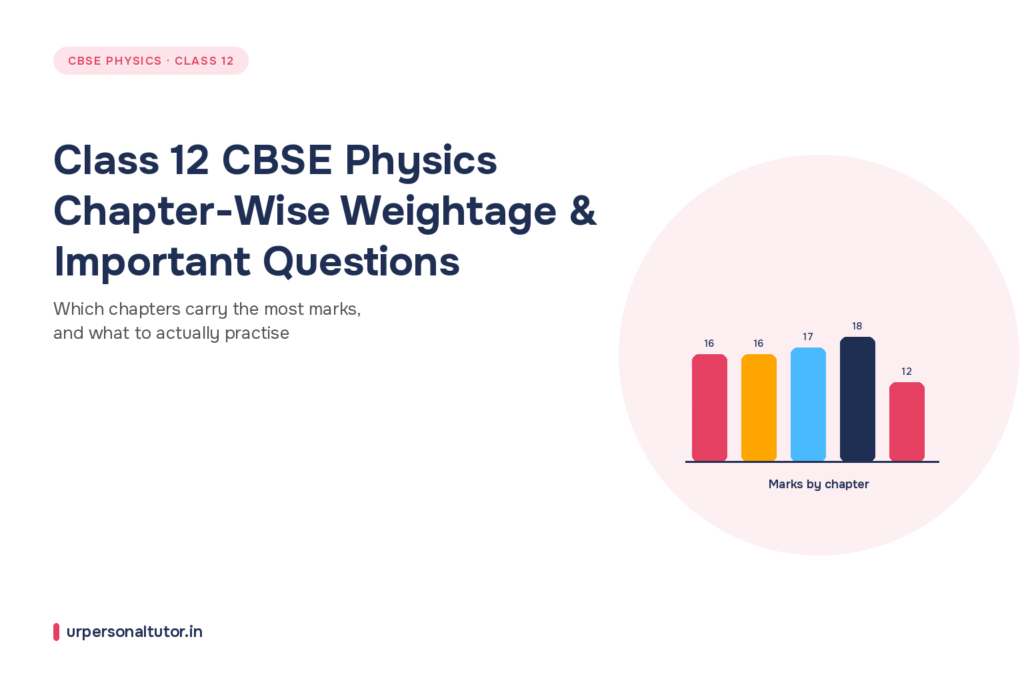
If you only have time to prioritise five chapters this year, make them Optics, Electromagnetic Induction, Current Electricity, Electrostatics, and Magnetism. Together they account for 46 of the 70 theory marks in the CBSE Class 12 Physics board exam. That single fact should shape how you plan the next few months, and it’s the starting point for every set of CBSE Class 12 physics important questions worth practising. This isn’t a guess. CBSE releases a fixed unit-wise blueprint each academic year, and the 2025-26 version keeps the theory paper at 70 marks across 9 units and 14 chapters, with 30 marks reserved for practicals. Once you know where those 70 marks actually sit, chapter-wise important questions stop feeling like a random pile of PYQs and start looking like a study plan — and it also makes it easier to spot common mistakes in CBSE Physics before they cost you marks, since most of them come from misjudging where the exam actually rewards effort. That’s also how important derivations for Class 12 Physics should be approached. Derivation-heavy chapters aren’t evenly distributed either, and a handful of them show up in the long-answer section almost every year. CBSE Class 12 Physics Chapter-Wise Weightage (2025-26) Here’s the official unit breakdown for the current session: Unit Chapters Marks Electrostatics Electric Charges and Fields, Electrostatic Potential and Capacitance 16 Current Electricity Current Electricity 16 Magnetic Effects of Current and Magnetism Moving Charges and Magnetism, Magnetism and Matter 17 Electromagnetic Induction and AC Electromagnetic Induction, Alternating Current 17 Electromagnetic Waves Electromagnetic Waves 18 Optics Ray Optics and Optical Instruments, Wave Optics 18 Dual Nature of Radiation and Matter Dual Nature of Radiation and Matter 12 Atoms and Nuclei Atoms, Nuclei 12 Electronic Devices Semiconductor Electronics 7 A few things jump out once you lay it out like this. Optics and Electromagnetic Waves are grouped separately on paper but often examined together, since wave behaviour connects both. Semiconductor Electronics carries the least weight at 7 marks, yet students routinely spend a disproportionate number of revision hours on it out of familiarity rather than payoff. That’s the kind of mismatch chapter-wise important questions are meant to fix. Why Chapter-Wise Weightage Should Drive Your Revision Order Marks-per-chapter tells you where your hours are worth the most, and that’s really what “important questions” means in practice. A chapter worth 18 marks with three question formats deserves repeated numerical practice, not a single read-through the night before. A 7-mark chapter deserves solid conceptual clarity and maybe fifteen past-year questions, not three weeks of your calendar. Set a rough rule: spend revision time roughly proportional to marks, then add a buffer for chapters you personally find slow, regardless of weightage. Ray optics is a good example — it’s only worth marks within the 18-mark Optics unit, but the diagram work and sign conventions take longer to get fluent in than the mark weight alone suggests. Unit-Wise Important Questions for CBSE Class 12 Physics Electrostatics and Current Electricity — 32 Marks Combined This pair is the most numerical-heavy portion of the paper, and CBSE tends to test it through a mix of derivations and applied problems rather than pure theory recall. Magnetic Effects, Electromagnetic Induction and AC — 34 Marks Combined This is the largest combined block on the paper, and questions here frequently connect two chapters in one problem — for instance, a moving conductor generating both a magnetic force and an induced EMF. Optics and Electromagnetic Waves — 36 Marks Combined The single highest-weightage block in the syllabus, and it rewards students who can move fluidly between ray diagrams, lens formulas, and wave-based reasoning for the same concept. Modern Physics: Dual Nature, Atoms and Nuclei — 24 Marks Combined Modern physics tends to carry a heavier conceptual load relative to its marks, and CBSE regularly frames questions as short numericals tied to a named law or equation. Semiconductor Electronics — 7 Marks Small weightage, but almost always tested through circuit-based or comparison questions rather than derivations. Turning Important Questions Chapterwise Into an Actual Study Routine [INSERT INFOGRAPHIC 1] Knowing the questions isn’t the same as being able to answer them under exam conditions. A workable routine looks something like this: pick one high-weightage chapter, work through 15-20 past-year and sample questions from it, then check how many you solved without referring back to notes. If that number is under 60%, the chapter needs another pass before you move on — no exceptions, even if the calendar says otherwise. Pacing this across an entire syllabus is where most students lose the plot, which is exactly what these time management tips for CBSE Physics preparation are built to fix — allocating study hours by chapter weight rather than by whichever topic feels most comfortable that week. Common Myths Around CBSE Class 12 Physics Important Questions Myth: solving only PYQs guarantees a repeat question. CBSE rarely repeats a question exactly, though it frequently repeats the underlying concept in a new numerical wrapper. Practising PYQs builds pattern recognition, not a guessed answer key. Myth: low-weightage chapters can be skipped entirely. Semiconductor Electronics is only 7 marks, but skipping it outright means giving up marks you could have secured with a few hours of focused revision. Skipping isn’t the same as deprioritising. Myth: memorising derivations word-for-word is enough. CBSE’s marking scheme awards marks for correct steps and reasoning, not verbatim recall. A student who understands why each step follows the last usually scores better than one who memorised the sequence but freezes when the question is phrased differently. Chapter-wise weightage is a planning tool, not a shortcut past actually working through problems. If you’d rather have someone map out a personalised schedule around these numbers instead of building one from scratch, you can book a session with a CBSE physics tutor and get a plan built around your specific gaps and exam date. Frequently Asked Questions Which chapter has the highest weightage in CBSE Class 12 Physics? Optics carries 18 marks, tied with Electromagnetic Waves
Physics Is Not a Hard Subject ? The Honest Answer
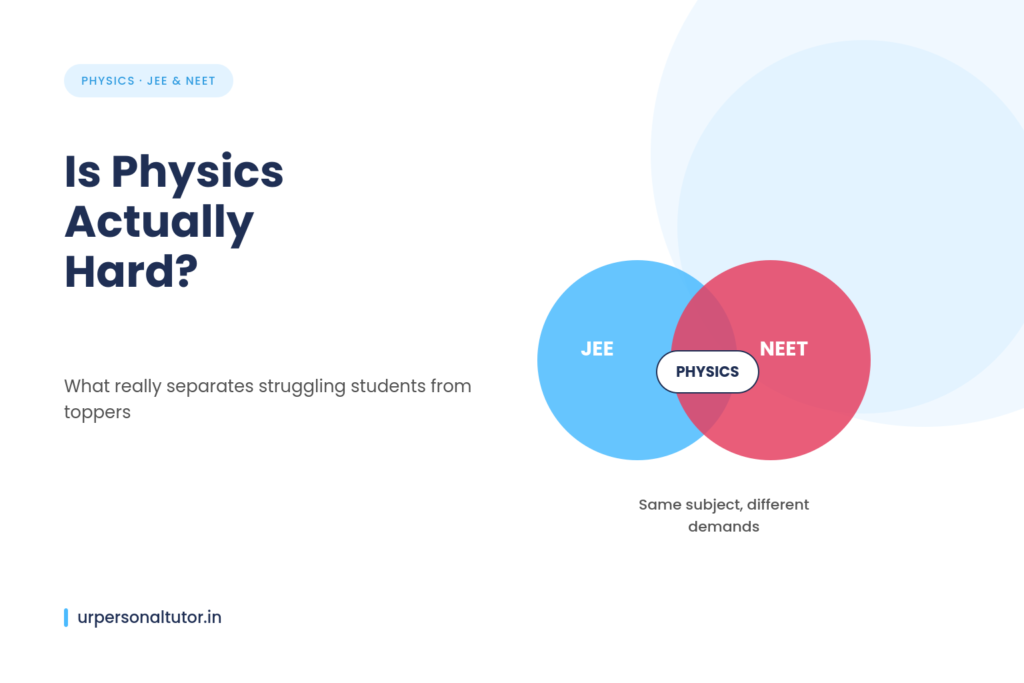
Is Physics Hard? The Honest Answer for JEE and NEET Aspirants No, physics is not inherently hard. It is dense, cumulative, and unforgiving of gaps, which feels the same as “hard” when you’re the one stuck on a rotational dynamics problem at 11 pm. But the subject itself is built on a small set of ideas, applied over and over. Students who struggle usually aren’t facing a harder subject than their classmates. They’re facing the same subject with a weaker foundation, less practice volume, or a teaching style that never connected the formula to the physical picture behind it. That distinction matters more than it sounds. If physics were genuinely hard in some fixed, unchangeable sense, coaching, tutoring, and revision plans wouldn’t move the needle. They do, consistently, which tells you the difficulty is mostly a function of how the subject is approached, not some ceiling baked into the topic. Why Does Physics Feel Difficult in the First Place? Three things make physics feel harder than it is. First, it stacks. Miss the vector basics in Class 11 and every mechanics chapter after it wobbles. Unlike history or even chemistry, where a weak chapter can be somewhat isolated, physics chapters lean on each other. A shaky grip on Newton’s laws will quietly sabotage rotational motion, SHM, and even parts of electromagnetism months later. Second, it demands two skills at once: conceptual understanding and mathematical execution. A student can genuinely understand why a pendulum’s period depends on length and still lose marks because their calculus or trigonometry slipped. Parents and students often diagnose this as “I’m bad at physics” when the real gap is applied maths. Third, most classroom teaching moves too fast to build intuition. Formulas get dictated, students copy them down, and the underlying physical picture never fully lands. That’s a teaching and pacing problem, not proof that the subject is genuinely difficult. Is Physics a Difficult Subject, or Is It Taught Wrong? This is worth separating clearly. Is physics a difficult subject in some absolute sense, or is it difficult the way any subject becomes difficult when it’s rushed? Ask any student who’s had one good teacher explain torque with a spanner and a bolt, versus one who wrote the formula on a board and moved on. Same syllabus, wildly different experience of difficulty. This is also why Class 11 feels so difficult after 10th catches so many toppers off guard. Two books per subject, faster pacing, and physics suddenly demanding calculus-level thinking, all at once. Students who were fine in Class 10 physics can feel like the subject “got hard” overnight. It didn’t get harder. The expectations changed faster than their study habits did. Why Is Physics Difficult for JEE Aspirants Specifically For JEE, is physics hard depends heavily on which physics you mean. Class 11 and 12 board-level physics and JEE-level physics are not the same animal. JEE physics demands multi-concept problems, tight time limits, and problems designed to punish rote formula plugging. A student who memorised without understanding will hit a wall the moment a question combines kinematics with energy conservation in a way they haven’t seen before. The good news: JEE physics rewards depth over memorisation more than JEE chemistry does. Once a student has gone through a proper foundation course for JEE and NEET, they can solve variations of a concept they’ve never practiced. That’s not true of, say, organic chemistry reaction memorisation. So while JEE physics has a steeper initial climb, it plateaus into something more manageable once the fundamentals are locked in. How Difficult Is Getting Physics UG-Level Marks in JEE? How difficult is getting physics UG in JEE, meaning scoring at the level that gets you into a good undergraduate seat, comes down to volume and error correction more than raw talent. JEE Advanced-level physics concept typically test two or three concepts stitched together, and most students lose marks not from ignorance but from small errors under time pressure: a sign flip, a missed constraint, an unchecked unit. Physics vs Chemistry in JEE: Which One Is Actually Harder? Is chemistry of JEE difficult as compared to physics is one of the most common questions students ask before Class 11 even starts. The honest answer: it depends on the type of intelligence you’re relying on. Physical and inorganic chemistry lean heavily on memorisation. Organic chemistry rewards pattern recognition once you’ve internalised reaction mechanisms. Physics rewards conceptual depth and mathematical comfort. A student with a strong memory but weaker maths instincts often finds chemistry more approachable early on, then hits a ceiling in physics later. A student who’s comfortable with equations but has a weaker memory for reagent lists tends to find the opposite. Neither is objectively harder. What’s true is that chemistry has more low-hanging fruit for quick score gains through memorisation, while physics has a higher ceiling once the concepts click, and a slower start while they don’t. Is NEET-UG Physics Harder Than IIT-JEE Physics? Is NEET-UG physics difficult than IIT-JEE physics is a question every NEET aspirant eventually asks, usually while comparing notes with a JEE friend. NEET physics questions are generally less multi-layered than JEE Advanced questions. They test the same syllabus but expect faster, more direct application rather than combining three concepts into one problem. That said, NEET physics is not “easy” by comparison. It’s a different kind of demand: speed and accuracy over 45 questions in limited time, with negative marking that punishes guesswork. Many NEET aspirants underestimate physics because biology dominates their study hours, and the truth is NEET physics preparation is difficult to ignore when it comes to where marks actually get lost. 5 Habits That Actually Make Physics Easier None of these are shortcuts. They’re just what consistently separates students who stop asking “is physics hard” and start treating it as manageable. Draw the diagram before touching the formula. A free body diagram or a labelled sketch forces you to understand the setup before you calculate anything. Derive, don’t just memorise. Deriving