

The fastest way to learn how to solve physics numericals for NEET is to stop treating every problem as a fresh puzzle. Most numericals in NEET Physics draw from a small set of repeatable patterns, and once you can spot the pattern, the actual calculation is usually the easy part. The mistake most aspirants make isn’t a lack of formula knowledge. It’s jumping straight into calculation before identifying what type of problem they’re even looking at.
Why NEET Physics Numericals Feel Harder Than They Are
NEET gives you roughly 66 seconds per question across the full paper, and Physics numericals eat into that budget faster than any other section. That time pressure is exactly why so many students search for how to solve physics numericals for NEET without wasting the first thirty seconds staring at the question.
Here’s the part most coaching classes skip: the difficulty in NEET Physics numericals rarely comes from the underlying concept. It comes from the question hiding which concept applies. A projectile motion question dressed up as a river-boat problem, or a rotational mechanics question disguised as a simple pulley setup, trips up students who know the formulas cold but haven’t practised recognising the setup fast.
How to Solve Physics Numericals for NEET Without Losing Time
Learning how to solve physics numericals for NEET comes down to building the same sequence into muscle memory, every single time, regardless of the topic.
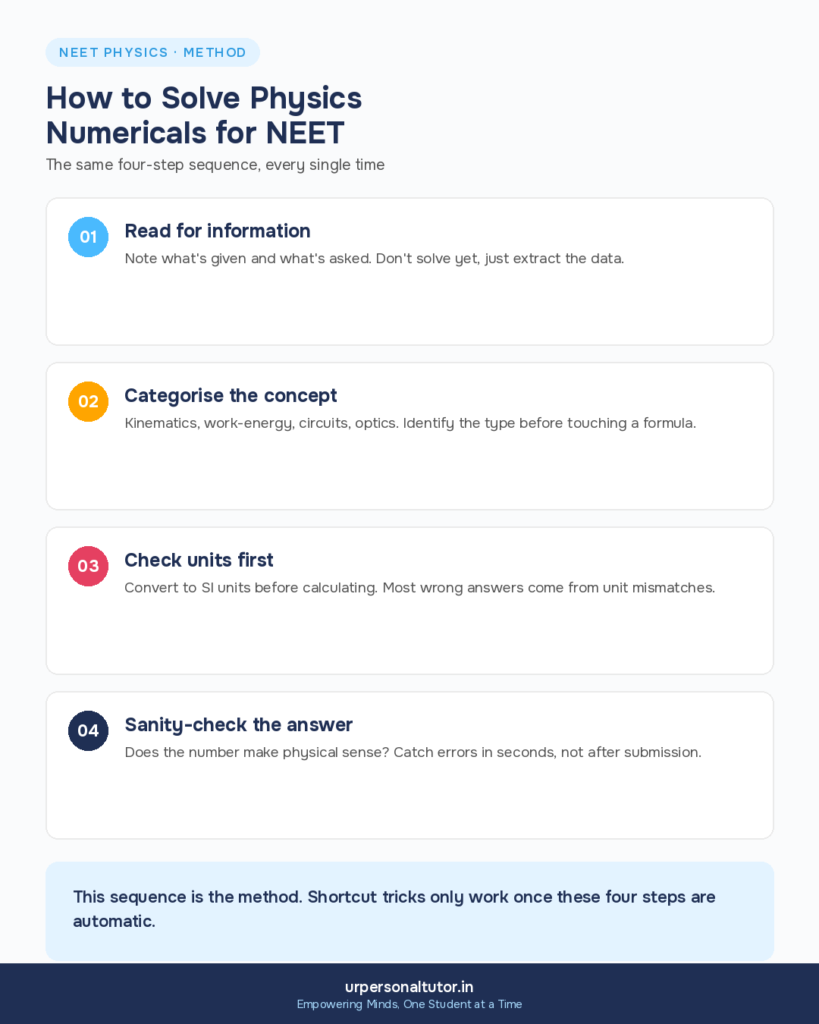
Start by reading the question once for information only, not for solving. Note down what’s given and what’s asked, nothing else. This alone saves time later, because students who skip this often re-read the question two or three times mid-calculation trying to recall a number they already passed over.
Next, identify the concept category before touching a formula. Is this kinematics, work-energy, circuits, or optics? NEET numericals are rarely ambiguous about category once you’ve separated the setup from the noise. This single habit is what separates students who know how to solve physics numericals for NEET efficiently from those who guess-and-check their way through a formula list.
Once the category is clear, write the relevant formula and check units before plugging in numbers. A surprising number of wrong answers in NEET Physics come from unit mismatches, not conceptual errors. Converting everything to SI units before calculation, rather than midway through, cuts this error out almost entirely.
Finally, sanity-check the answer against the physical situation. If a calculated velocity comes out faster than light, or a resistance value comes out negative, something upstream went wrong, and it’s faster to catch that in ten seconds than to lose the mark entirely. This four-part sequence is the actual answer to how to solve physics numericals for NEET consistently, not a one-off trick for a single chapter.
Shortcut Tricks for Physics Numericals for NEET That Actually Work
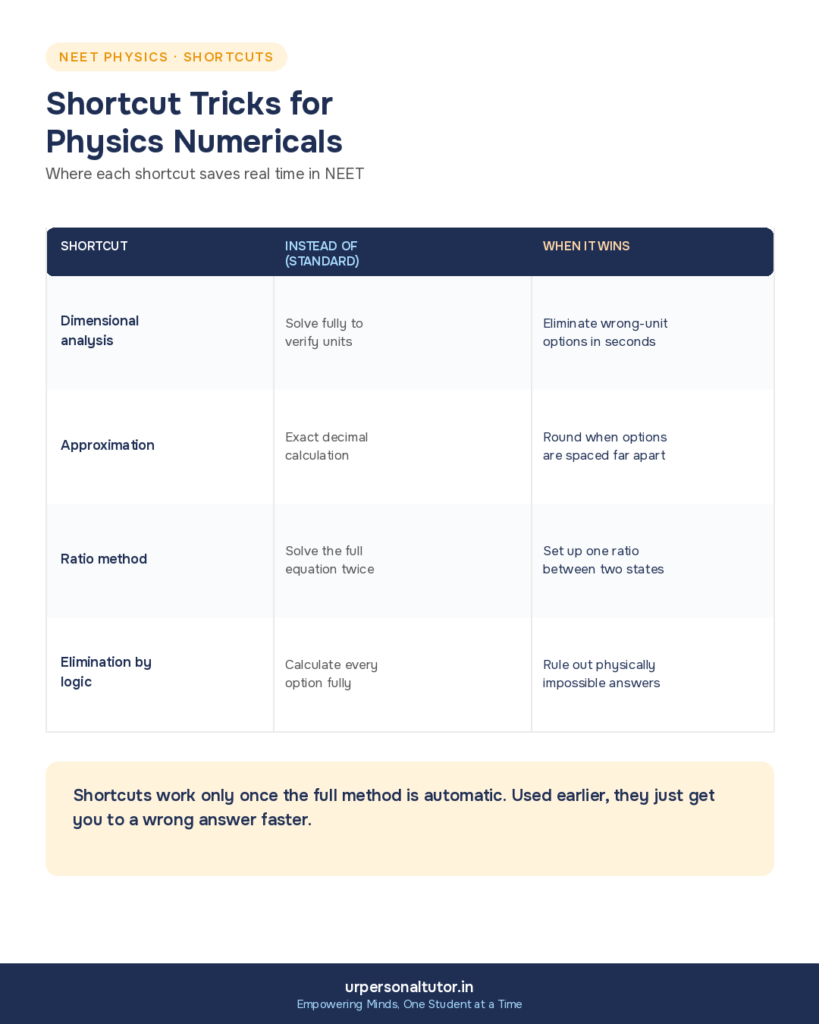
Shortcut tricks for physics numericals for NEET only help once the underlying method above is solid. Used before that, they become a crutch that falls apart the moment a question deviates slightly from the standard format.
That said, a few shortcuts genuinely save time without costing accuracy. Dimensional analysis can eliminate two or three answer choices in seconds when you’re unsure of a formula, since wrong-unit options are common distractors in NEET’s answer choices. Approximation is another one: NEET rewards speed, not decimal precision, so rounding intermediate values when the answer choices are spaced far apart can shave real time off a calculation without changing which option you select.
Ratio-based shortcuts work well for questions that ask how a quantity changes rather than its absolute value, common in gravitation and thermodynamics numericals. Instead of solving the full equation twice, setting up a ratio between the two states usually gets you to the answer in half the steps. These shortcut tricks for physics numericals for NEET are worth drilling specifically, chapter by chapter, rather than hoping they show up naturally during full-length practice.
One habit that ties both the method and the shortcuts together is tracking how many questions to solve per chapter for JEE and NEET alike, since chapters that appear more often in past papers deserve more shortcut drilling than chapters that show up rarely. Spending equal shortcut-practice time across every chapter is a common reason students plateau despite putting in consistent hours.
Common Mistakes When Solving NEET Physics Numericals
The most frequent mistake is skipping the categorisation step under exam pressure and jumping straight to a formula that seems to fit. This works until it doesn’t, usually on a question specifically designed to look like a familiar setup while testing a different concept entirely.
A second mistake is over-relying on memorised numbers instead of memorised relationships. Students who memorise that “the answer to this type of question is usually around X” instead of understanding why the relationship holds get caught out the moment NEET changes the given values in a way that breaks the pattern they memorised.
One habit that ties both the method and the shortcuts together is knowing where the marks actually concentrate. NEET physics important topics and concepts aren’t spread evenly across the syllabus, so drilling shortcuts at the same rate across every chapter ignores how heavily a handful of chapters get tested. Spending equal shortcut-practice time everywhere is a common reason students plateau despite putting in consistent hours.
Myth Check: Do Shortcut Tricks Replace Understanding the Concept
A common myth is that shortcut tricks for physics numericals for NEET can substitute for genuinely understanding the physics. They can’t, and leaning on them too early usually backfires. Shortcuts work because they skip steps in a process you already understand deeply. If the underlying process isn’t solid, a shortcut just gets you to a wrong answer faster.
The honest sequence is to build the full method first, practise it until it’s automatic, and only then layer shortcuts on top for the specific question types where they consistently save time. Students who reverse this order tend to do well on easy numericals and fall apart the moment NEET tweaks a familiar question just enough to break the shortcut’s assumptions.
The honest sequence is to build the full method first, practise it until it’s automatic, and only then layer shortcuts on top for the specific question types where they consistently save time. This is really a question of foundation, and students who never built a strong foundation in physics for NEET aspirants tend to reach for shortcuts as a substitute for understanding, which is exactly the substitution that breaks down the moment NEET tweaks a familiar setup.
Building This Into Your NEET Physics Routine
Knowing how to solve physics numericals for NEET in theory and doing it consistently under exam-day pressure are two different skills. The gap between them closes only through timed practice, not untimed practice. Solve numericals with a stopwatch running from the first read of the question, not from when you start writing.
It also helps to track your numerical accuracy separately from your conceptual accuracy during mock tests. A student who understands a concept but consistently gets the numerical wrong has a process problem, not a knowledge problem, and that’s fixable with the four-part method above rather than more theory revision. Consistent NEET physics preparation built around this kind of tracking tends to close numerical gaps faster than generic extra practice, since it tells you exactly where the breakdown is happening instead of just adding more volume.
Where This Leaves You Before Exam Day
There’s no single trick that makes NEET Physics numericals easy. What works is a repeatable sequence: read for information, categorise before calculating, check units early, and sanity-check the final answer. Shortcut tricks for physics numericals for NEET earn their place only after that sequence is automatic, applied selectively to the question types where they genuinely save time rather than across the board. Students who follow this order consistently see their numerical accuracy improve well before their theory scores do, simply because numericals reward process more than raw recall.
Frequently Asked Questions
How much time should I spend on each physics numerical in NEET?
Roughly 60 to 90 seconds per numerical is a realistic target once your method is automatic, though some multi-step questions in mechanics or electrodynamics may take closer to two minutes. If a single question is regularly taking over three minutes in practice, that’s a sign to revisit the categorisation step rather than push through more slowly.
Are physics numericals in NEET mostly formula-based or concept-based?
Both, but the balance shifts by chapter. Kinematics and electrostatics numericals tend to be more formula-driven once you’ve identified the setup, while numericals in modern physics or thermodynamics often hinge on correctly interpreting what the question is actually asking before any formula applies.
Should I solve numericals topic-wise or through mixed practice closer to the exam?
Topic-wise practice works best when you’re first building the method, since it lets you drill categorisation within a single concept area. Once the method is solid, shift to mixed practice, since NEET doesn’t organise its paper by chapter and mixed sets train you to categorise faster under realistic conditions.
Do NEET physics numericals ever require calculus?
No. NEET Physics numericals are designed to be solvable without calculus, unlike JEE Advanced, which occasionally expects it. If a numerical seems to need calculus to solve directly, there’s almost always a simpler approach using ratios, symmetry, or approximation that NEET intends instead.