
If you are starting your IB Extended Essay for the first time, the single most useful thing to know is this: the essay is a 4,000-word independent research paper marked against five official criteria, and most students lose marks in the first two weeks by picking a research question that is too broad to answer properly. Get the topic and question right early, and the rest of the process becomes far more manageable.
This guide walks through what the IB Extended Essay actually involves, how to pick a workable topic, what the official format expects, and how the marking works, so you can begin with a clear plan instead of a blank page.
What Is the IB Extended Essay?
The IB Extended Essay is one of the three core components of the IB Diploma, alongside Theory of Knowledge and CAS. It asks you to investigate a research question of your choosing in a subject you are studying, then present your findings in a 4,000-word paper written under the guidance of a supervisor at your school.
Unlike coursework, the Extended Essay is marked by an external IB examiner rather than your own teacher. It can add up to three bonus points to your overall Diploma score when combined with your Theory of Knowledge grade, and a very weak result on either component can put the full Diploma at risk. That combination of upside and risk is exactly why it deserves proper planning from day one, not a rushed attempt squeezed into study leave.
Because supervisors are only allowed limited contact hours with each student, a lot of the early decision-making falls on you. Knowing what a strong topic looks like before your first meeting will save weeks of back and forth.
How to Choose a Topic for Your IB Extended Essay
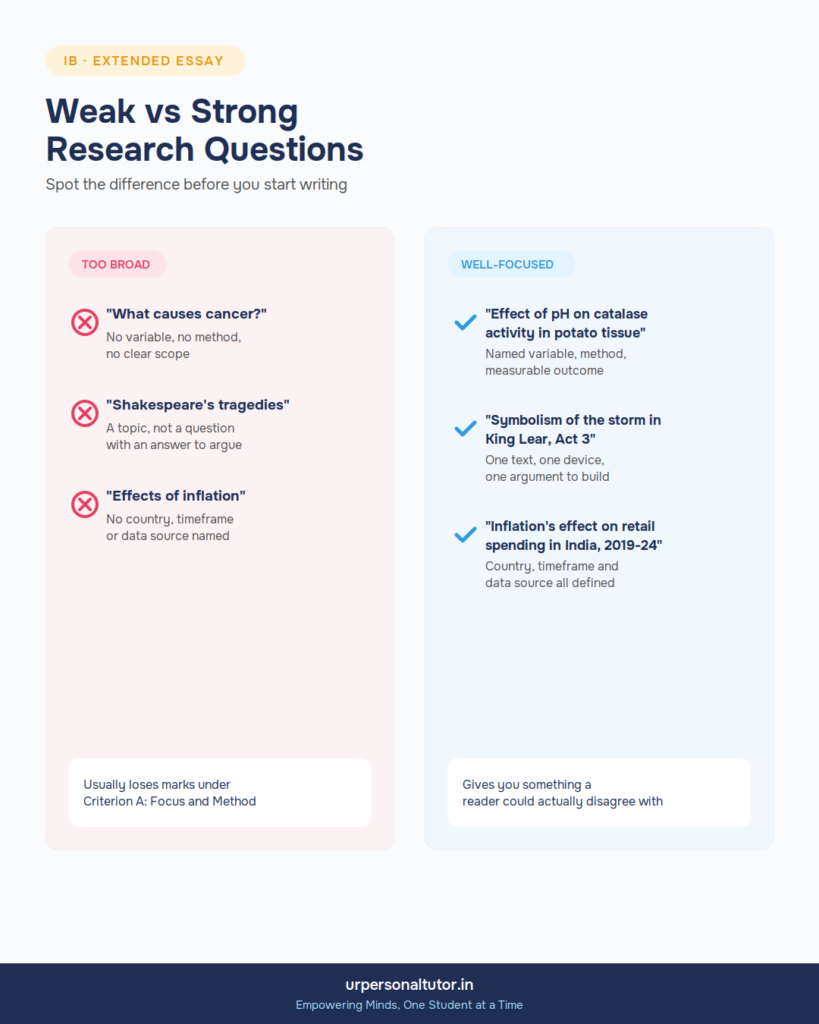
Pick a topic you can turn into a specific, answerable research question within your subject’s methodology, not a broad theme you find interesting. A good IB Extended Essay research question is narrow enough to investigate properly in 4,000 words and specific enough that a reader could disagree with your conclusion.
Compare these two approaches in biology. “What causes cancer?” cannot be answered in an Extended Essay; it is a textbook question, not a research question. A workable version might be “What is the effect of pH on catalase activity in potato tissue, measured by oxygen release rate?” That question names a variable, a method, and a measurable outcome. Most strong ib biology extended essay examples follow this pattern: a controlled variable, a clear method, and data you can actually collect.
The subject you choose changes what “good research” looks like. An ib economics extended essay usually works with real-world data, trade statistics, or a case study evaluated against economic theory. An ib english extended essay tends to build a literary argument through close textual analysis rather than experiments. Students preparing for both a Diploma exam load and an essay like this sometimes underestimate how much groundwork subject choice requires.
A rough test before you commit: can you list three sources or three experiments you could realistically access within the next month? If not, narrow the topic further.
Understanding the IB Extended Essay Format
The official structure is fixed, and following it correctly is worth real marks under presentation criteria. A standard Extended Essay includes a title page, a contents page, an introduction, the main body divided into logical sections, a conclusion, a full reference list, and appendices where needed.
The abstract that older sessions required has been phased out for most subjects under the current guidelines, so check your subject-specific instructions rather than assuming last year’s template applies. Word count matters too: the 4,000-word limit excludes the title page, contents page, footnotes, and bibliography, but it includes everything in the main body and any in-text citations.
Referencing has to be consistent throughout, using one recognised style such as MLA, APA, or Chicago. Examiners are trained to spot inconsistent citation formatting quickly, and it costs marks under presentation even when the underlying research is solid.
What the IB Extended Essay Guidelines Actually Require
Before you write a single paragraph, read your subject’s official ib extended essay guidelines rather than relying on general advice, including this one, as your only source. Each subject has its own guide covering acceptable methodologies, subject-specific terminology expectations, and examples of research questions that have worked well in the past.
Your school will also ask you to sign an academic honesty declaration confirming the essay is your own work and properly sourced. Plagiarism, including AI-generated text passed off as original writing, is treated as a serious breach and can result in the essay being awarded no marks at all. If you are unsure whether a source needs citing, cite it. Time spent checking your subject guide early is far cheaper than reworking a draft after your supervisor flags a structural problem three weeks before the deadline, which is a scenario covered in more depth in our guide to IB exam preparation and time management.
How the IB Extended Essay Mark Scheme Works
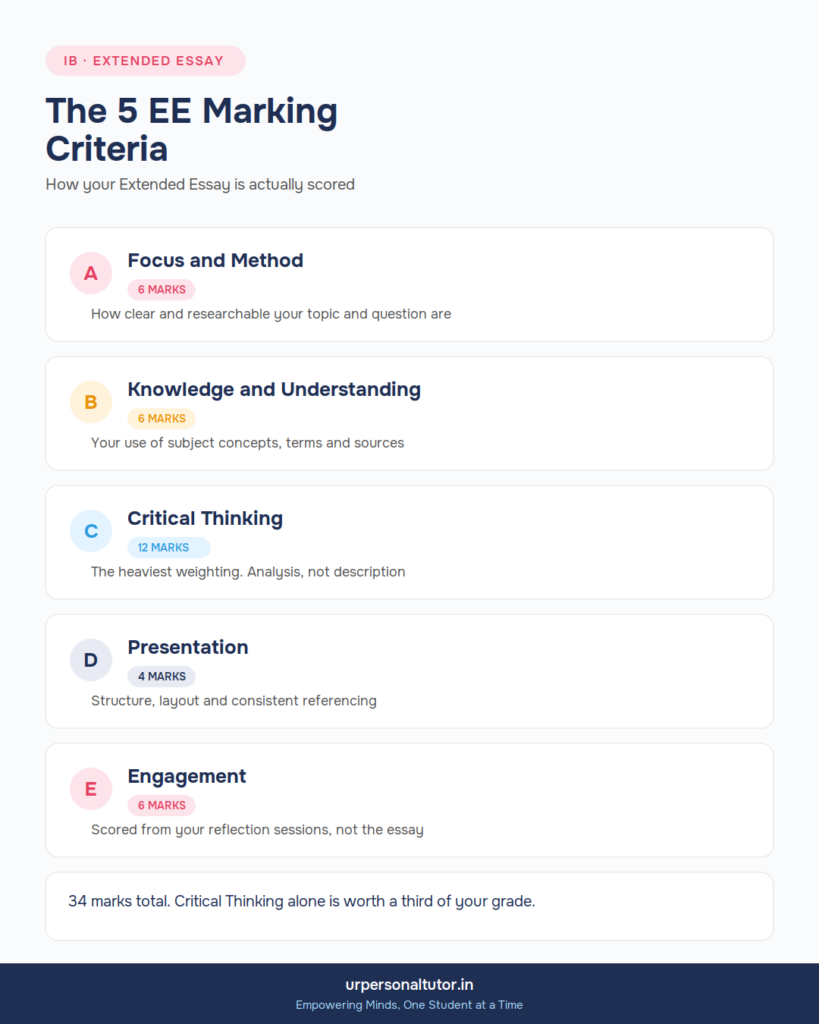
Your Extended Essay is graded out of 34 marks across five criteria under the current assessment model, which applies through the November 2026 session. Criterion A, Focus and Method, is worth 6 marks and looks at how clearly your research question and approach are defined. Criterion B, Knowledge and Understanding, is also worth 6 marks and assesses how well you use subject-specific concepts and terminology.
Criterion C, Critical Thinking, carries the most weight at 12 marks and rewards analysis, argument, and evaluation rather than description. Criterion D, Presentation, is worth 4 marks and covers structure, layout, and formatting. Criterion E, Engagement, is worth 6 marks, and unusually, it is assessed almost entirely from your Reflections on Planning and Progress form rather than the essay text itself.
Grade boundaries typically run from 27 to 34 marks for an A, down to 0 to 6 for an E, though exact figures shift slightly each session. If you are starting your research in the 2026 to 2027 school year, ask your coordinator whether your examination session falls under the current 34-mark model or the redesigned criteria being introduced from May 2027, since the two use different criterion names and weightings.
Understanding the ib extended essay marking criteria before you draft anything changes how you write. If Critical Thinking carries a third of your total marks, your essay needs sustained analysis threaded through every section, not just a summary of sources followed by a short conclusion.
Working With an IB Extended Essay Tutor
A supervisor at your school is required, but their contact time is limited by IB rules, usually to a handful of meetings across the whole process. That gap is why many students bring in an ib extended essay tutor alongside their school supervisor, particularly for subjects like physics or economics where methodology choices early on determine whether the whole project is workable.
A good tutor will not write your essay or your research question for you. What they can do is stress-test your question before you commit weeks of research to it, check your data analysis makes sense for your subject, and read drafts against the actual marking criteria rather than general writing advice. If you are weighing up whether one-to-one support makes sense for your situation, our piece on choosing the right physics tutor covers questions worth asking before you commit to sessions.
Common Beginner Mistakes in the IB Extended Essay
Three mistakes show up again and again in early drafts. The first is a research question that is really a topic in disguise, something like “Shakespeare’s use of tragedy,” which has no clear answer to argue toward. The second is collecting data or sources before narrowing the question, which leads to essays that wander because the writer is trying to use everything they found rather than what actually answers the question.
The third mistake is treating the reflection sessions with your supervisor as a formality. Since Criterion E is marked from your RPPF, vague reflections written the night before submission read as exactly that. Genuine notes about a method that did not work, a source that changed your thinking, or a problem you had to solve tend to score far better than polished summaries written after the fact.
FAQ: IB Extended Essay for Beginners
How long should I spend choosing my Extended Essay topic?
Most students who end up with strong essays spend two to four weeks narrowing their topic before writing anything, including time spent checking whether enough sources or data actually exist. Rushing this stage to “get started” usually costs more time later when the question needs reworking mid-draft.
Can I change my Extended Essay subject after I start?
Yes, though it becomes harder the further into the process you are. Most schools allow a subject or topic change within the first month if you flag concerns to your supervisor early, but changing after significant research has been done usually means starting the clock over.
Does the Extended Essay need to include original research?
It depends on the subject. Sciences typically expect original data collection through experiments, while subjects like history or English usually work with existing sources analysed through your own argument. Check your subject-specific guide, since expectations differ more than students often assume.
What happens if my Extended Essay exceeds 4,000 words?
Examiners are instructed to stop reading at the word limit, meaning content beyond 4,000 words in the main body will not be assessed at all. Going over the limit does not just risk a penalty; it risks losing your conclusion entirely if that is where the extra length ends up.
Start Your IB Extended Essay With a Clear Plan
The IB Extended Essay rewards early planning far more than late effort. A narrow, well-defined research question, a format that follows the official guidelines, and genuine engagement recorded honestly through your reflection sessions will do more for your final grade than an extra week of writing under pressure.
If you want a second opinion on your research question or help mapping out a realistic timeline before you commit to a topic, get in touch to arrange a consultation with one of our tutors.