
Go through five or six years of chemistry IGCSE past papers and the same question shapes keep showing up. Command words like “state,” “explain,” and “describe” carry specific mark expectations that repeat paper after paper. Multi-step calculation questions in the same three or four topics appear almost every session. Once a student recognises these patterns, past papers stop feeling random and start feeling predictable.
That’s the short answer. The rest of this guide walks through exactly which patterns recur, why they recur, and how to prepare for them without just memorising answers.
Why Cambridge IGCSE Chemistry Past Papers Follow a Predictable Structure
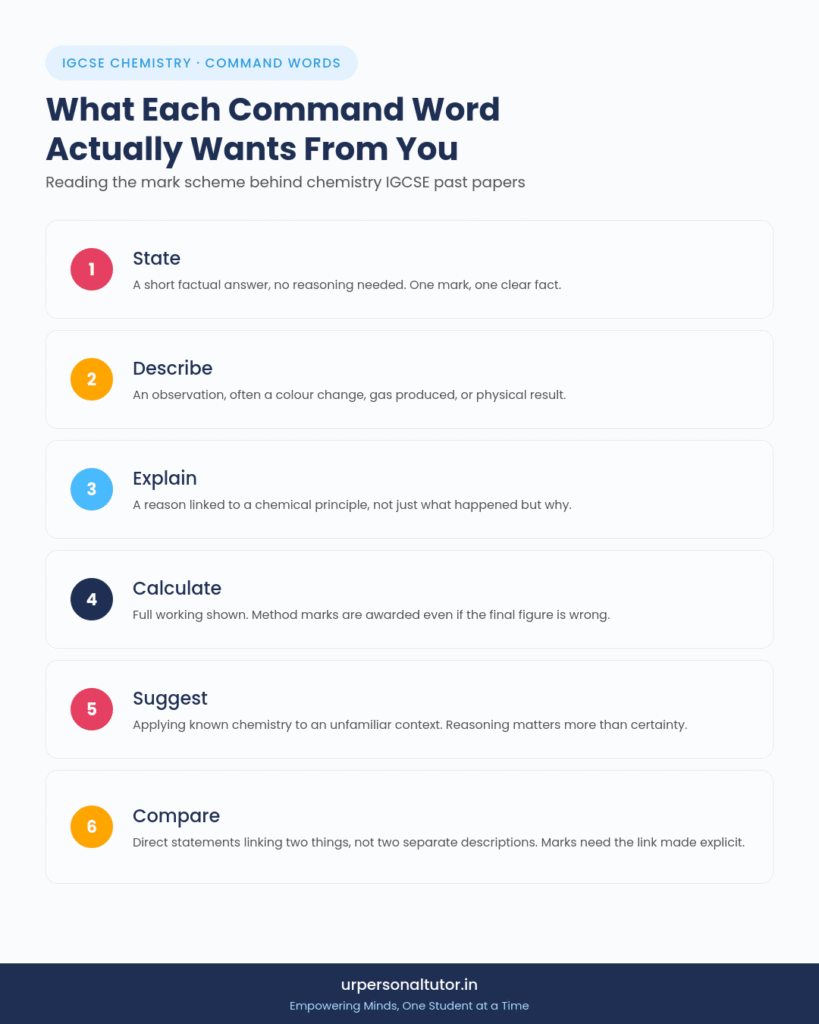
Cambridge IGCSE chemistry past papers are built from a fixed syllabus with defined assessment objectives, which is exactly why the structure repeats. Examiners write to a mark scheme framework that rewards specific command words differently. “State” wants a short factual answer. “Explain” wants a reason linked to a chemical principle. “Describe” wants an observation, often tied to a practical result like colour change or gas evolved.
Once a student sees this pattern across a handful of papers, the exam stops feeling unpredictable. It becomes a case of matching the command word to the type of answer it demands, rather than guessing at length or detail.
The Recurring Question Types in Chemistry IGCSE Past Papers
Command Word Questions
These sit at the core of almost every paper. A typical Paper 4 question might ask students to state the products of electrolysis, then explain why one product forms at a particular electrode. The mark scheme usually splits marks cleanly between the factual state and the reasoning behind it, so answering only half the question costs marks even when the chemistry is correct.
Practical and Observation-Based Questions
Practical questions describe an experiment and ask what a student would see, smell, or measure. Colour changes during titration, gas tests using a lit splint or limewater, and precipitate formation in ionic reactions come up repeatedly. Students who’ve actually done or watched these experiments answer faster, since the description comes from memory rather than guesswork.
Calculation Questions
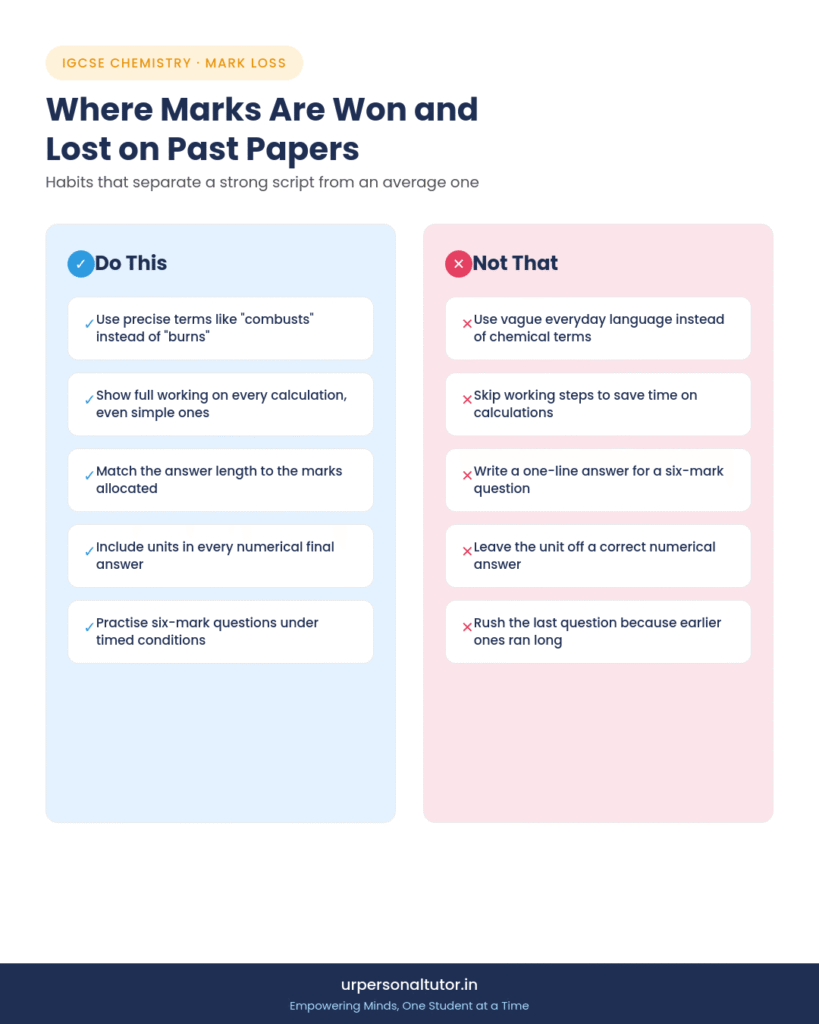
Moles, empirical formula, and percentage yield calculations appear in nearly every paper, often worth four to six marks each. These questions reward showing working, since method marks are awarded even when the final answer is wrong. Skipping steps to save time usually costs more marks than it saves.
Extended Response Questions
Longer six-mark questions, usually near the end of a paper, ask students to link several concepts together, such as explaining rates of reaction using both collision theory and a given graph. These questions test whether ideas connect, not just whether each fact is known individually.
How to Use Chemistry IGCSE Past Papers by Topic
Working through papers chronologically, one full paper at a time, is a common approach, but it isn’t always the most efficient one. Sorting chemistry igcse past papers by topic, pulling every electrolysis question from the last eight years into one set for example, shows the pattern much faster than spreading the same topic across separate full papers. A student revising acids and bases, for instance, can solve twenty related questions in an afternoon rather than stumbling on two or three scattered across different sessions.
This topic-first approach works particularly well in the run-up to exams, when there’s limited time left and certain weak areas need targeted practice rather than broad review. Many students build this into their final weeks alongside a structured 12-week revision plan that allocates specific weeks to specific paper types.
Where Students Lose Marks Even When They Know the Chemistry
A lot of mark loss in chemistry IGCSE past papers has nothing to do with not knowing the content. Students often understand a reaction perfectly but lose marks by writing “burns” instead of “combusts” in a context where the mark scheme wants precise terminology. Others give a correct answer but skip the unit in a calculation, which usually costs a mark even when the number itself is right.
Timing is another quiet cost. Six-mark extended questions get rushed because earlier short-answer questions took longer than planned, leaving too little time to structure a full response. Practising under timed conditions, not just working through questions untimed, catches this problem before it shows up on exam day.
What Cambridge IGCSE Chemistry Past Papers Reveal About Command Words
Breaking down a stack of cambridge igcse chemistry past papers by command word rather than by topic reveals just how consistent the mark allocation is. “Suggest” questions, which ask students to apply knowledge to an unfamiliar context, are graded more generously on reasoning than on getting the single “correct” answer. “Calculate” questions almost always award a method mark independent of the final figure. Recognising which command word is being used before writing a single word of the answer saves time and reduces the chance of writing more than the marks actually require.
Students moving between exam boards sometimes ask how chemistry content compares, particularly those weighing an IGCSE vs CBSE pathway, since command-word based marking is quite different from the descriptive answer style many CBSE papers reward.
Building a Topical Past Paper Habit That Actually Works
Chemistry topical past papers igcse students rely on most effectively are the ones revisited more than once. Solving a topic set cold, marking it honestly against the scheme, then returning to the same set two weeks later without looking at previous answers shows whether a concept has actually been retained or just recognised. This second pass is where most of the real improvement in exam technique happens, since it exposes whether an answer was understood or simply remembered from the first attempt.
Grade boundaries shift slightly year to year, so understanding how raw marks translate into a final grade also matters. A quick look at the IGCSE grading system helps put practice paper scores into context, since a strong raw score one year might sit at a different grade boundary than the same score the year before.
Ready to Build a Chemistry Revision Plan Around This?
Recognising question patterns is only useful once it shapes an actual study routine. If you’d like help turning this into a structured plan for the weeks ahead, book a session with Ur Personal Tutor or browse more exam preparation guides on the blog.
Frequently Asked Questions
How many years of chemistry IGCSE past papers should I practise?
Working through six to eight years of papers, both the standard and topical versions, usually covers enough repetition to spot the recurring command word and question-type patterns without over-practising the same content past the point of benefit.
Are IGCSE chemistry past papers similar across exam sessions in the same year?
Papers from the same syllabus year but different sessions, such as February/March versus May/June, often test the same topics with different numbers and contexts, which makes them useful for practising pattern recognition rather than memorising specific answers.
Do calculation questions in chemistry IGCSE past papers follow the same format every year?
Broadly yes. Mole calculations, empirical formula, and percentage yield questions follow consistent multi-step formats, though the specific compounds and numbers change each session.
Is it better to time past papers or work through them untimed first?
Both have a place. Working untimed first while learning a topic makes sense, but shifting to timed conditions at least a month before the exam catches pacing problems that untimed practice never reveals.
Do mark schemes for chemistry IGCSE past papers explain why marks were lost?
Most official mark schemes list acceptable answers and common misconceptions examiners penalise, which makes them worth reading in full rather than just checking whether the final answer matches.