
If your IGCSE physics revision feels scattered, the fix usually isn’t more practice. It’s more targeted practice. Working through questions topic by topic, rather than jumping between random past papers, forces you to master one set of ideas at a time and exposes exactly which formulas you haven’t actually learned yet. Most students who plateau in physics aren’t short on effort. They’re short on structure.
This matters even more once you start relying on all IGCSE physics formulas as your revision anchor. A formula sheet only helps if you know which formula belongs to which topic and why. Random practice papers mix everything together, so a weak spot in electricity gets buried under twelve questions you already know how to do. Topic-wise practice strips that noise away.
Why Mixed Practice Sets Hide Your Weak Topics
A typical past paper covers six or seven topics in one sitting. You might score 70% overall and feel fine about it, but that number can hide a real problem. Maybe you got every mechanics question right and every electricity question wrong, and the average just smoothed it over. You won’t see that pattern unless you isolate topics and test them one at a time.
Topic-wise questions solve this by giving you a clean signal. If you sit down and do fifteen questions on waves, your score on that set tells you exactly where you stand in waves, nothing else. Over a few weeks, that builds an honest map of your strengths rather than a vague sense of “I’m okay at physics.” Students following a structured 12-week revision plan tend to build this topic-by-topic map early, which is exactly why it works better than cramming everything together in the final month.
Building Your All IGCSE Physics Formulas List by Topic
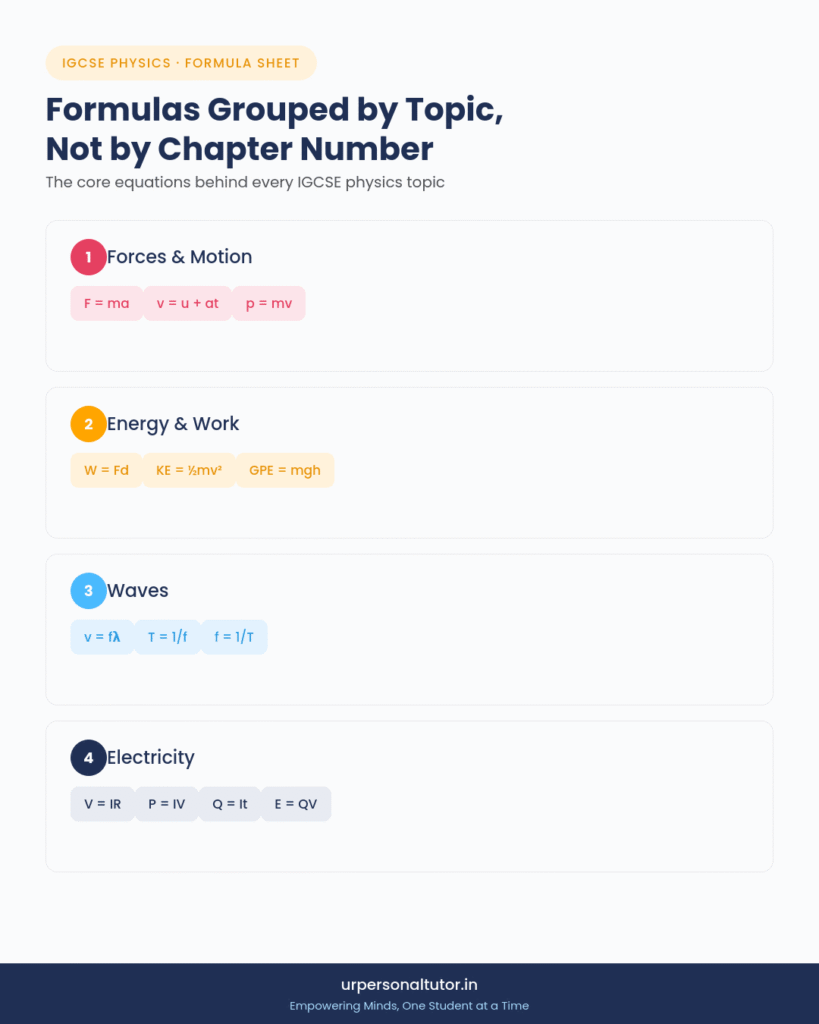
Before you start topic-wise practice, it helps to organise all IGCSE physics formulas into groups that match the syllabus structure: forces and motion, energy, waves, electricity, magnetism, and matter. Most students keep one long formula sheet with everything crammed onto a single page, and that’s actually part of the problem. A flat list makes it harder to see which formulas cluster together and which ones you keep confusing.
Split your igcse physics formula sheet into six or seven smaller sections, one per topic, and revise them alongside the matching topic questions. When you practise density and pressure questions, only the matter formulas should be in front of you. When you move to circuits, switch to the electricity page. This pairing between formula and question type is what actually locks the equations into memory, far more than reading a full list of all IGCSE physics formulas in isolation ever will.
How to Practise Each Physics Topic Without Just Memorising Answers
Start each topic with the conceptual questions before you touch calculations. IGCSE physics papers reward understanding, not just plugging numbers into a formula, and examiners are good at spotting students who’ve memorised a method without grasping why it works. Read the question twice, identify what’s actually being asked, then decide which formula from your all IGCSE physics formulas list applies.
Once the concept clicks, move into calculation-heavy questions on the same topic. Repeat wrong answers a day later rather than immediately, since spacing out the repeat catches whether you actually understood the fix or just copied the mark scheme. Students often skip this step and wonder why the same mistake reappears in their next mock exam.
Keep a short error log per topic. Write down which formula you misapplied and why, not just the correct answer. Over a term, this log becomes more useful than any generic study guide because it’s built entirely from your own mistakes.
Where Formula Mix-Ups Cost the Most Marks
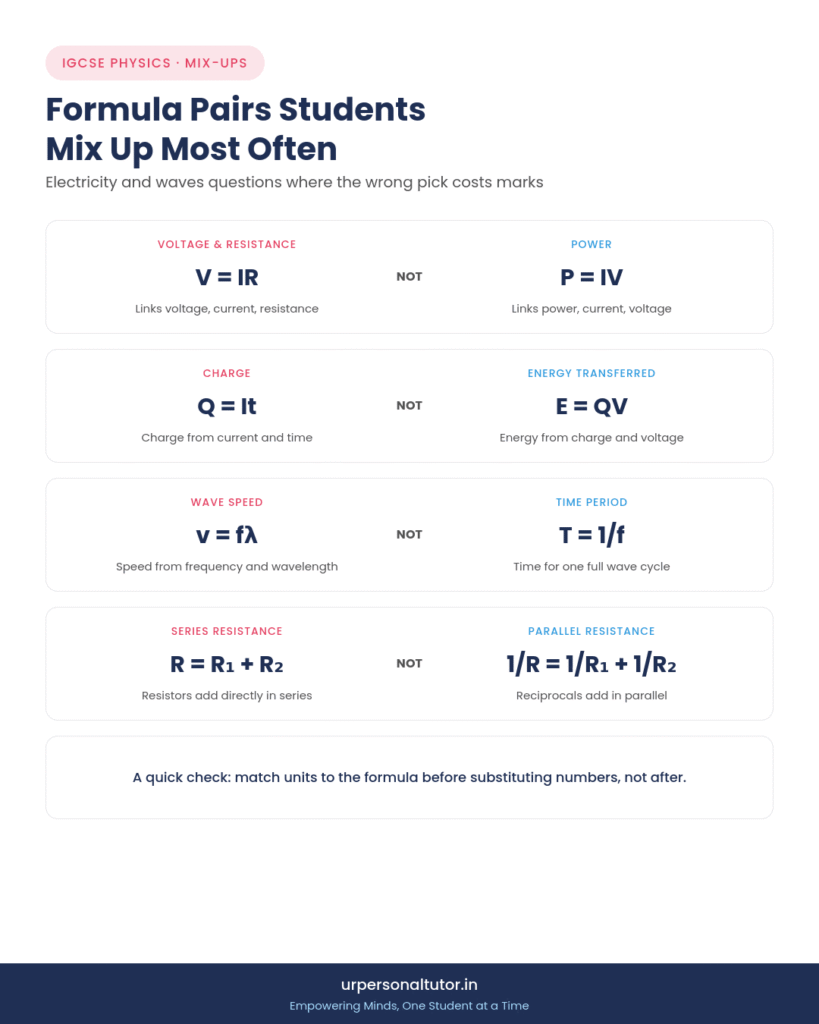
Electricity and waves are where most students lose marks tied directly to formula confusion. Voltage, current, and resistance equations look similar enough that under exam pressure, students swap them. Wave speed, frequency, and wavelength cause the same problem in reverse, since all three variables can be rearranged three different ways depending on what the question gives you.
This is also where grade boundaries get decided. A single formula mix-up on a six-mark question can be the difference between one grade band and the next, which is worth keeping in mind if you’re mapping your target score against the IGCSE grading system. Topic-wise drilling on just electricity, repeated until the formulas stop getting swapped, closes this gap faster than doing another full past paper.
Turning Weak Topics Into an Actual Study Schedule
Once you know your weak topics from isolated practice, build your remaining revision time around them instead of repeating a generic checklist. Give weak topics two sessions a week and strong topics one, and re-test every two weeks to check whether the gap is closing. This is a different approach from GCSE physics revision in some ways, so if you’re weighing GCSE against IGCSE for a syllabus switch, the formula lists and command word expectations do shift slightly between boards, and it’s worth checking that before locking in your revision structure.
Physics is cumulative. A shaky grasp of forces in the first term tends to resurface in momentum questions two terms later, so closing gaps early rather than in the final fortnight before exams pays off more than any last-minute cramming session ever does.
Ready to Turn Weak Topics Into Strong Ones?
If you’d rather have someone map your weak topics for you instead of guessing, a session or two of one-to-one physics tuition can usually identify the two or three formula groups costing you the most marks, and build a plan around them from there. Book a consultation and we’ll go through your last mock paper together, topic by topic.
Frequently Asked Questions
How many IGCSE physics topics should I revise before starting past papers?
Cover all core topics at least once with topic-wise questions before attempting a full past paper. Mixing topics too early hides weak areas rather than revealing them, so sequence matters more than speed here.
Is it better to memorise all IGCSE physics formulas or understand where they come from?
Both, but in that order for exam day: understanding first, memorisation second. Students who only memorise struggle when a question is phrased differently from the practice version they’re used to, even when the underlying formula is identical.
How often should I retest a topic once I think I’ve mastered it?
Roughly every two to three weeks. Physics knowledge fades faster than most students expect, and a topic you nailed in September can slip by December without a quick retest to catch it early.
Do topic-wise questions help with the practical or only the theory paper?
They help with both, since practical papers still test the same underlying formulas, just applied to experimental data and uncertainty rather than clean textbook numbers.