

The hardest A-Level physics questions are difficult because they combine two or three concepts in an unfamiliar context, not because they use content students haven’t studied. Top students solve them by identifying which separate ideas are being tested inside one question, then working through each piece in isolation before combining them. Most students lose marks not from lacking knowledge, but from trying to solve the whole question at once instead of breaking it apart first.
Every A-Level physics paper has a handful of questions that separate strong students from everyone else. They rarely sit at the end by coincidence. Exam boards deliberately design the hardest A-Level physics questions to test whether a student can apply familiar physics in an unfamiliar arrangement, not just recall it. That distinction matters more than most revision guides admit, and it changes how these questions should actually be practiced.
What Makes the Hardest A-Level Physics Questions So Difficult
A question becomes one of the hardest A-Level physics questions when it forces a student to recognise which topic is even being tested. A mechanics question that quietly requires energy conservation halfway through, or a fields question that switches from electric to magnetic reasoning mid-way, catches students who’ve only practiced topics in isolation, a pattern that becomes obvious once you look at how tightly interconnected topics are across the A-Level physics syllabus.
This is different from a question simply being long. Length alone doesn’t make something hard. A six-mark question that clearly signals “use conservation of momentum” is often easier than a four-mark question that gives no such signal and expects the student to spot it themselves.
How Top Students Read These Questions Differently
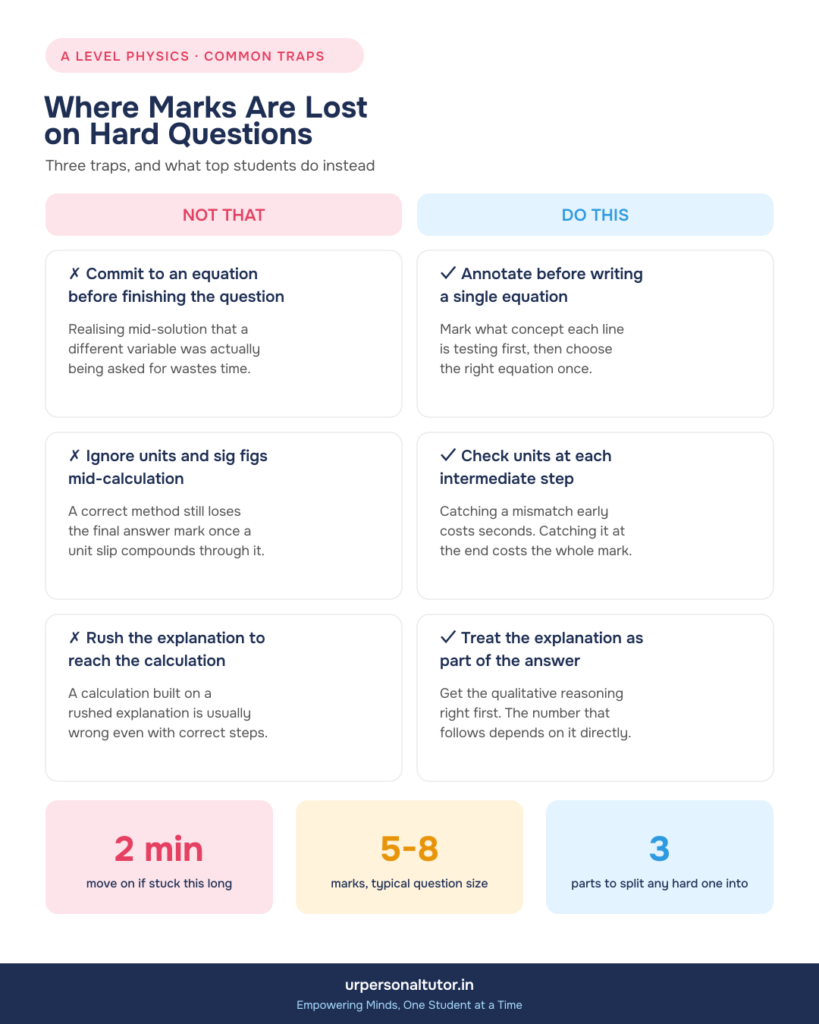
Top students don’t start calculating the moment they finish reading. They spend the first ten to fifteen seconds identifying what physics concept each sentence in the question is pointing toward, often underlining or annotating the command words and given values before writing a single equation. This habit alone accounts for a large share of the gap between students who handle the hardest A-Level physics questions comfortably and those who don’t.
A useful way to build this habit is annotating past questions after the fact rather than only during timed practice. Going back through a question you’ve already solved and marking which concept each line was testing trains the same pattern recognition that top students use instinctively during the actual exam.
Breaking Down a Multi-Step Mechanics Question
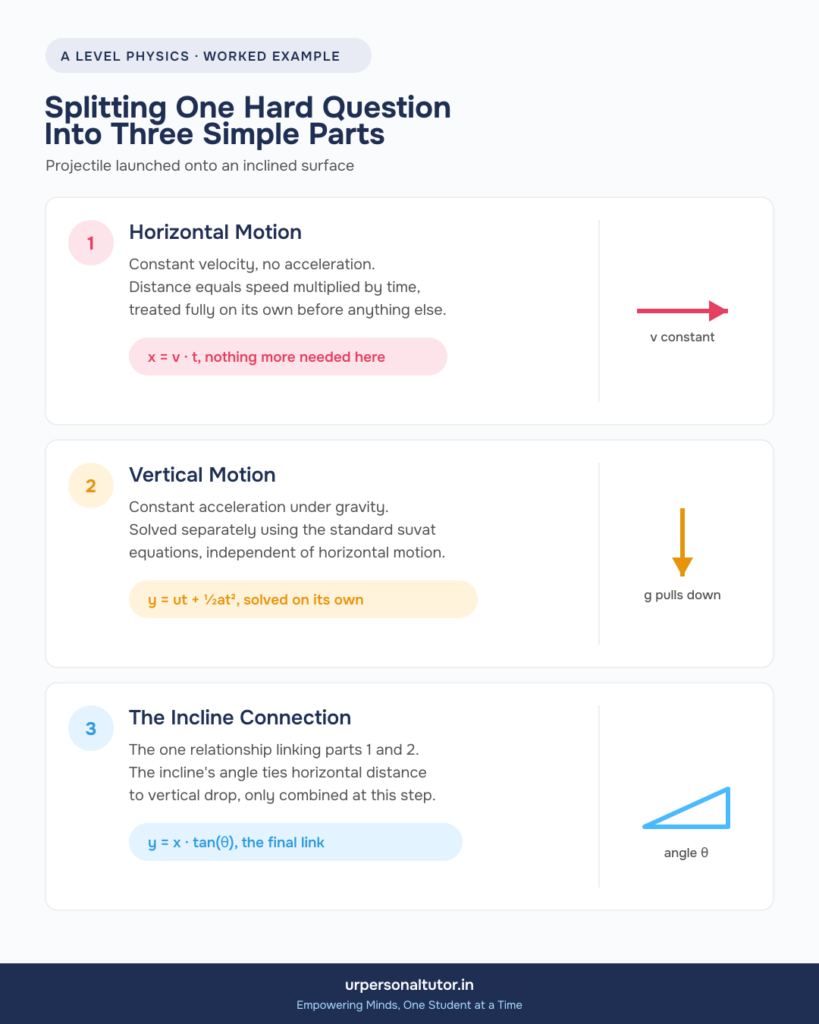
Take a typical example: a projectile launched from a height, landing on an inclined surface, with a question asking for the time of flight. Students who struggle usually try to solve the whole trajectory in one combined equation. Students who handle the hardest A-Level physics questions well split it immediately: horizontal motion as one clean equation, vertical motion as a second, and the incline’s geometry as a third relationship connecting the two.
None of those three pieces is individually hard. The difficulty is entirely in recognising that three separate relationships need to be set up before any numbers get substituted. This is exactly the skill that separates a grade A student from a grade C student on the same question, since both likely know the underlying equations.
Common Traps in the Hardest A-Level Physics Questions
The most common trap is committing to an equation before fully reading the question, then realising halfway through that a different variable was actually being asked for. A close second is ignoring units and significant figures mid-calculation, which compounds into a wrong final answer even when the physics reasoning was correct throughout.
A third trap shows up specifically in questions that mix qualitative and quantitative demands, asking a student to first explain a phenomenon and only then calculate something dependent on that explanation. Students who rush past the explanation to reach the calculation often get the number wrong too, since the calculation was built on an incomplete or incorrect understanding from the first part.
Building the Skill Through Practice, Not Just Volume
Solving more questions doesn’t automatically make someone better at the hardest A-Level physics questions. What matters is solving a smaller number of genuinely difficult questions slowly, with full working shown, rather than a large number of easier questions quickly. Timed practice has its place closer to the exam, but early practice should prioritise understanding why a question is structured the way it is, which is exactly why this kind of slow, difficult-question work belongs early in a revision plan rather than squeezed into the final fortnight.
Past papers organised by topic tend to work better for this than papers organised by year, since a student can isolate exactly the type of multi-step question they’re weakest at rather than working through a mixed paper where only two questions actually challenge them.
Why Some Students Freeze Under Exam Conditions
A student who can solve a difficult question calmly at home sometimes blanks on an equivalent question in the exam hall. This usually isn’t a knowledge gap, it’s a time-pressure response. The hardest A-Level physics questions often appear two-thirds of the way through a paper, right when time pressure is highest and confidence from earlier questions has either built up or eroded.
Practicing under genuine time constraints, not just working through questions with unlimited time, closes most of this gap. It’s less about speed and more about training the brain to still apply the “break it into parts” habit even when the clock is visible.
A Realistic Study Approach for These Questions
A student aiming to get comfortable with the hardest A-Level physics questions benefits from checking their own syllabus coverage first, since a shaky grasp of one chapter often resurfaces specifically in the multi-concept questions that combine it with something else.
From there, a slower month of targeted, difficult-question practice works better than a rushed final sprint, one that saves the hardest questions for the very end, when there’s no time left to sit with a question that doesn’t click on the first attempt.
It also helps to know what typically goes wrong under exam conditions specifically, since some of the marks lost on hard questions come from technique rather than physics. A look at common exam mistakes alongside difficult-question practice tends to close both gaps at once instead of treating them as separate problems.
FAQs
Are the hardest A-Level physics questions usually in mechanics?
Mechanics tends to produce a large share of multi-step questions because it combines easily with energy and momentum concepts, but genuinely hard questions appear just as often in fields and electricity, particularly where two field types interact.
How many marks do the hardest A-Level physics questions usually carry?
They’re most commonly worth five to eight marks, though difficulty doesn’t always scale with mark allocation, since a well-disguised four-mark question can trip up more students than an obviously long eight-mark one.
Should I skip a hard question and come back to it later in the exam?
Yes, if a question isn’t yielding progress within roughly two minutes of genuine attempt, moving on and returning later usually protects more marks overall than losing time that could secure easier questions elsewhere on the paper.
Do calculator-based errors matter as much as conceptual errors on hard questions?
They matter more than most students expect, since a correct method with a calculator slip still loses the final answer mark, even though method marks along the way are usually preserved under standard mark schemes.
Is it worth memorising past hard questions directly?
Not directly, since exam boards rarely repeat a question verbatim, but memorising the underlying structure and concept combinations that make a question hard is genuinely useful and transfers to unfamiliar versions of the same idea.