
The Cambridge A-Level syllabus is built subject by subject, each with its own syllabus code, split across an AS stage and an A2 stage that together make up the full qualification. There isn’t a single shared syllabus document the way some national boards structure things. A student’s physics syllabus, chemistry syllabus, and economics syllabus are each separate documents from Cambridge International, updated on their own schedule, with their own paper structure and grading criteria.
That subject-by-subject design is exactly why so many students find the a level syllabus confusing when they first look for it online. Searching for “the A Level syllabus” as if it were one PDF leads nowhere useful, because what you actually need is the specific syllabus document for each subject you’re taking, published under its own code and revised on its own cycle.
How the Cambridge A-Level Syllabus Is Structured
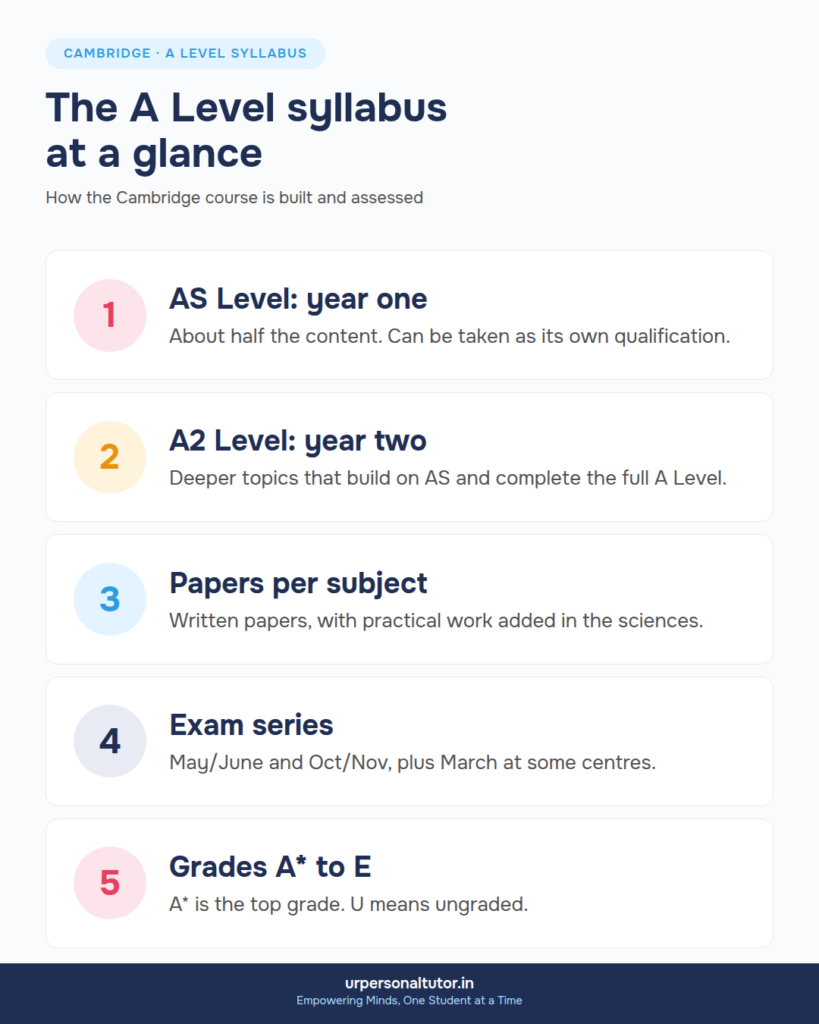
Every Cambridge a level syllabus follows a two-stage design: Cambridge International AS Level content first, followed by the second half of content that completes the full A Level, often still called A2 informally even though Cambridge itself doesn’t always use that label anymore. Students can, in some subjects, take the AS portion as a standalone qualification without continuing to the full A Level, which gives some flexibility that doesn’t exist in every exam board’s structure.
Each subject’s a level course syllabus lists its own set of topics, assessment objectives, and command words, the specific verbs like “explain,” “evaluate,” or “calculate” that tell you what kind of answer a question expects. Two students studying different subjects under the same Cambridge A Level umbrella can have syllabus documents that look nothing alike in structure, even if both follow the same general AS-to-full-qualification design.
What a Cambridge A-Level Syllabus Document Actually Contains
A syllabus document itself isn’t just a topic list. It typically opens with an overview of the qualification’s aims, followed by a full breakdown of content organised by topic or unit, then a section on assessment objectives that explains how marks are distributed across skills like knowledge recall, application, and analysis. Command words get their own section too, since misreading a command word is one of the most common ways students lose marks on questions they otherwise understood.
Science and math syllabuses tend to include a formula list or data booklet reference as well, detailing exactly what will and won’t be provided in the exam. If you want to see what a fully worked example of this looks like for one specific subject, the physics syllabus breakdown for CIE 9702 walks through how one science subject’s document is actually organised, paper by paper.
How Papers Are Structured Within the Syllabus
Most subjects under the cambridge a level syllabus system split their assessment across multiple papers rather than one long exam. Sciences commonly separate multiple-choice papers from longer structured-response papers, and often add a dedicated practical paper that tests lab skills directly rather than through written description alone. Humanities and languages tend to lean more on extended written responses and, in some subjects, coursework components marked by the school and moderated externally.
This paper-by-paper split matters for how you should actually prepare. Revising “the syllabus” as one undivided block of content ignores the fact that a multiple-choice paper rewards speed and breadth, while a structured-response paper rewards depth and the ability to build a full argument or derivation from scratch.
AS Level vs the Full A Level
A Cambridge a level syllabus generally treats the AS stage as content that’s slightly less demanding in depth, though covering related themes, compared to what gets added in the second half of the qualification. Grading also differs: standalone AS Level results are graded on a narrower scale than the full A Level, which is one reason schools sometimes use AS grades as a checkpoint rather than a final outcome, especially when a student plans to continue to the full qualification.
It’s worth knowing this distinction going in, because study resources sometimes blur AS and full A Level content together without flagging which parts apply to which stage. A syllabus document itself is usually explicit about this, marking AS-only content separately from full A Level additions.
Why the Syllabus Code Matters More Than the Subject Name
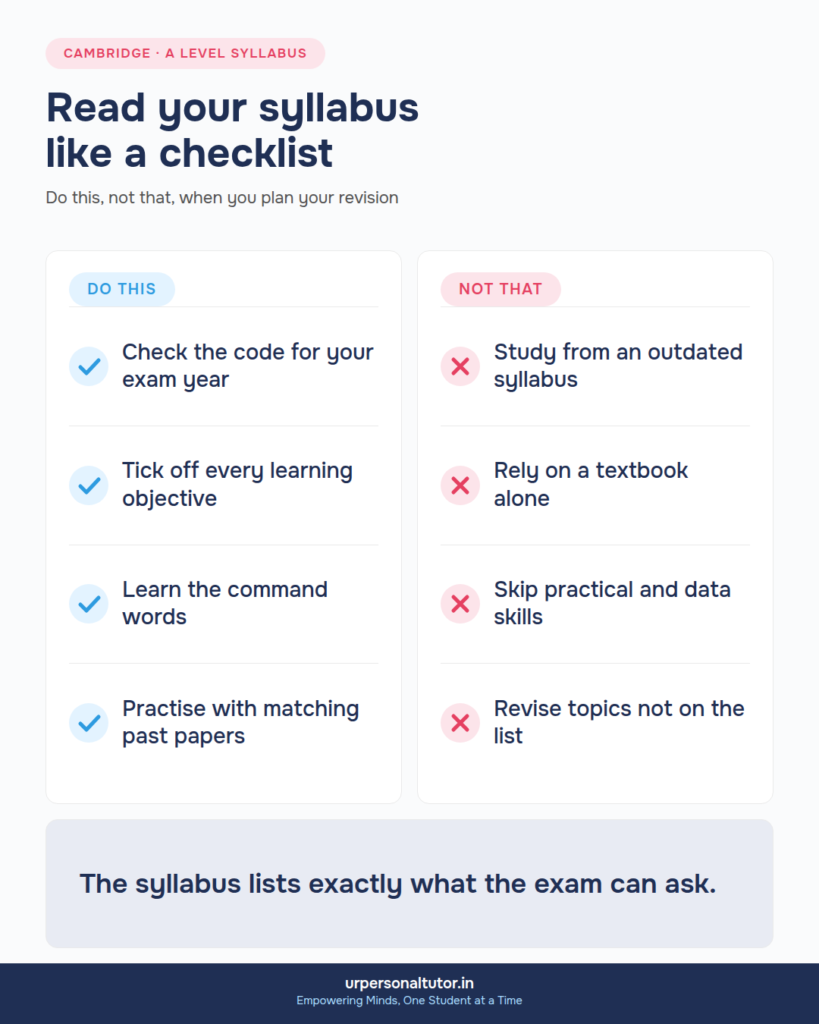
Two schools teaching “A Level Chemistry” might actually be following different syllabus codes if one follows Cambridge International and another follows a different exam board entirely, and even within Cambridge, syllabus codes get revised periodically with content shifts that aren’t always obvious from the subject name alone. Always checking the exact syllabus code your school has registered you for, rather than assuming based on the subject title, avoids the fairly common mistake of revising from an outdated or mismatched version of the a level syllabus.
This confusion shows up most with subjects that have had recent syllabus revisions, where an older sibling’s notes or a secondhand textbook might reference content that’s since been removed or restructured.
How the Syllabus Connects to Final Grades
The cambridge a level syllabus for each subject sets out exactly how much weight each paper carries toward the final grade, and that weighting isn’t always split evenly. A practical paper might carry less percentage weight than a written structured paper despite taking real class time to prepare for, which occasionally surprises students who assume every paper counts equally.
Grade boundaries themselves aren’t fixed in the syllabus document, since those shift slightly each exam series based on overall performance, but the syllabus does fix how many total marks are available and how they’re distributed. Students planning a revision timeline around final grades benefit from understanding this weighting early, since a subject where one paper carries 40% of the total mark deserves proportionally more prep time than a paper worth 15%.
Common Mistakes Students Make With the A-Level Syllabus
The most frequent mistake is treating a textbook as the syllabus itself. Textbooks are written to broadly match a syllabus but often include extra depth or examples that go beyond what’s actually examinable, which can lead to over-preparing on tangents while under-preparing on core assessment objectives. Cross-checking any textbook chapter against the actual syllabus document catches this early.
Another common issue is ignoring the assessment objectives section entirely and jumping straight to content. Two students can know identical content but score very differently if one has practised applying it in the specific way a paper’s mark scheme rewards. A structured revision plan built around a subject’s actual paper weighting tends to close that gap faster than content review alone.
A third mistake is leaving syllabus-code verification until close to the exam. Confirming the exact code and version early in the course, directly from the school or Cambridge’s own published list, avoids a last-minute scramble to figure out which topics actually apply.
FAQs
Is the Cambridge A-Level syllabus the same every year?
No, syllabus documents are revised periodically, sometimes with significant content changes, so checking the version and code your school has registered for each year matters more than assuming continuity from a previous cohort.
Do all Cambridge A-Level subjects follow the same paper structure?
No, paper structure varies considerably by subject, with sciences typically including a dedicated practical component that humanities and language subjects usually don’t have.
Can a student take AS Level without continuing to the full A Level?
In many subjects yes, since Cambridge allows AS Level to be certificated as a standalone qualification, though this depends on how the school has structured the course rather than being guaranteed for every subject.
Where can students find the official syllabus document for their subject?
Cambridge International publishes syllabus documents directly on its own website under each subject’s specific code, and schools registering students for exams typically have access to the current version as well.
Does the syllabus document explain how grade boundaries are set?
No, the syllabus sets out total marks and how they’re weighted across papers, but grade boundaries are determined separately each exam series based on that series’ overall candidate performance.