

IGCSE Physics Syllabus Explained: What Students Need to Study
The IGCSE physics syllabus covers six main topic areas: general physics, thermal physics, waves, electricity and magnetism, atomic physics, and space physics. Cambridge assesses it through two or three written papers plus a practical component, and students choose between a Core and an Extended tier depending on the grades they’re targeting. That’s the short version. The rest of this guide walks through what each section actually involves and how to plan your study time around it. [INSERT FEATURED IMAGE] What Is the Cambridge IGCSE Physics Syllabus (0625)? The Cambridge IGCSE physics syllabus is officially numbered 0625, and it’s designed to build scientific thinking rather than just memory recall. Students learn to apply physical laws to real situations, interpret data from experiments, and explain phenomena using correct terminology. Cambridge updates the syllabus periodically, so it’s worth checking the exact specification document for your exam year rather than relying on notes from an older cohort. Most schools teach the content over two years, starting in Year 10. The pacing matters more than students expect. Rushing through electricity in three weeks to “get it over with” usually means it has to be relearned before the mock exams anyway. Core Topics Covered in the IGCSE Physics Syllabus Here’s what sits inside the IGCSE physics syllabus, section by section. General physics opens the syllabus and covers motion, mass, density, forces, momentum, and energy transfers. This is the foundation for nearly everything that follows, which is why weak understanding here tends to show up as weak marks in later topics too. Thermal physics deals with kinetic theory, states of matter, thermal expansion, and heat transfer through conduction, convection, and radiation. Students often find this section approachable at first glance, then lose marks because they describe processes vaguely instead of using the specific vocabulary examiners look for. Waves covers general wave properties, light, and sound. Refraction and reflection questions come up almost every year, usually paired with a diagram students need to complete accurately rather than just describe. Electricity and magnetism is the largest section by mark allocation in most papers. It includes circuits, current, voltage, resistance, electromagnetic effects, and magnetic fields. Circuit calculations are where a lot of Core-tier students plateau, since the maths compounds quickly if the basic formulas aren’t automatic. Atomic physics introduces radioactivity, the structure of the atom, and nuclear processes. It’s a shorter section but a common source of last-minute panic, since it’s frequently left until the end of the course. Space physics rounds things out with the solar system, stars, and the universe. It’s usually the smallest scoring section, though Extended-tier papers go slightly deeper into orbital motion and the life cycle of stars. Core vs Extended: Which IGCSE Physics Syllabus Tier Should You Choose? Cambridge splits the IGCSE physics extended syllabus from the Core tier, and picking the right one changes both what you study and the highest grade you can achieve. Core tier caps out at a C grade (or equivalent under the 9-1 scale) but covers a narrower range of content, with less demanding maths. Extended tier opens access to the full grade range up to an A*, but adds harder numerical problems, more depth on electromagnetism, and questions that expect students to apply concepts to unfamiliar contexts rather than recall them directly. Teachers usually make this call around the midpoint of Year 10, based on mock results and how comfortable a student is with algebra-heavy questions. If you’re on the border, it’s worth talking through the trade-offs with a personalized igcse tutor before committing, since switching tiers late in the course is possible but adds pressure to an already tight timeline. How the IGCSE Physics Syllabus Is Assessed Assessment for the IGCSE physics syllabus is split between written theory papers and a practical skills component. Core-tier students sit Paper 1 (multiple choice) and Paper 3 (theory), while Extended-tier students sit Paper 2 and Paper 4 instead, both of which carry a higher proportion of extended-response and calculation questions. All students also complete either Paper 5 (a practical test) or Paper 6 (an alternative to practical, for schools without full lab access). Grade boundaries shift slightly year to year depending on overall performance across the cohort, so a raw mark that scored a B one session might score an A the next. It’s a system worth understanding rather than obsessing over, since chasing exact percentage targets can distract from actually learning the content properly. Practical Skills the IGCSE Physics Syllabus Tests Practical competence isn’t an add-on to the IGCSE physics syllabus, it’s a formally examined component. Students are expected to plan simple investigations, take accurate readings, record data in appropriate tables, plot graphs correctly with labelled axes, and draw conclusions that are actually supported by the data collected. Errors in this section are rarely about physics understanding. They’re about habits like forgetting units, misreading a scale, or drawing a best-fit line that ignores an obvious anomaly. Students who only ever revise from a textbook, without doing hands-on practicals or at least working through past practical papers, tend to underperform relative to their theory knowledge. It’s one of the most fixable gaps in the whole syllabus. Common Struggles Students Face With the IGCSE Physics Syllabus A persistent myth is that the IGCSE physics syllabus rewards memorising formulas and definitions word for word. It doesn’t, not on its own. Cambridge questions frequently rephrase a familiar concept into an unfamiliar scenario, and students who’ve only memorised without understanding the underlying logic get stuck the moment the wording changes. A formula sheet helps with recall, but it can’t substitute for knowing when and why to apply a given equation. The honest answer is that strong performance comes from a mix of solid recall, comfort with the maths, and enough exposure to varied question styles that nothing on exam day feels genuinely unfamiliar. There’s no shortcut that skips the practice. How to Study the IGCSE Physics Syllabus Effectively Spacing out revision across the full two-year course, rather than compressing it into the
IB vs IGCSE: Difficulty Level, Workload, and Academic Expectations
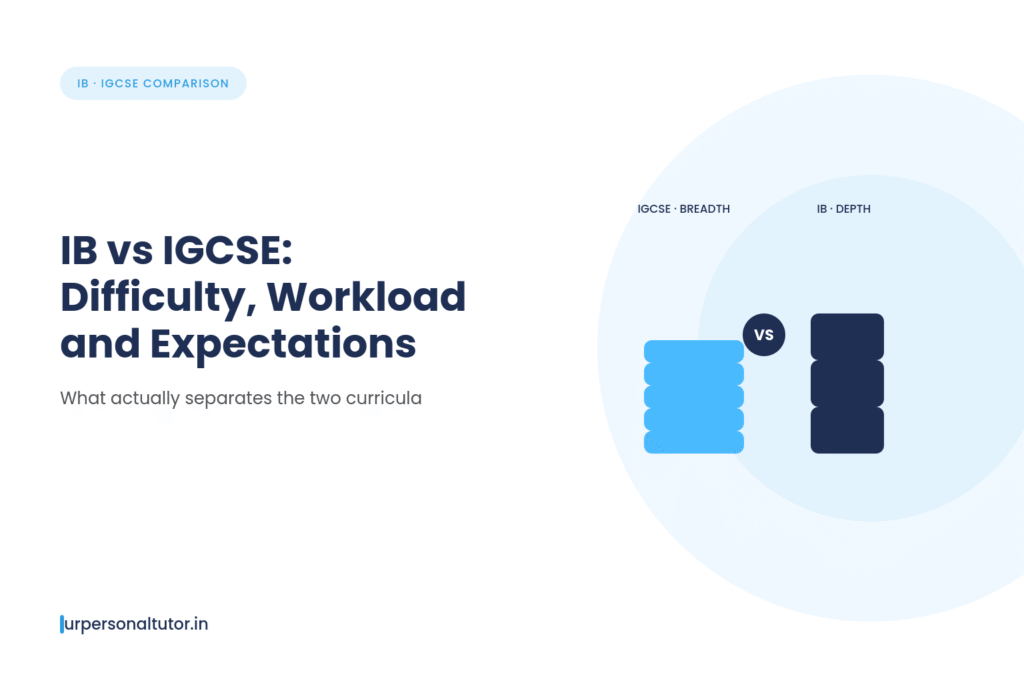
IB vs IGCSE: Which One Is Actually Harder IB is generally considered more demanding than IGCSE, mainly because of its two-year Diploma structure, extended essay, and Theory of Knowledge component, while IGCSE is a two-year foundation curriculum that ends at Class 10 with no equivalent research or reflection workload. That’s the short answer. But calling IB “harder” without context misses what actually makes each one difficult in its own way, and that’s what parents comparing IB vs IGCSE usually want to understand before choosing a school. This comparison looks at workload, grading, subject depth, and what each curriculum expects from a student day to day, not just exam difficulty on paper. IB vs IGCSE at a Glance: What Separates Them Structurally IGCSE runs from Class 9 to Class 10, acting as a foundation stage before students pick A-Levels, IB Diploma, or a national board for Classes 11 and 12. IB, when people say “IB” without qualifying it, usually means the IB Diploma Programme, which runs across Class 11 and 12 and is a self-contained two-year qualification with its own university-entry weight. This is where a lot of confusion starts. Comparing IB vs IGCSE directly is a bit like comparing a foundation year to a final qualification, because they don’t sit at the same stage of schooling. IGCSE prepares a student for choices ahead; IB is often one of those choices. Difficulty Level: Where IB and IGCSE Actually Diverge IGCSE difficulty comes from breadth. Students typically take 8 to 10 subjects, each assessed with detailed syllabus content and external exams, which means constant switching between subject types and exam formats. The workload is wide rather than deep. IB difficulty comes from depth and independent work. A typical IB Diploma student takes six subjects, three at Higher Level and three at Standard Level, alongside the Extended Essay, Theory of Knowledge, and CAS (Creativity, Activity, Service) hours. None of that exists in IGCSE. The research-driven component of IB exam prep and time managment is often what catches students off guard, since it demands sustained independent work over months rather than exam-season revision. Neither curriculum is objectively “easier.” A student who thrives on broad subject coverage may find IGCSE more manageable, while a student who prefers depth over breadth often finds IB’s structure more natural, even with the extra workload it brings. Workload Comparison Between IB and IGCSE IGCSE workload is front-loaded with content coverage and past-paper practice, especially in the final two terms before board exams. Most of it is exam-pattern based: know the syllabus, practise the question styles, repeat. IB workload is spread more evenly across two years, but it never really lets up. Internal assessments, lab reports, oral commentaries, and the Extended Essay all carry deadlines throughout both years, not just at the end. A student comparing IB vs IGCSE purely on “how many hours per week” often underestimates IB, because the hours aren’t concentrated the same way. They show up as a constant background load rather than a single intense exam season. Academic Expectations in IB and IGCSE Classrooms IGCSE classrooms tend to be structured around syllabus completion. Teachers move through defined content, and success is measured by how well a student reproduces that content accurately under exam conditions. IB classrooms expect more self-direction. Students are regularly asked to justify reasoning, cite sources, and reflect on their own learning process, not just produce correct answers. This shift catches many students by surprise in Class 11, particularly those coming from a board-heavy Class 10 where marks were tied closely to memorisation. Understanding the gap between GCSE and IGCSE-style teaching versus IB’s expectations can help families set the right expectations before committing to either path. IB vs IGCSE India: What Indian Students Should Know IB vs IGCSE India comparisons come with a few local wrinkles. IB Diploma scores are widely accepted by Indian universities now, but some competitive exam pathways, like JEE or NEET preparation running alongside school, can feel harder to balance with IB’s CAS and Extended Essay deadlines than with a more exam-focused IGCSE or CBSE track. Availability also matters practically. IB schools remain less common outside major Indian cities compared to IGCSE, which has wider reach through international and semi-international schools. Families weighing IB vs IGCSE India should factor in school access, not just curriculum preference, since switching boards mid-way is far more disruptive than choosing carefully at the outset. IGCSE vs IB Diploma: Choosing the Right Path After Class 10 The real decision point isn’t IGCSE vs IB as competing options, since most students do IGCSE first and then decide what comes next. The question is really IGCSE vs IB diploma versus A-Levels versus a national board for Classes 11 and 12. Students who enjoyed the breadth of IGCSE subjects and want to keep options open often lean toward A-Levels. Students who want a globally recognised, research-heavy qualification with built-in reflection and service components tend to choose IB. Neither choice is wrong, but it should follow from how a student actually studies, not just which one sounds more prestigious on paper. Common Myths About the Difference Between IB and IGCSE One persistent myth is that IGCSE is “easy” because it doesn’t have IB’s extended components. In reality, IGCSE’s breadth across 8 to 10 subjects creates its own kind of pressure, especially for students who struggle to context-switch between very different subject types in the same week. Another myth is that IB automatically leads to better university outcomes than IGCSE followed by A-Levels or a board curriculum. University admissions depend far more on individual grades and subject choices than on which qualification badge sits on the transcript. The difference between IB and IGCSE matters less to admissions officers than how well a student actually performed within whichever system they were in. Still Deciding Between IB and IGCSE? Choosing between IB and IGCSE, or figuring out what comes after IGCSE, usually goes smoother with someone who’s guided students through both. If you’d like help thinking through which path fits
Common Question Patterns Found in IGCSE Chemistry Past Papers
Go through five or six years of chemistry IGCSE past papers and the same question shapes keep showing up. Command words like “state,” “explain,” and “describe” carry specific mark expectations that repeat paper after paper. Multi-step calculation questions in the same three or four topics appear almost every session. Once a student recognises these patterns, past papers stop feeling random and start feeling predictable. That’s the short answer. The rest of this guide walks through exactly which patterns recur, why they recur, and how to prepare for them without just memorising answers. Why Cambridge IGCSE Chemistry Past Papers Follow a Predictable Structure Cambridge IGCSE chemistry past papers are built from a fixed syllabus with defined assessment objectives, which is exactly why the structure repeats. Examiners write to a mark scheme framework that rewards specific command words differently. “State” wants a short factual answer. “Explain” wants a reason linked to a chemical principle. “Describe” wants an observation, often tied to a practical result like colour change or gas evolved. Once a student sees this pattern across a handful of papers, the exam stops feeling unpredictable. It becomes a case of matching the command word to the type of answer it demands, rather than guessing at length or detail. The Recurring Question Types in Chemistry IGCSE Past Papers Command Word Questions These sit at the core of almost every paper. A typical Paper 4 question might ask students to state the products of electrolysis, then explain why one product forms at a particular electrode. The mark scheme usually splits marks cleanly between the factual state and the reasoning behind it, so answering only half the question costs marks even when the chemistry is correct. Practical and Observation-Based Questions Practical questions describe an experiment and ask what a student would see, smell, or measure. Colour changes during titration, gas tests using a lit splint or limewater, and precipitate formation in ionic reactions come up repeatedly. Students who’ve actually done or watched these experiments answer faster, since the description comes from memory rather than guesswork. Calculation Questions Moles, empirical formula, and percentage yield calculations appear in nearly every paper, often worth four to six marks each. These questions reward showing working, since method marks are awarded even when the final answer is wrong. Skipping steps to save time usually costs more marks than it saves. Extended Response Questions Longer six-mark questions, usually near the end of a paper, ask students to link several concepts together, such as explaining rates of reaction using both collision theory and a given graph. These questions test whether ideas connect, not just whether each fact is known individually. How to Use Chemistry IGCSE Past Papers by Topic Working through papers chronologically, one full paper at a time, is a common approach, but it isn’t always the most efficient one. Sorting chemistry igcse past papers by topic, pulling every electrolysis question from the last eight years into one set for example, shows the pattern much faster than spreading the same topic across separate full papers. A student revising acids and bases, for instance, can solve twenty related questions in an afternoon rather than stumbling on two or three scattered across different sessions. This topic-first approach works particularly well in the run-up to exams, when there’s limited time left and certain weak areas need targeted practice rather than broad review. Many students build this into their final weeks alongside a structured 12-week revision plan that allocates specific weeks to specific paper types. Where Students Lose Marks Even When They Know the Chemistry A lot of mark loss in chemistry IGCSE past papers has nothing to do with not knowing the content. Students often understand a reaction perfectly but lose marks by writing “burns” instead of “combusts” in a context where the mark scheme wants precise terminology. Others give a correct answer but skip the unit in a calculation, which usually costs a mark even when the number itself is right. Timing is another quiet cost. Six-mark extended questions get rushed because earlier short-answer questions took longer than planned, leaving too little time to structure a full response. Practising under timed conditions, not just working through questions untimed, catches this problem before it shows up on exam day. What Cambridge IGCSE Chemistry Past Papers Reveal About Command Words Breaking down a stack of cambridge igcse chemistry past papers by command word rather than by topic reveals just how consistent the mark allocation is. “Suggest” questions, which ask students to apply knowledge to an unfamiliar context, are graded more generously on reasoning than on getting the single “correct” answer. “Calculate” questions almost always award a method mark independent of the final figure. Recognising which command word is being used before writing a single word of the answer saves time and reduces the chance of writing more than the marks actually require. Students moving between exam boards sometimes ask how chemistry content compares, particularly those weighing an IGCSE vs CBSE pathway, since command-word based marking is quite different from the descriptive answer style many CBSE papers reward. Building a Topical Past Paper Habit That Actually Works Chemistry topical past papers igcse students rely on most effectively are the ones revisited more than once. Solving a topic set cold, marking it honestly against the scheme, then returning to the same set two weeks later without looking at previous answers shows whether a concept has actually been retained or just recognised. This second pass is where most of the real improvement in exam technique happens, since it exposes whether an answer was understood or simply remembered from the first attempt. Grade boundaries shift slightly year to year, so understanding how raw marks translate into a final grade also matters. A quick look at the IGCSE grading system helps put practice paper scores into context, since a strong raw score one year might sit at a different grade boundary than the same score the year before. Ready to Build a Chemistry Revision Plan Around This? Recognising
IB Extended Essay Tips for Beginners: How to Start Strong
If you are starting your IB Extended Essay for the first time, the single most useful thing to know is this: the essay is a 4,000-word independent research paper marked against five official criteria, and most students lose marks in the first two weeks by picking a research question that is too broad to answer properly. Get the topic and question right early, and the rest of the process becomes far more manageable. This guide walks through what the IB Extended Essay actually involves, how to pick a workable topic, what the official format expects, and how the marking works, so you can begin with a clear plan instead of a blank page. What Is the IB Extended Essay? The IB Extended Essay is one of the three core components of the IB Diploma, alongside Theory of Knowledge and CAS. It asks you to investigate a research question of your choosing in a subject you are studying, then present your findings in a 4,000-word paper written under the guidance of a supervisor at your school. Unlike coursework, the Extended Essay is marked by an external IB examiner rather than your own teacher. It can add up to three bonus points to your overall Diploma score when combined with your Theory of Knowledge grade, and a very weak result on either component can put the full Diploma at risk. That combination of upside and risk is exactly why it deserves proper planning from day one, not a rushed attempt squeezed into study leave. Because supervisors are only allowed limited contact hours with each student, a lot of the early decision-making falls on you. Knowing what a strong topic looks like before your first meeting will save weeks of back and forth. How to Choose a Topic for Your IB Extended Essay Pick a topic you can turn into a specific, answerable research question within your subject’s methodology, not a broad theme you find interesting. A good IB Extended Essay research question is narrow enough to investigate properly in 4,000 words and specific enough that a reader could disagree with your conclusion. Compare these two approaches in biology. “What causes cancer?” cannot be answered in an Extended Essay; it is a textbook question, not a research question. A workable version might be “What is the effect of pH on catalase activity in potato tissue, measured by oxygen release rate?” That question names a variable, a method, and a measurable outcome. Most strong ib biology extended essay examples follow this pattern: a controlled variable, a clear method, and data you can actually collect. The subject you choose changes what “good research” looks like. An ib economics extended essay usually works with real-world data, trade statistics, or a case study evaluated against economic theory. An ib english extended essay tends to build a literary argument through close textual analysis rather than experiments. Students preparing for both a Diploma exam load and an essay like this sometimes underestimate how much groundwork subject choice requires. A rough test before you commit: can you list three sources or three experiments you could realistically access within the next month? If not, narrow the topic further. Understanding the IB Extended Essay Format The official structure is fixed, and following it correctly is worth real marks under presentation criteria. A standard Extended Essay includes a title page, a contents page, an introduction, the main body divided into logical sections, a conclusion, a full reference list, and appendices where needed. The abstract that older sessions required has been phased out for most subjects under the current guidelines, so check your subject-specific instructions rather than assuming last year’s template applies. Word count matters too: the 4,000-word limit excludes the title page, contents page, footnotes, and bibliography, but it includes everything in the main body and any in-text citations. Referencing has to be consistent throughout, using one recognised style such as MLA, APA, or Chicago. Examiners are trained to spot inconsistent citation formatting quickly, and it costs marks under presentation even when the underlying research is solid. What the IB Extended Essay Guidelines Actually Require Before you write a single paragraph, read your subject’s official ib extended essay guidelines rather than relying on general advice, including this one, as your only source. Each subject has its own guide covering acceptable methodologies, subject-specific terminology expectations, and examples of research questions that have worked well in the past. Your school will also ask you to sign an academic honesty declaration confirming the essay is your own work and properly sourced. Plagiarism, including AI-generated text passed off as original writing, is treated as a serious breach and can result in the essay being awarded no marks at all. If you are unsure whether a source needs citing, cite it. Time spent checking your subject guide early is far cheaper than reworking a draft after your supervisor flags a structural problem three weeks before the deadline, which is a scenario covered in more depth in our guide to IB exam preparation and time management. How the IB Extended Essay Mark Scheme Works Your Extended Essay is graded out of 34 marks across five criteria under the current assessment model, which applies through the November 2026 session. Criterion A, Focus and Method, is worth 6 marks and looks at how clearly your research question and approach are defined. Criterion B, Knowledge and Understanding, is also worth 6 marks and assesses how well you use subject-specific concepts and terminology. Criterion C, Critical Thinking, carries the most weight at 12 marks and rewards analysis, argument, and evaluation rather than description. Criterion D, Presentation, is worth 4 marks and covers structure, layout, and formatting. Criterion E, Engagement, is worth 6 marks, and unusually, it is assessed almost entirely from your Reflections on Planning and Progress form rather than the essay text itself. Grade boundaries typically run from 27 to 34 marks for an A, down to 0 to 6 for an E, though exact figures shift slightly each session. If
How Topic-Wise IGCSE Physics Questions Can Improve Your Exam Performance
If your IGCSE physics revision feels scattered, the fix usually isn’t more practice. It’s more targeted practice. Working through questions topic by topic, rather than jumping between random past papers, forces you to master one set of ideas at a time and exposes exactly which formulas you haven’t actually learned yet. Most students who plateau in physics aren’t short on effort. They’re short on structure. This matters even more once you start relying on all IGCSE physics formulas as your revision anchor. A formula sheet only helps if you know which formula belongs to which topic and why. Random practice papers mix everything together, so a weak spot in electricity gets buried under twelve questions you already know how to do. Topic-wise practice strips that noise away. Why Mixed Practice Sets Hide Your Weak Topics A typical past paper covers six or seven topics in one sitting. You might score 70% overall and feel fine about it, but that number can hide a real problem. Maybe you got every mechanics question right and every electricity question wrong, and the average just smoothed it over. You won’t see that pattern unless you isolate topics and test them one at a time. Topic-wise questions solve this by giving you a clean signal. If you sit down and do fifteen questions on waves, your score on that set tells you exactly where you stand in waves, nothing else. Over a few weeks, that builds an honest map of your strengths rather than a vague sense of “I’m okay at physics.” Students following a structured 12-week revision plan tend to build this topic-by-topic map early, which is exactly why it works better than cramming everything together in the final month. Building Your All IGCSE Physics Formulas List by Topic Before you start topic-wise practice, it helps to organise all IGCSE physics formulas into groups that match the syllabus structure: forces and motion, energy, waves, electricity, magnetism, and matter. Most students keep one long formula sheet with everything crammed onto a single page, and that’s actually part of the problem. A flat list makes it harder to see which formulas cluster together and which ones you keep confusing. Split your igcse physics formula sheet into six or seven smaller sections, one per topic, and revise them alongside the matching topic questions. When you practise density and pressure questions, only the matter formulas should be in front of you. When you move to circuits, switch to the electricity page. This pairing between formula and question type is what actually locks the equations into memory, far more than reading a full list of all IGCSE physics formulas in isolation ever will. How to Practise Each Physics Topic Without Just Memorising Answers Start each topic with the conceptual questions before you touch calculations. IGCSE physics papers reward understanding, not just plugging numbers into a formula, and examiners are good at spotting students who’ve memorised a method without grasping why it works. Read the question twice, identify what’s actually being asked, then decide which formula from your all IGCSE physics formulas list applies. Once the concept clicks, move into calculation-heavy questions on the same topic. Repeat wrong answers a day later rather than immediately, since spacing out the repeat catches whether you actually understood the fix or just copied the mark scheme. Students often skip this step and wonder why the same mistake reappears in their next mock exam. Keep a short error log per topic. Write down which formula you misapplied and why, not just the correct answer. Over a term, this log becomes more useful than any generic study guide because it’s built entirely from your own mistakes. Where Formula Mix-Ups Cost the Most Marks Electricity and waves are where most students lose marks tied directly to formula confusion. Voltage, current, and resistance equations look similar enough that under exam pressure, students swap them. Wave speed, frequency, and wavelength cause the same problem in reverse, since all three variables can be rearranged three different ways depending on what the question gives you. This is also where grade boundaries get decided. A single formula mix-up on a six-mark question can be the difference between one grade band and the next, which is worth keeping in mind if you’re mapping your target score against the IGCSE grading system. Topic-wise drilling on just electricity, repeated until the formulas stop getting swapped, closes this gap faster than doing another full past paper. Turning Weak Topics Into an Actual Study Schedule Once you know your weak topics from isolated practice, build your remaining revision time around them instead of repeating a generic checklist. Give weak topics two sessions a week and strong topics one, and re-test every two weeks to check whether the gap is closing. This is a different approach from GCSE physics revision in some ways, so if you’re weighing GCSE against IGCSE for a syllabus switch, the formula lists and command word expectations do shift slightly between boards, and it’s worth checking that before locking in your revision structure. Physics is cumulative. A shaky grasp of forces in the first term tends to resurface in momentum questions two terms later, so closing gaps early rather than in the final fortnight before exams pays off more than any last-minute cramming session ever does. Ready to Turn Weak Topics Into Strong Ones? If you’d rather have someone map your weak topics for you instead of guessing, a session or two of one-to-one physics tuition can usually identify the two or three formula groups costing you the most marks, and build a plan around them from there. Book a consultation and we’ll go through your last mock paper together, topic by topic. Frequently Asked Questions How many IGCSE physics topics should I revise before starting past papers? Cover all core topics at least once with topic-wise questions before attempting a full past paper. Mixing topics too early hides weak areas rather than revealing them, so sequence matters more than speed here.
IGCSE Physics Questions by Topic: The Best Way to Practice for Exam Success
Practicing IGCSE Physics Questions by Topic Beats Random Paper Solving The fastest way to improve is to work through IGCSE physics questions by topic rather than jumping between full mixed papers from the start. Topic-based practice isolates exactly where the gaps are, whether that’s forces, electricity, or waves, so revision time goes toward what actually needs fixing instead of getting spread thin across everything at once. Mixed papers still matter closer to the exam, but they test speed and exam technique, not understanding. Understanding comes first, and that’s built through targeted practice, one topic at a time. Why Random Practice Papers Waste Revision Time Solving a full past paper feels productive. It also hides weak spots. A student might get an electricity question right purely because that section came up rarely, while a genuine gap in moments and equilibrium goes unnoticed because only one question touched it. Working through igcse physics topic wise questions instead surfaces the pattern immediately: solve fifteen questions on the same topic and any recurring mistake becomes obvious within the first five. How to Structure IGCSE Physics Questions by Topic Practice Start with the syllabus topic list rather than a random question bank. IGCSE Physics splits into six broad areas: Motion and Forces, Electricity and Magnetism, Waves, Energy Resources and Energy Transfers, Solids Liquids and Gases, and Nuclear Physics. Each carries a different weight in the final paper, and Motion and Forces along with Electricity typically make up the largest share of marks. Work through one topic fully before moving to the next. Pull every past paper question tagged to that topic across the last six to eight years, solve them without looking at mark schemes first, then mark strictly. A rushed mark scheme check defeats the purpose. The goal of igcse physics questions by topic practice is finding out what you’d actually lose marks for, not confirming what you already know. Forces and Motion This topic covers speed, acceleration, momentum, and Newton’s laws, and it’s where calculation errors show up most. Practicing igcse physics questions by topic here means drilling unit conversions and free-body diagrams separately before combining them into full multi-step problems. Electricity and Magnetism Circuit questions reward students who can read a diagram fast. Series and parallel circuit calculations, along with electromagnetic induction, appear almost every session. A dedicated pass through electricity questions by topic catches sign errors and formula mix-ups that otherwise repeat across an entire paper. Waves and Radiation Wave questions test definitions as much as maths. Frequency, wavelength, and the wave equation come up constantly, often dressed up in unfamiliar contexts like sound in different media or electromagnetic spectrum applications. Using IGCSE Physics Topic Wise Questions to Target Weak Areas Once a topic has been through a full round of practice, log the mistakes. Not just the score, but the type of error: calculation slip, misread question, or a genuine conceptual gap. Over a few weeks this log becomes a clear map of where the real weaknesses sit, and revising becomes less about redoing everything and more about circling back to the two or three topics that keep causing trouble. A well-paced 12-week structur works well for fitting this kind of topic-by-topic drilling in alongside school coursework, since it leaves room to revisit weak topics twice without cramming everything into the final fortnight. Common Mistakes When Practicing IGCSE Physics Questions by Topic The most common mistake is treating topic practice as a one-time pass. A topic solved once in October and never touched again gets forgotten by exam day. Spaced repetition matters here just as much as it does anywhere else in revision. Revisit each topic at least twice, with a gap of several weeks between attempts, rather than solving it once and moving on permanently. Another frequent error is ignoring command words. IGCSE mark schemes are strict about the difference between “state,” “describe,” and “explain,” and a technically correct answer written in the wrong format often loses marks anyway. Practicing igcse physics questions by topic should include reading the mark scheme’s exact wording, not just checking whether the final number matches. Skipping the Alternative to Practical paper is another gap. Students often focus entirely on Paper 1 and Paper 2 content while ignoring practical-based questions on apparatus and experimental method, which make up a meaningful chunk of the overall grade. What Marks Actually Get Awarded in Practice Sessions Understanding how grade boundaries work changes how practice sessions get scored at home. A student who assumes 70 percent guarantees a top grade might be off by a full boundary in either direction, since the exact igcse grading system shift slightly each session based on overall paper difficulty. Treating a practice score as a rough guide rather than a fixed target keeps revision honest. Ready to Build a Topic-by-Topic Practice Plan? Sorting through years of past papers by topic takes real time, and getting the pacing right so no topic gets neglected is often where students get stuck without guidance. Working with a one-to-one physics tutor who structures this properly can save weeks of trial and error. If you’d like help building a personalised topic-wise revision schedule, book a session with Ur Personal Tutor or browse more exam guides on the blog. Frequently Asked Questions How many IGCSE physics questions by topic should I solve per topic? Around 20 to 30 questions per topic, pulled from multiple exam sessions, gives enough coverage to spot patterns in mistakes without spending so long on one topic that others get neglected. Should I solve topic-wise questions before or after past papers? Topic-wise practice should come first. Full past papers work best in the final four to six weeks, once individual topics are solid enough that a mixed paper tests exam technique rather than basic understanding. Are IGCSE physics topic wise questions available for every exam board? Cambridge, Edexcel, and Oxford AQA all publish past papers that can be sorted by topic, though the syllabus split varies slightly between boards, so it’s worth checking
How to Crack NEET in 5 Months: A Practical Guide for Students

Yes, you can crack NEET in 5 months, but it depends entirely on where you’re starting from. A student who has already finished Class 11 and 12 syllabus once has a real shot at cracking NEET in 5 months with focused revision. A student starting from zero faces a much steeper climb, and needs to be honest about that before building a plan. This guide breaks down exactly what a realistic 5-month NEET plan looks like, chapter by chapter, so you can judge for yourself whether this timeline fits your starting point. Is It Possible to Crack NEET in 5 Months From Scratch? Technically yes, but it’s rare, and it demands 10 to 12 hours of focused study daily with almost no wasted time. Most students who ask “is it possible to crack NEET in 5 months” from a standing start are better served by targeting a strong foundational base first rather than rushing straight into problem-solving. Physics and Chemistry both reward depth over speed, and skipping fundamentals to save time usually costs more time later when concepts don’t stick. If you’re asking this question with less than five months of prior NEET-level preparation behind you, it’s worth building that strong foundation in physics in the first three to four weeks before layering on full-syllabus revision. Month-by-Month Breakdown to Crack NEET in 5 Months Here’s a practical structure for how to clear NEET in 5 months, split across the four subjects and a dedicated revision phase. Month 1: Foundation and Syllabus Mapping Spend the first month identifying weak chapters honestly. Physics units like Mechanics, Electrodynamics, and Modern Physics carry the highest weightage, so they deserve priority from day one. Biology, which makes up half the NEET paper, needs daily NCERT reading alongside diagram practice. Chemistry splits into Physical, Organic, and Inorganic, each needing a different study approach. Month 2 and 3: Deep Revision and Problem Solving These two months are where most of the actual score-building happens. Solve chapter-wise problems rather than jumping straight into mixed practice sets. Organic Chemistry reaction mechanisms and Physics numerical problems both need repeated exposure, not a single pass. Biology should shift from reading to active recall, using flashcards or short self-tests after each chapter. Month 4: Full Syllabus Mock Tests By month four, full-length mock tests should replace chapter-wise practice almost entirely. A weekly test series built around real exam timing helps surface weak areas that isolated chapter practice tends to miss. This is also when negative marking strategy, time allocation per section, and question-order decisions start to matter as much as raw knowledge. Month 5: Revision, Error Analysis, and Final Prep The last month is not for learning new content. It’s for revisiting error logs, redoing formula sheets, and tightening speed on question types that still cause hesitation. Students who try to crack NEET in 5 months often make the mistake of cramming new topics this late, which usually hurts more than it helps. Is There Anyone Who Cracked NEET in 5 Months? What Their Prep Looked Like Yes, students do crack NEET in 5 months, and the ones who succeed share a few common habits. They stick to a fixed daily schedule instead of studying in unpredictable bursts. They treat mock test scores as diagnostic tools, not just numbers to track. And they almost always come in with at least a partial base from earlier coaching or school preparation, rather than starting completely cold. Anyone wondering is there anyone who cracked NEET in 5 months should also notice what these students didn’t do: they didn’t try to cover every reference book cover to cover. They picked NCERT and one or two problem sets, then repeated those thoroughly instead of spreading thin across multiple sources. Myth-Busting: What a 5-Month NEET Plan Can and Cannot Fix Five months is enough time to fix weak problem-solving speed, patchy revision habits, and shaky topic-wise scores. It is not enough time to build strong fundamentals from absolute zero in Physics and Chemistry while also completing full syllabus coverage and revision. This is the same honest trade-off that applies to shorter timelines too, and it’s worth comparing against whether you can crack NEET in 2 months to understand how much preparation time genuinely changes outcomes. Claims of cracking NEET from scratch in a few months without any prior base are usually exaggerated or come from students who had stronger foundations than they publicly let on. Building a plan around realistic starting points beats chasing shortcuts that rarely hold up under actual exam pressure. Common Mistakes Students Make When Trying to Crack NEET in 5 Months Many students overload their schedule with too many subjects per day instead of rotating focus in blocks. Others skip mock tests until the final month, losing the chance to fix mistakes early. A frequent error is spending too long on Physics numericals while neglecting Biology, even though Biology carries the highest weightage on the NEET paper. Balance across subjects matters more than mastering one at the expense of the others. Ready to Build Your 5-Month NEET Plan? A generic timeline only goes so far. The right plan depends on your current score, your weak chapters, and how many hours you can realistically commit each day. If you’d like help mapping out a personalised five-month schedule, book a session with Ur Personal Tutor or browse more preparation guides on the blog. Frequently Asked Questions What NEET score is realistic in a 5-month preparation window? It depends heavily on your starting point, but students with a partial base often move from a 400-range score to 550 or higher with focused five-month preparation, while those starting from scratch should aim for consistent improvement rather than a fixed target number. Should I join a crash course to crack NEET in 5 months? A structured crash course can help if it comes with regular testing and doubt-clearing, but it isn’t mandatory. Self-study with a strict schedule and reliable test series works just as well for disciplined students.
Online Private Tutor vs Group Classes: Which Is Better for Students?

An Online Private Tutor Works Better for Most Students, But Not Every Subject or Budget For most students struggling with a specific subject, an online private tutor delivers faster results than group classes. One-on-one attention means the pace matches the student instead of the average of twenty other students in the room. But group classes still win on cost, and they work well for students who are already confident and just need practice alongside peers. The right choice depends on three things: how far behind or ahead the student is, how much budget is available, and whether the student learns better with individual focus or peer energy. Let’s break each of these down. What an Online Private Tutor Actually Offers That a Classroom Can’t An online private tutor builds every session around one student’s gaps, not a syllabus timeline. If a student is stuck on projectile motion for the third week running, a private tutor stays there until it clicks. A group class, even a small one, has to move forward on schedule regardless of who’s still catching up. This is the core argument for tutoring for students who are behind or aiming for a specific score jump. A 45-minute private session can cover more ground than a 90-minute group class simply because there’s no waiting for questions, no repeating explanations for the room, and no pace mismatch. Where Group Classes Still Make Sense Group classes aren’t obsolete. They’re genuinely useful in a few situations. Peer discussion helps some students retain concepts better, especially in subjects like biology or chemistry where explaining an idea out loud to a classmate cements it faster than silent practice. Group settings also introduce healthy competition, which motivates certain students more than one-on-one sessions ever could. Cost is the other real factor. Online home tuition or a private tutor typically costs two to four times more per hour than a group class, since the tutor’s time isn’t being split. For a family managing multiple subjects across multiple children, group classes stretch the budget further. Cost Comparison: Online Private Tutor vs Group Classes Here’s roughly how the two options compare on price and pace, based on typical rates across online tuition websites. Private tutor (1-on-1): Higher hourly cost, but sessions are shorter and more focused. Fewer total hours needed to close a specific gap. Group classes (4 to 15 students): Lower hourly cost, but more total hours needed since pace is shared across the group. Works out cheaper overall for steady, broad coverage rather than targeted fixes. Semi-private (2 to 4 students): A middle ground many tutoring websites now offer. Costs less than one-on-one, keeps some individual attention, but still requires some pace compromise between students. When a Private Tutor Is Clearly the Better Choice A few situations tip the decision firmly toward an online private tutor. A student who has fallen behind after missing school due to illness or a transfer needs to close a specific gap fast, and group pacing won’t allow that. A student aiming for a narrow, high-stakes target, like a board exam boundary or an entrance exam cutoff, benefits from a professional tutor online who can drill exactly the weak areas rather than reviewing everything evenly. Exam years matter here too. Students without a solid foundation from earlier grades often struggle silently in group settings because asking basic questions in front of peers feels embarrassing. A tutor working one-on-one removes that friction entirely, which is often why families search for foundation classes once a student starts falling behind in Class 11. When Group Classes Are the Smarter Pick Group classes make more sense when a student is broadly on track and just needs steady reinforcement rather than a targeted fix. They also work well early in an academic year, before specific weak spots have even shown up yet, since there’s nothing narrow to drill down on. And for families juggling tuition costs across two or three subjects, splitting the budget across group sessions and reserving private tutoring for the one subject that genuinely needs it is often the most practical approach. Some students preparing for competitive exams choose a hybrid model deliberately, using group classes for broad syllabus coverage and one on one tutoring for the specific chapters that keep costing them marks in mock tests. How to Decide: A Quick Framework Ask three questions before choosing. Is the student behind in a specific area, or broadly weak across the subject? Specific gaps favour a private tutor. Broad weakness across many topics can often be handled in a group setting more affordably. Is the goal a narrow score target, like clearing a cutoff, or general improvement? Narrow targets favour one-on-one. Does the student ask questions freely in a group, or stay quiet? Quiet students usually get more value from individual attention since their real gaps never surface in a classroom. Families preparing for competitive exams sometimes combine both, using JEE NEET tuition sessions for the parts of the syllabus where a single wrong concept could cost several marks, while keeping general revision in a group format. Ready to Figure Out What Fits Your Child Best? Every student’s situation is different, and the right answer often isn’t purely private or purely group, it’s a mix that changes as the exam gets closer. If you’d like help figuring out what makes sense for your child’s subject, timeline, and budget, book a session with Ur Personal Tutor or browse more guides on the blog. Frequently Asked Questions Is online private tutoring more effective than in-person group classes? Effectiveness depends more on how targeted the session is than whether it happens online or in person. An online private tutor working on a student’s specific weak areas usually outperforms an in-person group class covering material a student has already mastered. How much more does a private tutor cost compared to group classes? Private tutoring typically runs two to four times the hourly rate of group classes, though total hours needed are often lower since sessions
Live Online Tutoring vs Recorded Classes: Which Is Better for Students?
Live online tutoring beats recorded classes for most students because it gives real-time doubt-solving, personalised pacing, and accountability that pre-recorded video simply cannot replicate. Recorded classes still have their place, mainly for quick revision or topics a student has already understood once. But if the goal is actually learning something new, especially a subject like physics, chemistry, or math where one missed step derails the whole problem, live online tutoring is the stronger choice. Parents researching options for their children often assume recorded lectures are “good enough” because they’re cheaper and available on demand. That assumption breaks down the moment a student hits a question a video can’t answer. What Is Live Online Tutoring and How Does It Differ from Recorded Classes? Live online tutoring means a real tutor teaches a student in real time over video call, responding to questions as they come up and adjusting the lesson based on how the student is actually performing. Recorded classes are pre-made videos, often filmed once and sold or streamed to thousands of students who never get direct feedback. The core difference isn’t the screen. It’s the feedback loop. In live online tutoring, if a student says “wait, why did the sign flip there,” the tutor stops and explains it on the spot. In a recorded class, the student either figures it out alone, rewinds the same three minutes five times, or gives up and moves on with a gap in their understanding. That gap compounds. A student who doesn’t understand why the sign flipped in one physics problem will hit the same confusion in the next ten problems that use the same rule. Live Online Tutoring vs Recorded Class: A Straight Comparison Cost is usually the first thing families compare, and recorded classes do win there. A subscription to a video library costs a fraction of one-to-one sessions. But cost per hour and value per hour aren’t the same number. With recorded classes, a student watches passively. Attention drifts around the fifteen-minute mark for most teenagers, and there’s no one checking whether they’re actually absorbing the material or just letting the video play in the background while they scroll their phone. Live online tutoring forces active engagement because the tutor is watching, asking questions, and expecting answers. Pacing is another gap. Recorded content moves at one fixed speed for every student who ever watches it. A student who needs three extra minutes on projectile motion doesn’t get them. A student who already understands rotational dynamics still has to sit through the full explanation because skipping ahead risks missing something. Live online tutoring adjusts pace lesson by lesson, sometimes minute by minute, based on what the student actually needs that day. Why Live Online Math Tutoring Works Better Than Video Lessons for Problem-Solving Math is a subject built on sequence. Get one step wrong and every step after it is wrong too, even if the method is otherwise correct. This is exactly where live online math tutoring earns its value. In a recorded video, a student watches someone else solve the problem correctly. That’s useful for seeing the method, but it doesn’t reveal where the student’s own reasoning breaks down. Live online math tutoring flips this: the student works the problem, the tutor watches in real time, and the mistake gets caught the moment it happens, not three questions later on a test. There’s also a confidence factor worth naming honestly. Students rarely admit confusion out loud when it’s just them and a screen playing a video. They tell themselves they’ll “figure it out later.” With a live tutor present, that avoidance gets interrupted, and the student is more likely to actually ask the question instead of quietly falling behind. When an Online Live Chemistry Tutor Beats a Pre-Recorded Course Chemistry has its own specific problem: it mixes conceptual understanding with a heavy vocabulary of reactions, mechanisms, and exceptions that don’t always follow a clean pattern. An online live chemistry tutor can catch the exact moment a student confuses two similar-sounding mechanisms, something a recorded course has no way of noticing. Lab-based reasoning is another area where live sessions matter. Chemistry exams often ask students to predict what happens in a reaction they’ve never directly memorised, based on principles they’re expected to apply on the spot. An online live chemistry tutor can walk through that reasoning process interactively, asking guiding questions rather than just stating the answer, which builds the kind of transferable understanding that recorded content struggles to teach. Board exam boards like ICSE, CBSE, IGCSE, and A-Level chemistry papers also vary in how they phrase and structure questions. A tutor working live with a student can tailor explanations to the exact exam board the student is sitting, something a generic recorded chemistry course, often built for a different curriculum entirely, cannot do. The Case for Recorded Classes: When They Actually Make Sense None of this means recorded classes are useless. They’re genuinely good for revision once a concept has already been taught properly the first time. A student reviewing organic chemistry reaction mechanisms two weeks before an exam, who already understands the underlying logic, can benefit from rewatching a clear five-minute explanation at 1.5x speed. Recorded classes also work well for topics that are purely descriptive rather than problem-solving heavy, such as historical background in a subject or definitional content that doesn’t require interactive practice. And for students in time zones or schedules that make live sessions genuinely impossible, recorded content is better than nothing. The honest answer is that recorded classes work as a supplement, not a substitute, for the initial teaching of a concept. Myth: “Recorded Classes Are Just as Good Because You Can Pause and Rewind” This is one of the most common claims made by recorded course platforms, and it needs a direct answer. Pausing and rewinding lets a student replay content, but it doesn’t generate new explanations. If a student didn’t understand something the first time, watching the identical sentence again rarely fixes
NEET Biology Preparation for Beginners: Where and How to Start

Start NEET Biology Preparation With NCERT, Not Reference Books The right place to begin NEET biology preparation is the NCERT textbook, not a bulky reference guide picked up because a senior recommended it. Nearly 85 to 90 percent of NEET biology questions trace back directly to NCERT lines, diagrams, and examples. A beginner who starts with a thick reference book before NCERT usually ends up more confused, not less, because reference books add detail that NEET rarely tests at that depth. That’s the direct answer. The rest of this guide walks through how to structure biology preparation for NEET from scratch, chapter by chapter, without wasting the first few months on the wrong material. Why Biology Deserves Priority Early On Biology carries the highest weightage of any subject in NEET, with 90 out of 200 questions coming from Botany and Zoology combined. That’s nearly half the exam. Yet a lot of beginners treat biology as the “easy, scoring” subject and push it to the side while focusing on physics and chemistry first. That’s backwards. Early NEET biology preparation should get real time on the calendar, not leftover hours after physics numericals are done. Biology also rewards consistency more than intensity. A student who reads a chapter for thirty minutes daily for two months retains more than one who cram-reads the same chapter for six hours the weekend before a test. Building Notes That Actually Help During Revision Good biology notes for NEET preparation aren’t a copy of the textbook in smaller handwriting. They work best as a condensed, diagram-heavy summary that can be revised in under fifteen minutes per chapter closer to the exam. Three things make notes genuinely useful: Write them chapter-wise, right after finishing that chapter in NCERT, while the concepts are still fresh. Draw diagrams yourself rather than pasting printed ones, since redrawing forces the brain to process structure instead of just recognising an image. Keep a separate page for numerical values, classifications, and exceptions, since these small details are exactly what beginners forget under exam pressure. Skipping the note-making stage feels like it saves time early on, but it usually costs far more time later, when revision means rereading entire chapters instead of glancing at a condensed page. How to Prepare for Biology for NEET Without Feeling Overwhelmed The syllabus looks massive at first glance, 38 chapters spread across Class 11 and Class 12. The way to prepare for biology for NEET without drowning in that volume is to split it into three passes rather than trying to master each chapter in one sitting. The first pass is about reading and understanding, without worrying about retention. The second pass is active recall, where a student closes the book and tries to write down what they remember before checking against the text. The third pass, usually a few weeks later, is pure revision using the condensed notes built earlier. Beginners who try to perfect every chapter on the first read often stall out on early units and never reach the later ones before exams arrive. NEET Preparation Tips for Biology: Which Chapters to Prioritise Not every chapter carries equal weight, and one of the most practical neet preparation tips for biology is to know that up front. Genetics and Evolution, Ecology, Human Physiology, and Plant Physiology together contribute a disproportionately large share of questions each year. Cell Biology and Biotechnology follow close behind. That doesn’t mean other chapters can be skipped. Chapters like Reproduction and Human Health and Disease still show up reliably, just with slightly fewer questions attached. A beginner short on time should read every chapter at least once, but spend the deepest revision effort on the higher-weightage units first. How to Prepare Biology Chapters for NEET, Unit by Unit Botany Units Plant Physiology and Plant Kingdom are the two chapters beginners underestimate the most. Both involve a lot of classification and process-based questions, which means diagrams and flowcharts help far more than plain text notes. Morphology of Flowering Plants is largely descriptive and rewards students who can visualise plant parts rather than just memorise terms. Zoology Units Human Physiology dominates this half of the syllabus. Digestion, Breathing and Exchange of Gases, and Body Fluids and Circulation are dense chapters, but they also repeat concepts across each other, so understanding one properly makes the next easier. Genetics and Evolution tends to intimidate beginners because of Mendelian ratios and molecular biology terminology, but it becomes manageable once broken into smaller sub-topics rather than tackled as one giant chapter. Common Mistakes Beginners Make Early On The most common mistake is jumping to solving previous year questions before finishing even one full read of NCERT. Question practice matters, but it works best once the foundation is in place, not as a substitute for it. Another frequent mistake is ignoring diagrams and NCERT line-by-line details in favour of summarised online notes. NEET regularly picks questions directly from NCERT captions, footnotes, and figure labels, details that most third-party notes leave out entirely. A third mistake is inconsistent daily time for biology. Physics and chemistry often get scheduled first because they feel harder, leaving biology squeezed into whatever time is left. Since biology carries the largest chunk of marks, it deserves a fixed daily slot, not the leftovers. Turning Preparation Into a Weekly Routine A simple weekly structure works better than an ambitious one that collapses after a few days. Four to five chapters get a first read each week, with thirty minutes set aside daily purely for revising notes from chapters already covered. Weekends work well for attempting timed questions on whatever was studied that week, since testing under a small time limit mimics exam conditions better than untimed practice does. Once a few months of steady reading are behind you, working a proper test series for NEET into the routine becomes far more useful than it would have been at the very start, since there’s now enough covered syllabus to actually test. Ready to Build a Proper Study